

How Data Annotation Quality Is Checked
# Senior-expert
# Data-labelling
# Dataset-review
# Data-science
# Guide
Gold questions, agreement, and what they measure
October 13, 2026
Aleksandar Scekic

Rebecca Hobbs
To Put Things Into Perspective
About one task in a hundred already has a confirmed answer sitting behind it, and you will never know which one. It is not there to catch you out, and the reason why changes how the whole process looks.
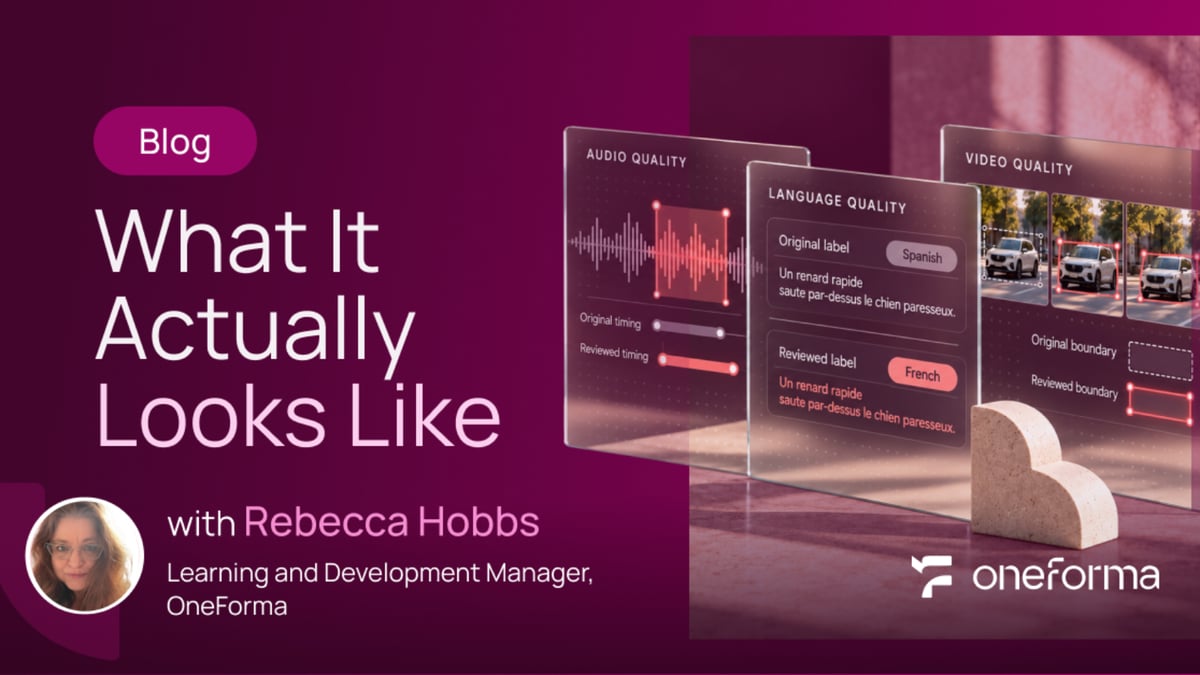
This comes from our session with Rebecca Hobbs, OneForma's Learning and Development Manager, who has spent around two decades on the quality side of annotation projects and says she still takes a quality metric personally.
A data annotation quality check looks like surveillance from the inside, and that feeling costs good experts a lot of unnecessary worry. This post covers what a check actually measures, how gold questions and agreement scores work, and what to do when a guideline can be read two ways.
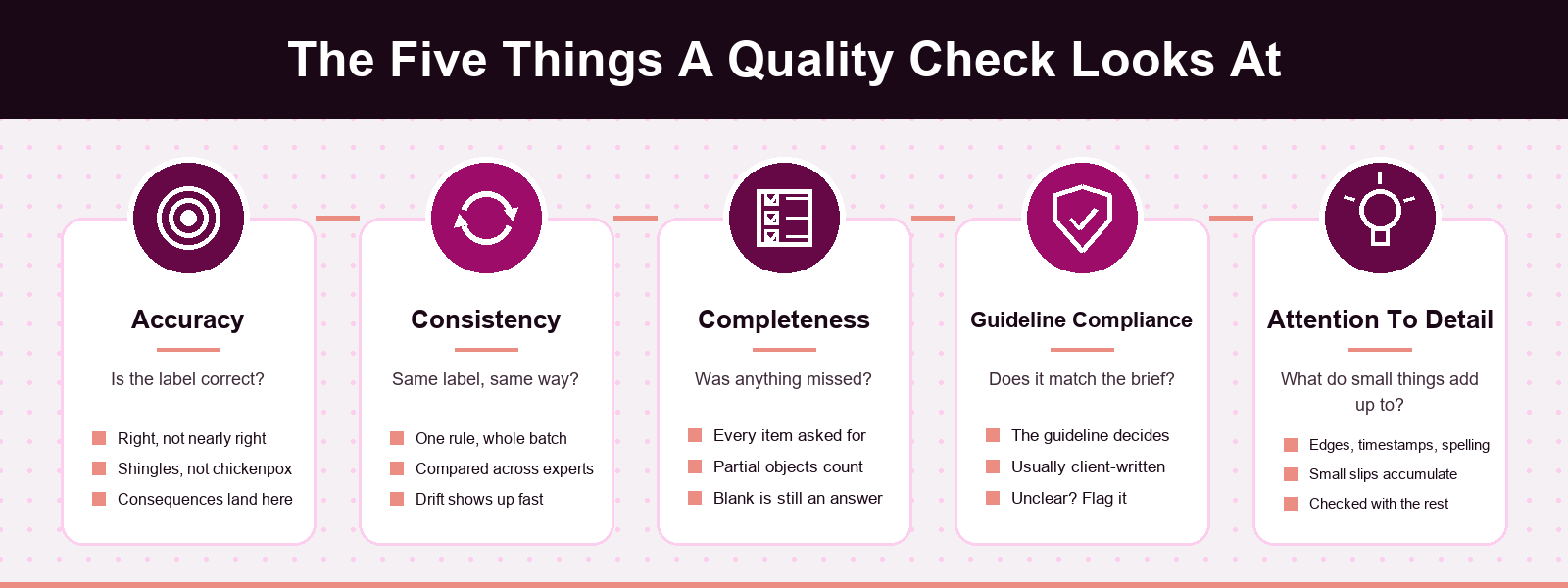
The five things a data annotation quality check looks at: accuracy, consistency, completeness, guideline compliance, attention to detail
The Five Things A Data Annotation Quality Check Looks At
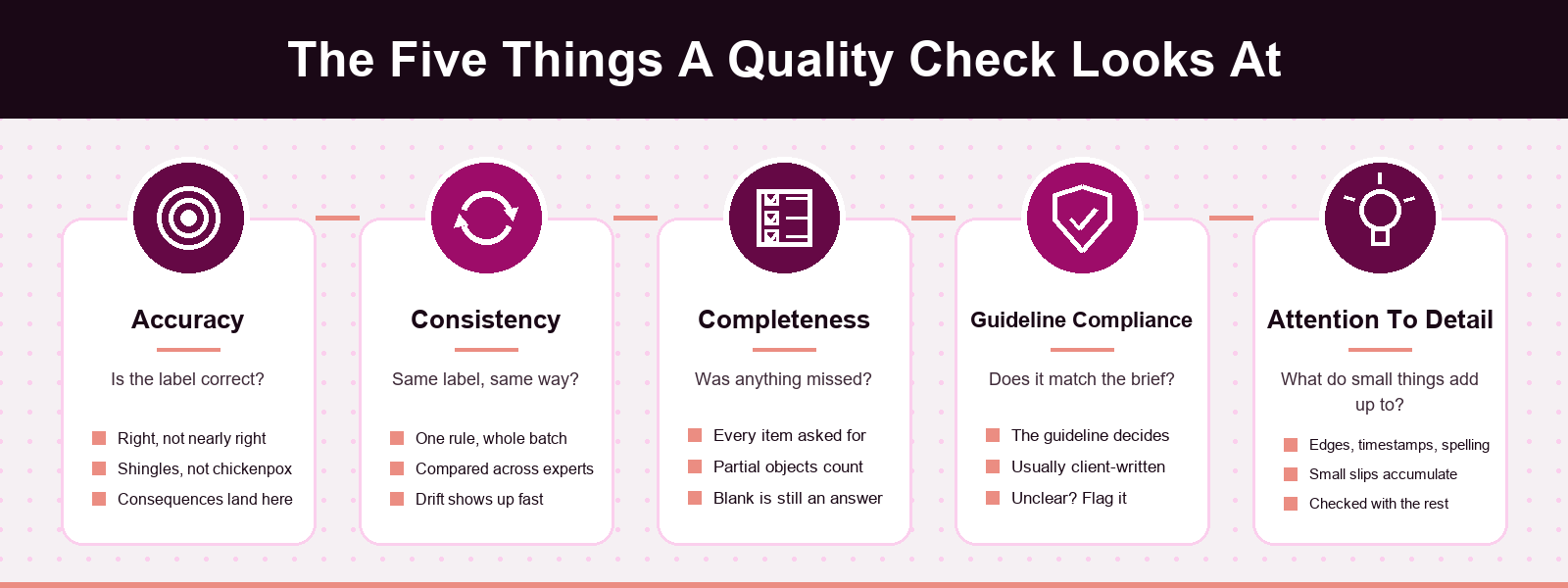
Accuracy is the obvious one, and it is only the first of five. The other four decide as much, and the important part is that they are not checked one at a time. They overlap, a review sees them together, and a single mistake in any one of them chips away at the integrity of the whole annotated set.
Accuracy
Is the label correct? Is that photo really a dog and not a cat, or more seriously, is it shingles and not chickenpox?
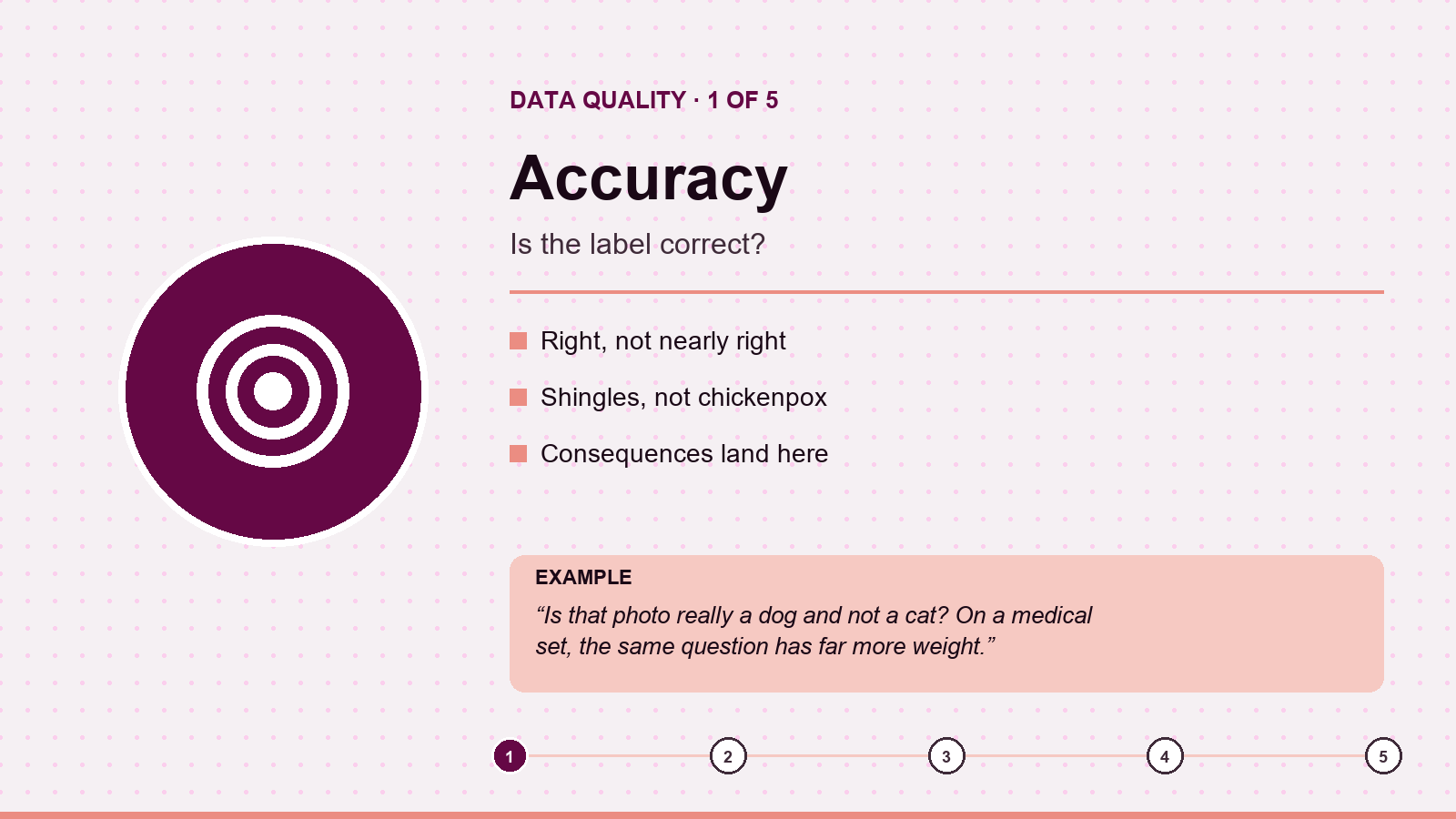
Accuracy in a data annotation quality check: is the label correct
Consistency
Do you apply the same label the same way across a whole batch, and does your reading match what other experts on the project produce?
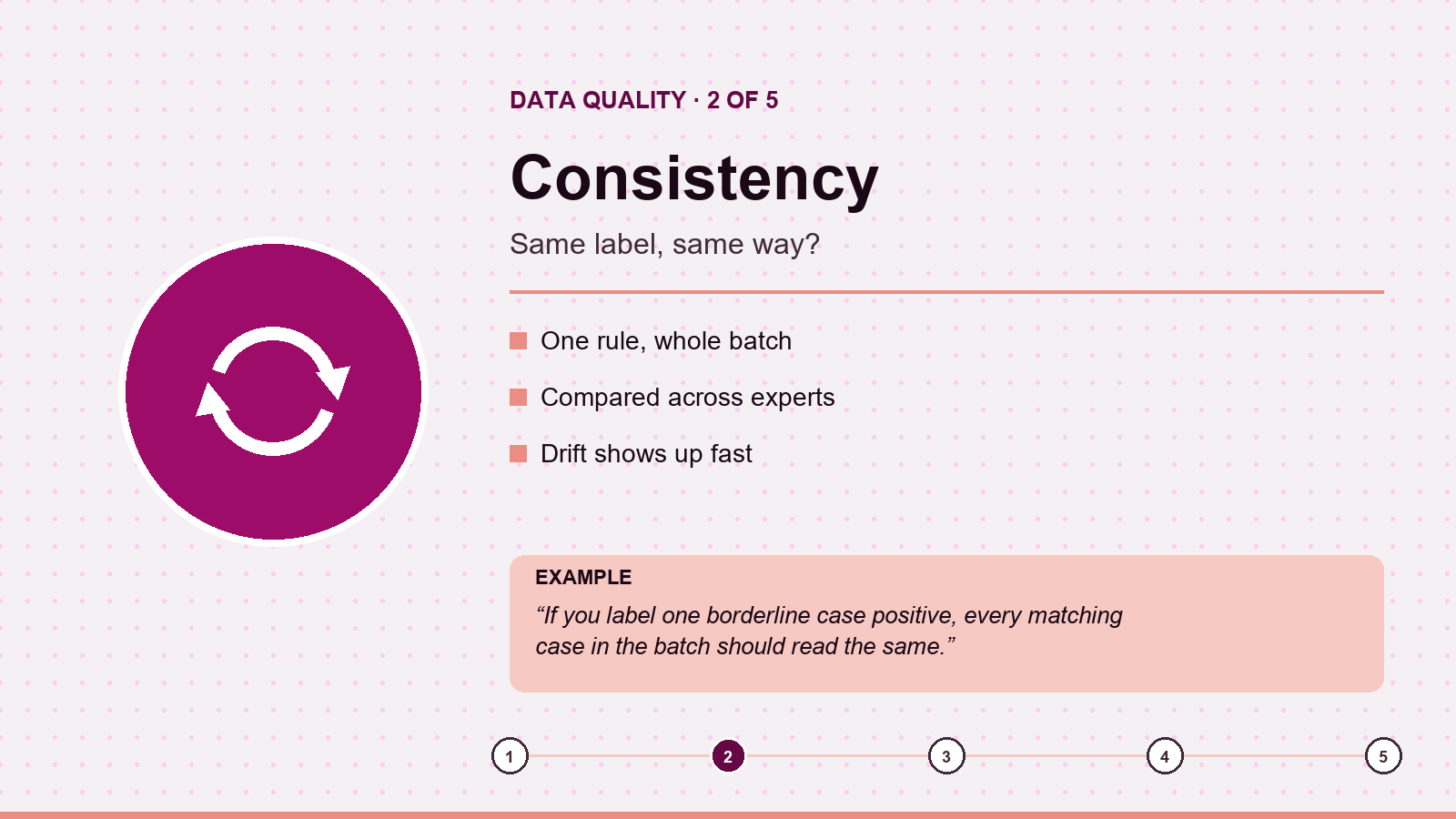
Consistency in a data annotation quality check: the same label applied the same way
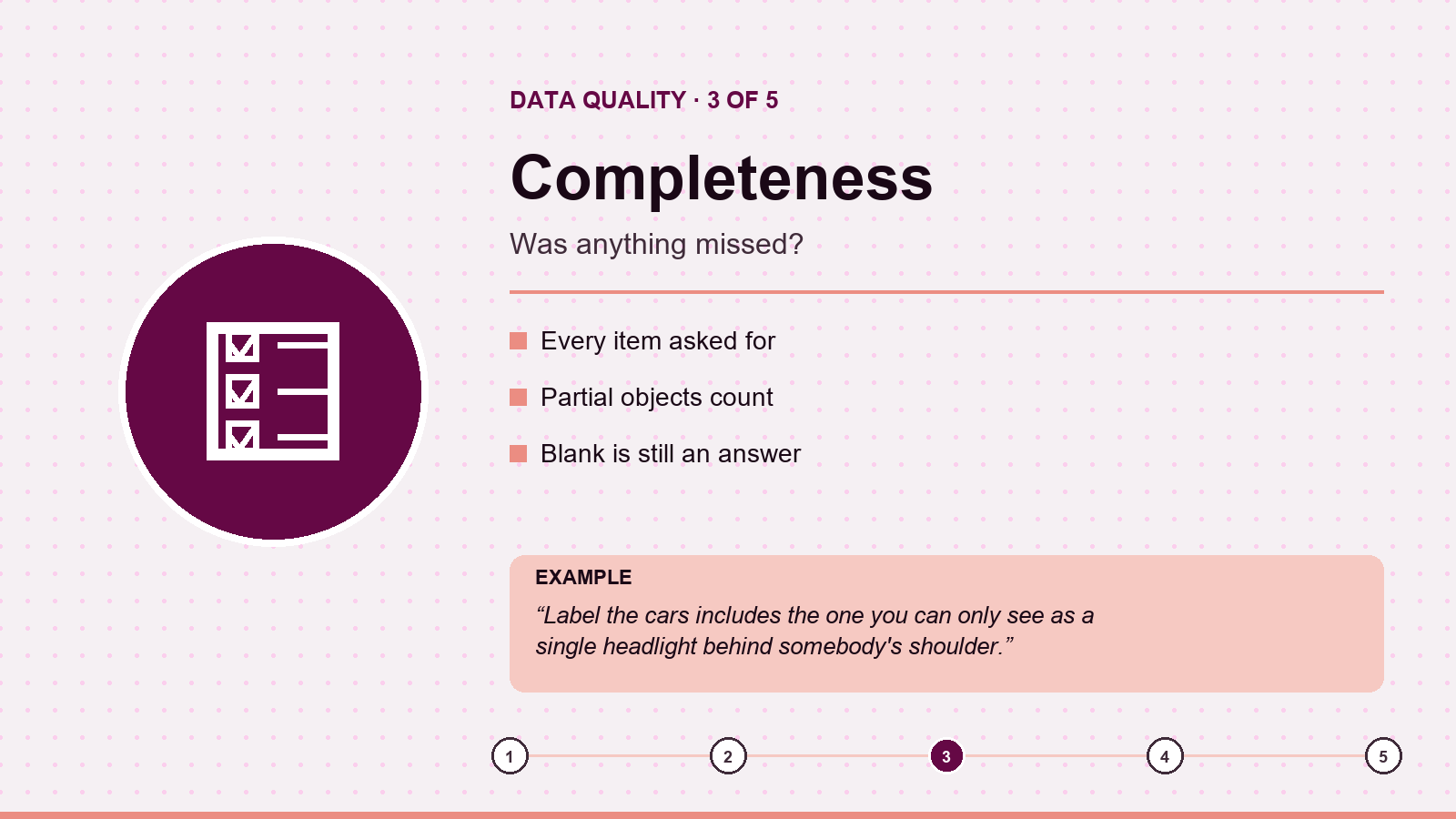
Completeness
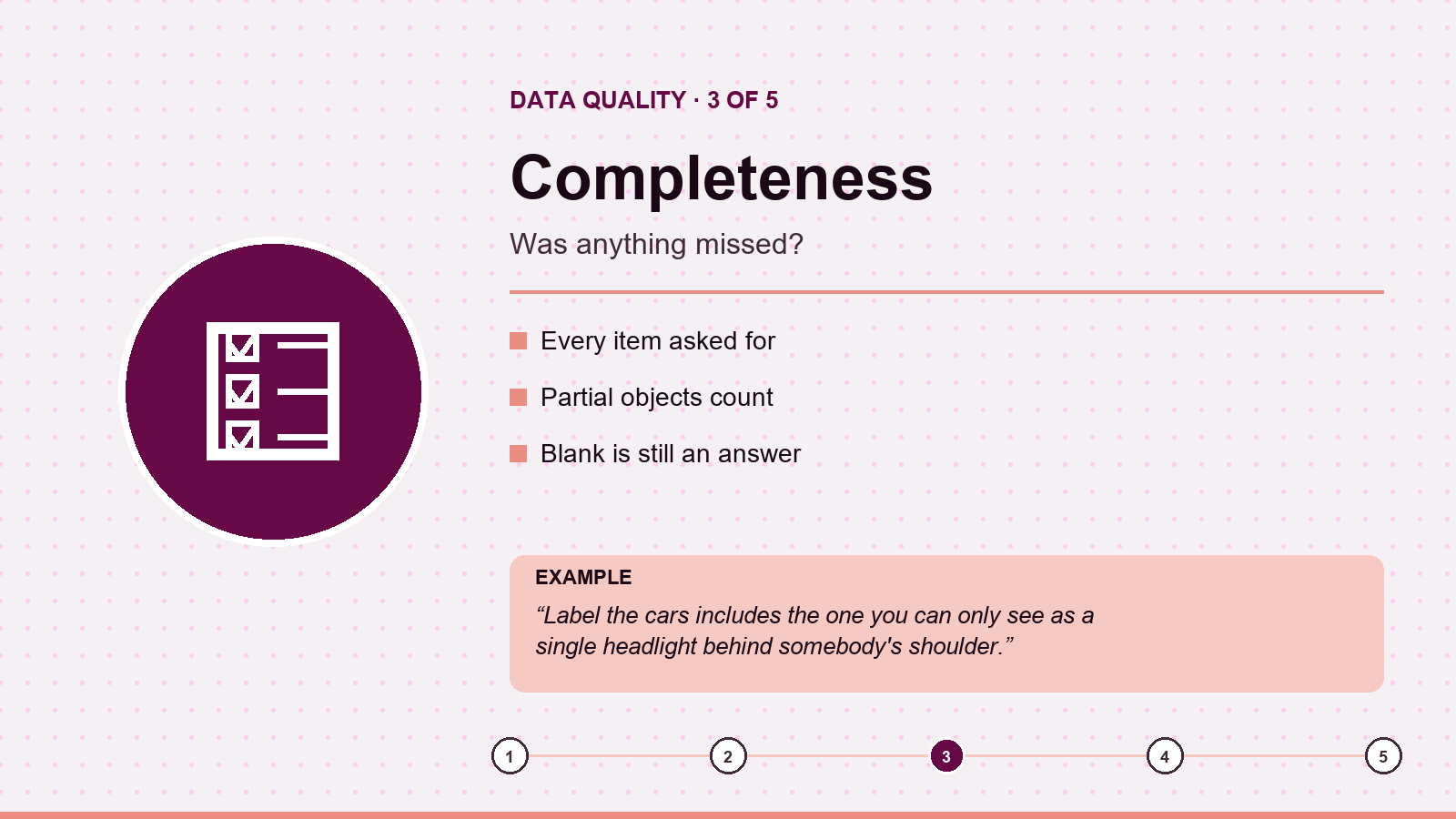
Was anything missed? Partial objects count, and a blank where the guideline expects an answer is itself an answer.
Completeness in a data annotation quality check: nothing missed in the batch
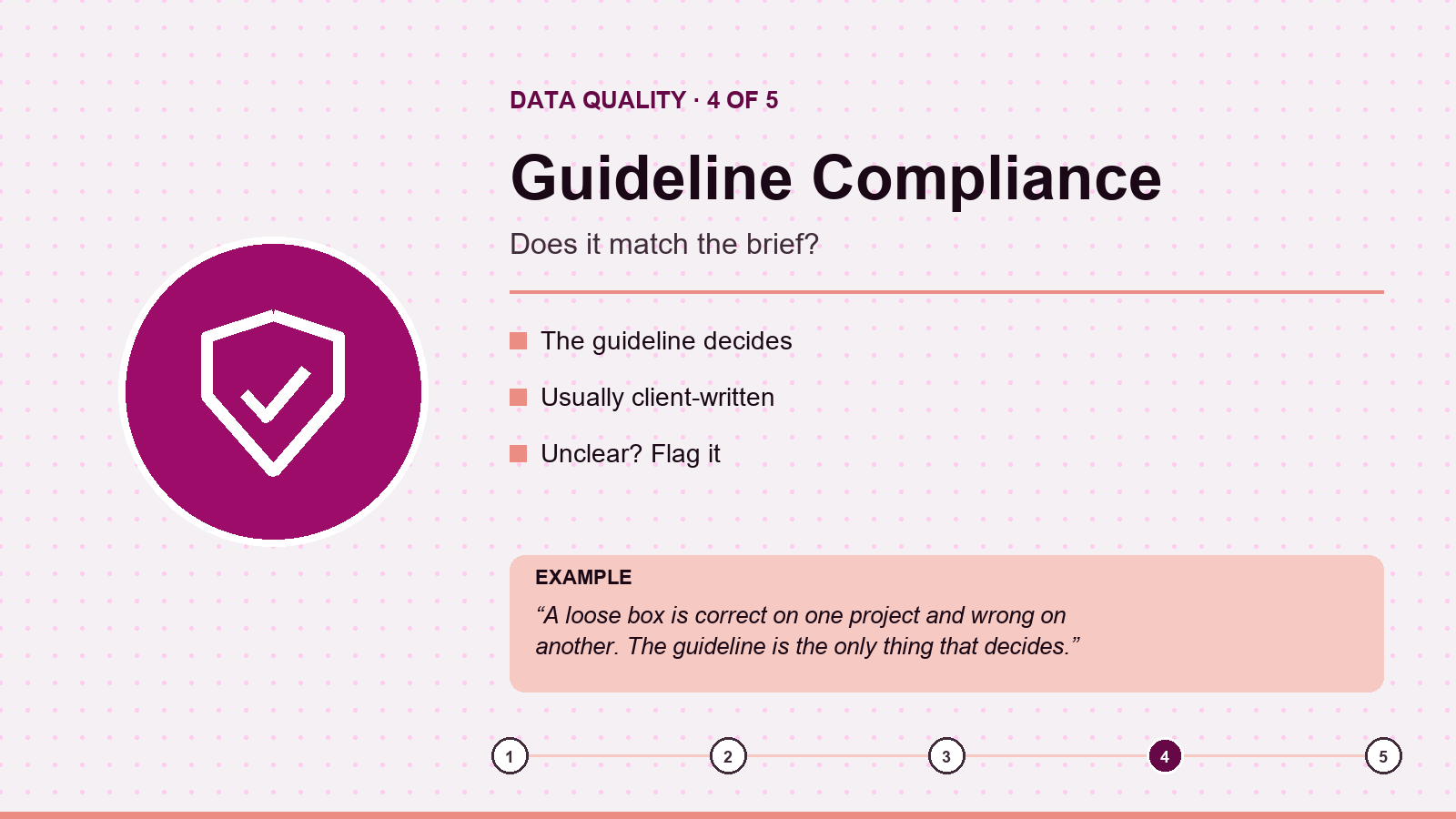
Guideline Compliance
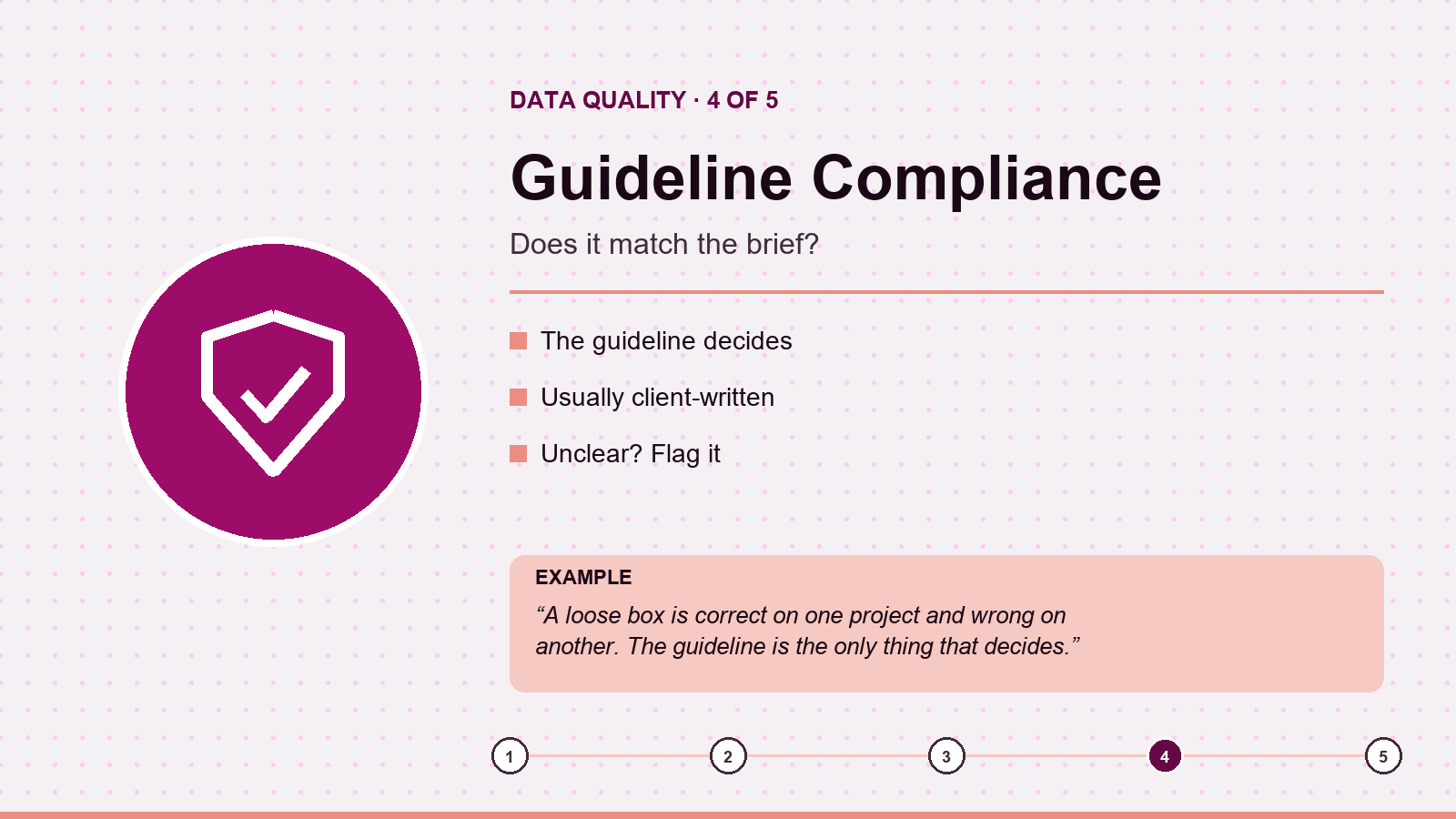
Does the work match what the project actually asked for, rather than what seemed sensible at the time?
Guideline compliance in a data annotation quality check: the work matches what the project asked for
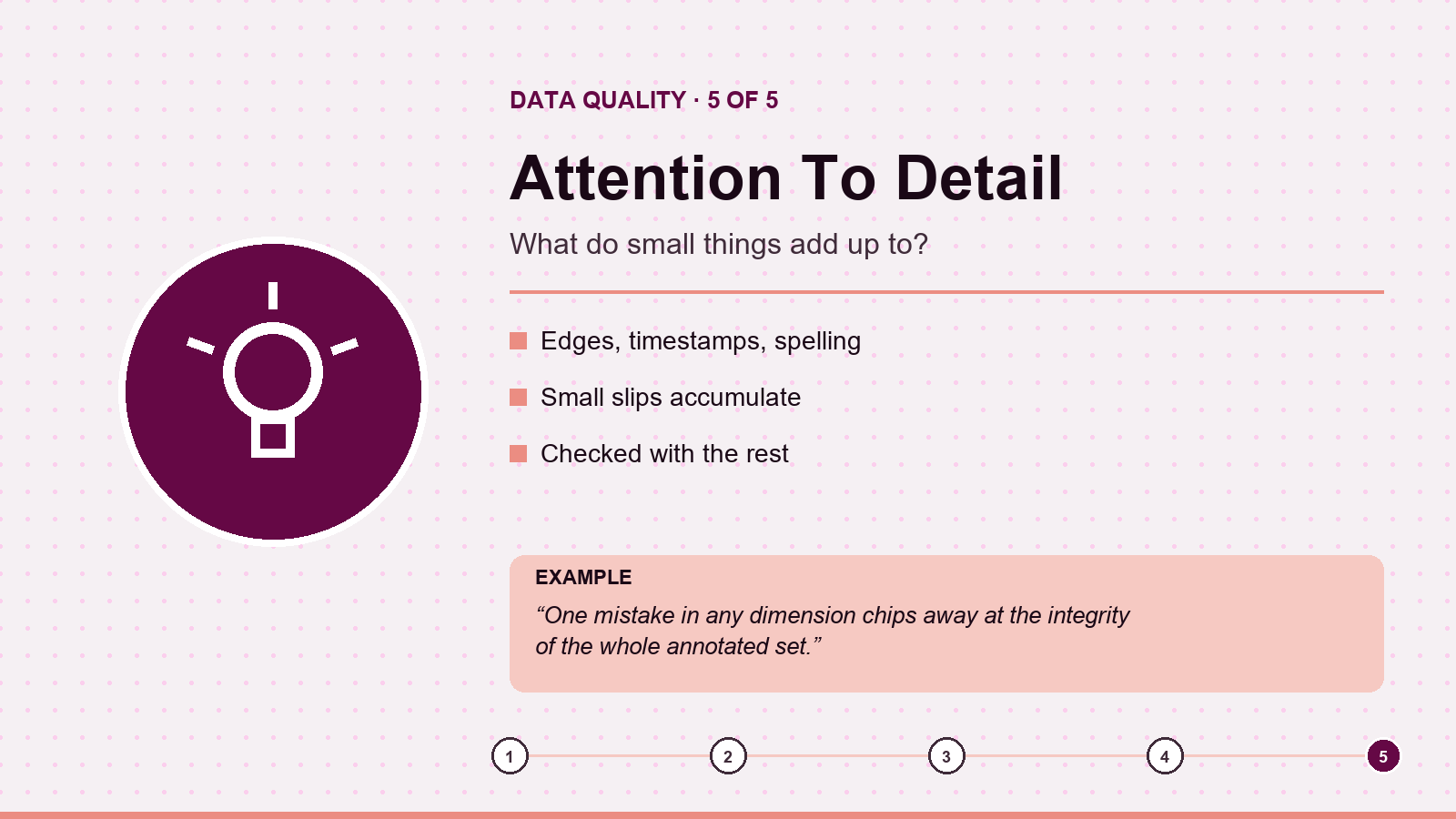
Attention To Detail
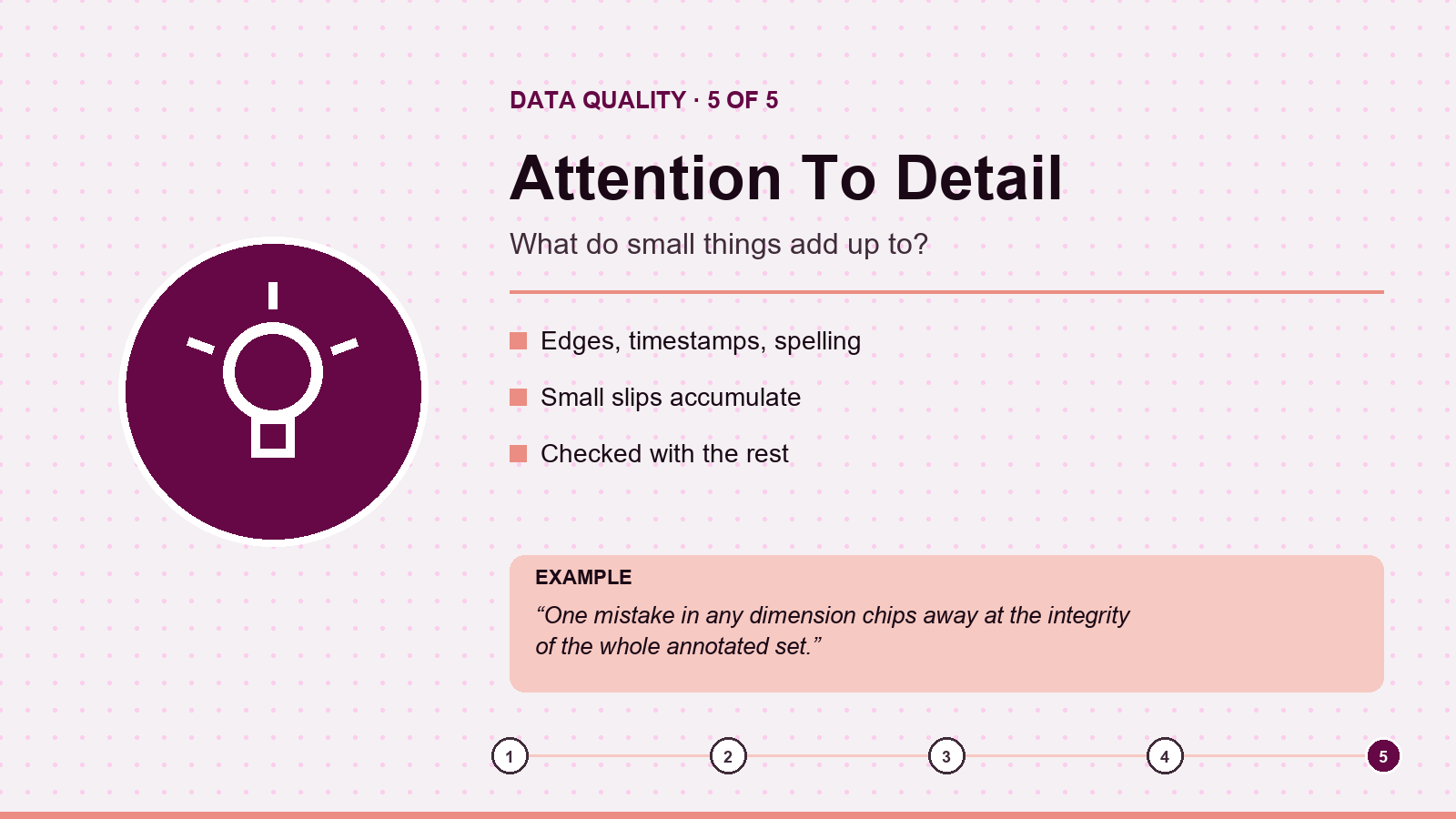
The small things: an edge a few pixels out, a timestamp a second late, a spelling. On their own they are nothing, and they accumulate.
Attention to detail in a data annotation quality check: the small things that accumulate
Maps projects are the clearest example of all five landing in one task. You confirm a pin sits on the right building, do side research to verify the address, and give a separate relevance rating for the result, all in the same piece of work.
What Is A Gold Question?
A gold question is a task item already checked and confirmed as ground truth, slipped back into the project queue at random. You annotate it without knowing, and the system compares your answer to the one it already holds. Roughly one in a hundred works this way, enough to show whether guidelines are applied correctly.
Gold sets have a reputation for being traps, and Rebecca, who has been on the receiving end of them for decades, was direct about it.
"They're not there to trip you up. They are not there to find you out."
The better comparison is a spot check on a factory line. You do not test every single item coming off it, but you do want to know the line is calibrated. It lets a project confirm that everyone is reading the guidelines the same way without reviewing every task by hand, which would be impossible at any real volume.
Why Agreement Between Experts Matters
Sometimes you and several other people see the same item, annotate it separately, and the project compares the results. If everyone agrees, that is a good sign the guideline is clear and being followed.
Picture a referee calling a foul with ten people watching. Nine say it was a foul, and they can point to why. The referee was almost certainly right. Now picture the same call splitting five against five. At that point the useful question is not who was wrong, it is whether the rules themselves are clear enough to call. That is exactly what an agreement check is for. It does not just score people, it finds the places where a guideline has a gap, is genuinely ambiguous, or has run into an edge case nobody anticipated.
"Low agreement usually means that there's a gap in the guidelines. It's very rarely a sign that you're a bad annotator."
You may also see the term inter-annotator agreement, and occasionally Cohen's kappa. The first is the broad idea of how consistently people label the same thing. The second is a specific formula that discounts the agreement you would expect from chance alone, in the same way that guessing on a multiple-choice test still produces some correct answers.
What To Do When A Guideline Is Ambiguous
Guideline examples are always clean. A photo of a dog in front of a fire, labeled "dog." Then production arrives and you have a crowded street scene, an instruction to label the cars, and one car that is a single headlight behind somebody's shoulder.
The rule is simple and Rebecca did not soften it: call it out, do not guess. Name the section that is unclear, say which two readings you can see, and explain your reasoning against the guideline rather than against your intuition. Most projects give you somewhere to do this, whether that is a comment box on the task, your project manager, or a project group in the community. It is worth knowing that project guidelines are generally written by the client, not by us, so your flag is the thing that starts the conversation that gets them changed.
One practical point she corrected herself on during the session, and it is worth repeating precisely. Do not screenshot guidelines and share them anywhere. If your project management team needs to see a section to fix an issue, you can send it to them directly. In a community forum, point people to the page number and the section title instead, because your peers on the project have access to the same document.
What Data Heuristics Watch For
Alongside gold questions and agreement, projects run automated rules that flag likely problems. These are called data heuristics, and they look at behavior rather than content. They are rough, deliberately, and they only ever produce a flag for a human to look at.
The examples are what you would expect. Somebody moving at five seconds per item on work that genuinely takes longer. Somebody selecting the same option every single time. Somebody labeling every picture of an animal "dog" regardless of what is in it. None of these prove anything on their own, which is the point of calling them heuristics. They surface the small number of cases worth a closer look, so the rest of the review can stay focused.
Why Quality Checks Are On Your Side
All of this exists because the consequences are real. The same mechanisms sit behind annotation feeding medical diagnosis, financial transactions and legal precedent, and nobody wants to be the source of the data that made a system worse at any of them. Quality control is how that gets caught early rather than late.
There is a second reason, and it is the better one. When your judgment disagrees with the pattern, that disagreement is information. It is how an ambiguous guideline gets found and rewritten, which is why Rebecca describes an expert's judgment as sitting inside the system rather than outside it.
"Your judgment doesn't just apply to the guidelines. It often helps shape them."
How Data Annotation Quality Is Checked
About one task in a hundred already has a confirmed answer sitting behind it, and you will never know which one. It is not there to catch you out, and the reason why changes how the whole process looks.
This comes from our session with Rebecca Hobbs, OneForma's Learning and Development Manager, who has spent around two decades on the quality side of annotation projects and says she still takes a quality metric personally.
A data annotation quality check looks like surveillance from the inside, and that feeling costs good experts a lot of unnecessary worry. This post covers what a check actually measures, how gold questions and agreement scores work, and what to do when a guideline can be read two ways.
The five things a data annotation quality check looks at: accuracy, consistency, completeness, guideline compliance, attention to detail
The Five Things A Data Annotation Quality Check Looks At
Accuracy is the obvious one, and it is only the first of five. The other four decide as much, and the important part is that they are not checked one at a time. They overlap, a review sees them together, and a single mistake in any one of them chips away at the integrity of the whole annotated set.
Accuracy
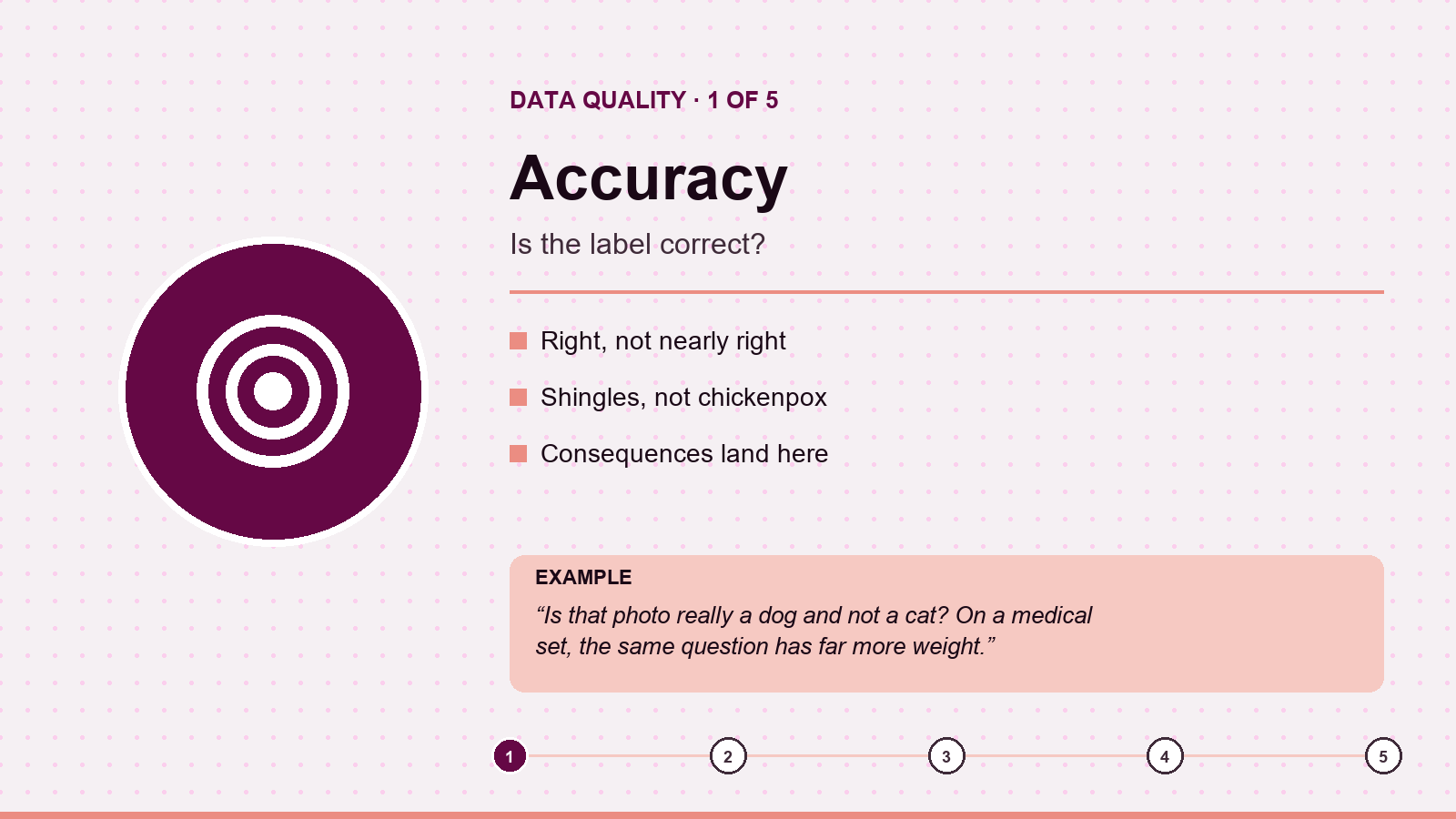
Is the label correct? Is that photo really a dog and not a cat, or more seriously, is it shingles and not chickenpox?
Accuracy in a data annotation quality check: is the label correct
Consistency
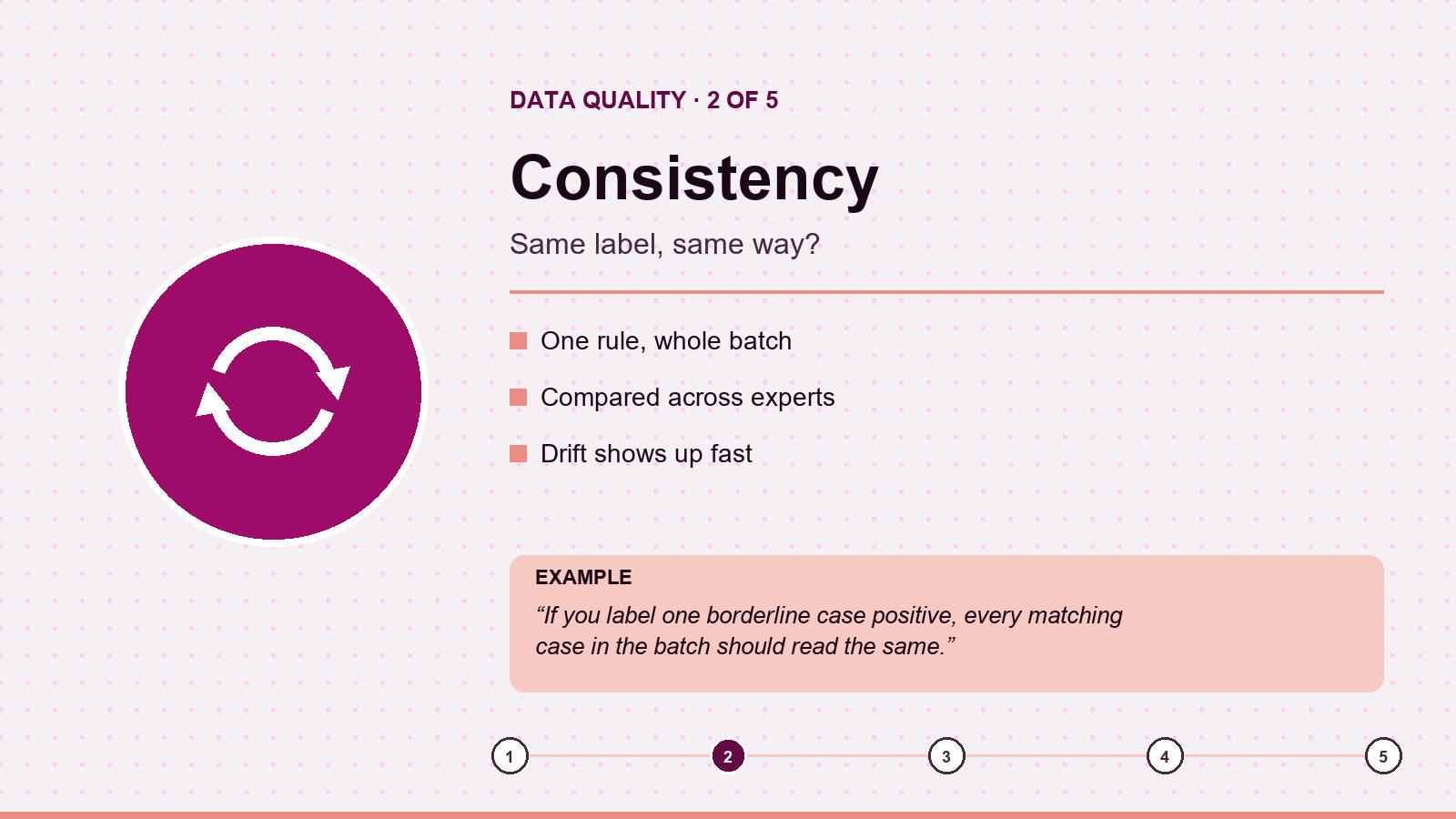
Do you apply the same label the same way across a whole batch, and does your reading match what other experts on the project produce?
Consistency in a data annotation quality check: the same label applied the same way
Completeness
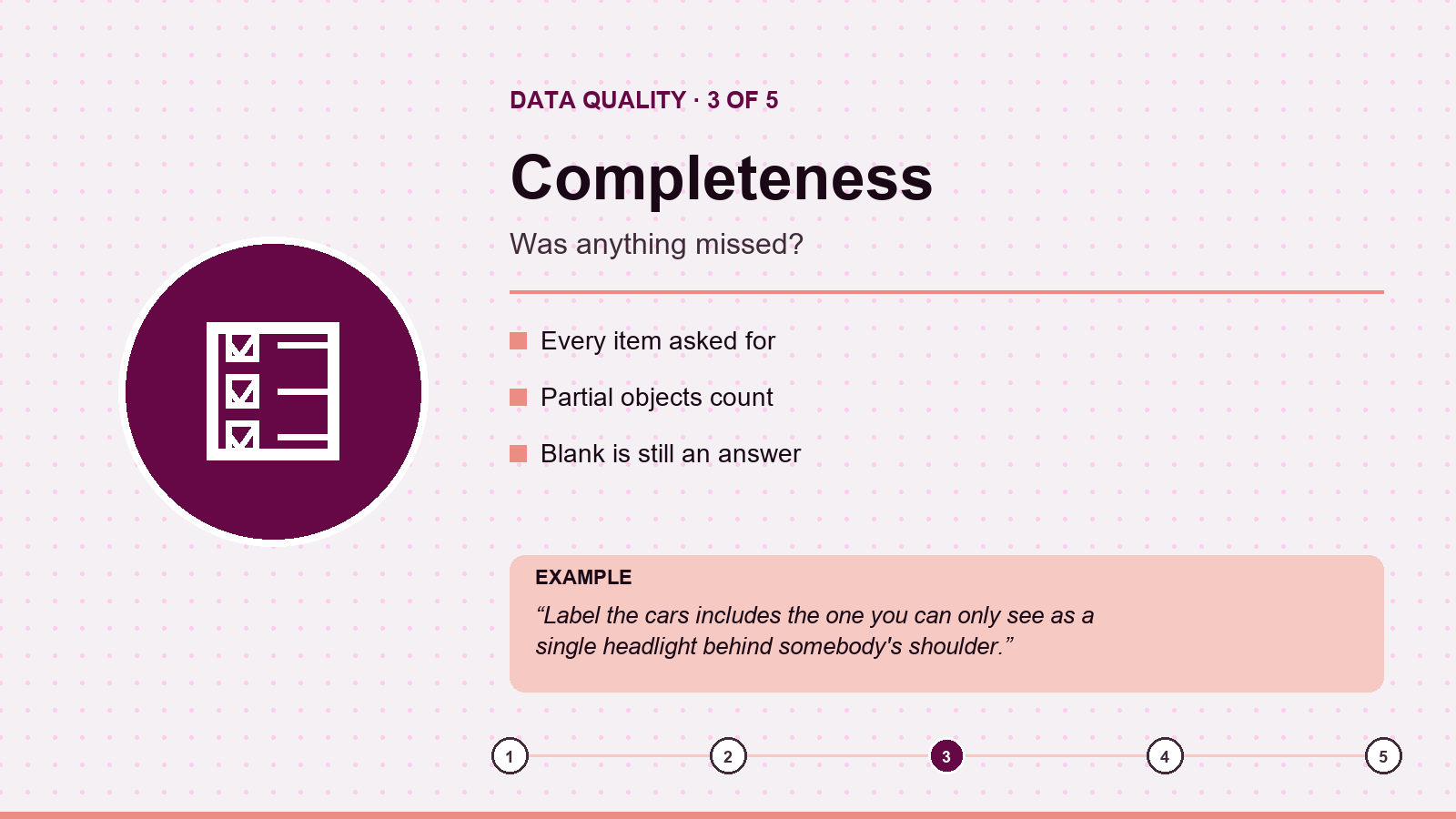
Was anything missed? Partial objects count, and a blank where the guideline expects an answer is itself an answer.
Completeness in a data annotation quality check: nothing missed in the batch
Guideline Compliance
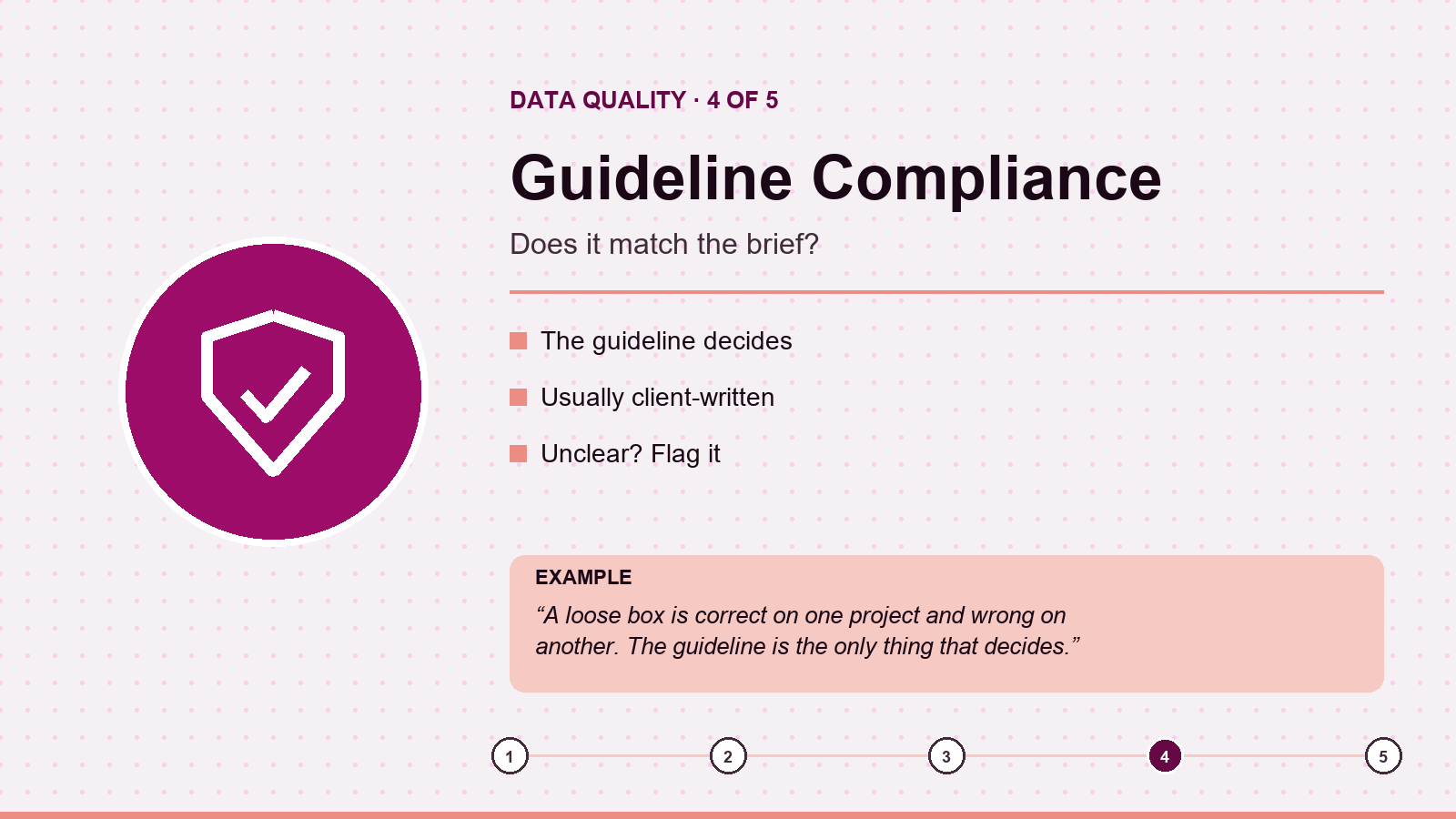
Does the work match what the project actually asked for, rather than what seemed sensible at the time?
Guideline compliance in a data annotation quality check: the work matches what the project asked for
Attention To Detail
The small things: an edge a few pixels out, a timestamp a second late, a spelling. On their own they are nothing, and they accumulate.
Attention to detail in a data annotation quality check: the small things that accumulate
Maps projects are the clearest example of all five landing in one task. You confirm a pin sits on the right building, do side research to verify the address, and give a separate relevance rating for the result, all in the same piece of work.
What Is A Gold Question?
A gold question is a task item already checked and confirmed as ground truth, slipped back into the project queue at random. You annotate it without knowing, and the system compares your answer to the one it already holds. Roughly one in a hundred works this way, enough to show whether guidelines are applied correctly.
Gold sets have a reputation for being traps, and Rebecca, who has been on the receiving end of them for decades, was direct about it.
"They're not there to trip you up. They are not there to find you out."
The better comparison is a spot check on a factory line. You do not test every single item coming off it, but you do want to know the line is calibrated. It lets a project confirm that everyone is reading the guidelines the same way without reviewing every task by hand, which would be impossible at any real volume.
Why Agreement Between Experts Matters
Sometimes you and several other people see the same item, annotate it separately, and the project compares the results. If everyone agrees, that is a good sign the guideline is clear and being followed.
Picture a referee calling a foul with ten people watching. Nine say it was a foul, and they can point to why. The referee was almost certainly right. Now picture the same call splitting five against five. At that point the useful question is not who was wrong, it is whether the rules themselves are clear enough to call. That is exactly what an agreement check is for. It does not just score people, it finds the places where a guideline has a gap, is genuinely ambiguous, or has run into an edge case nobody anticipated.
"Low agreement usually means that there's a gap in the guidelines. It's very rarely a sign that you're a bad annotator."
You may also see the term inter-annotator agreement, and occasionally Cohen's kappa. The first is the broad idea of how consistently people label the same thing. The second is a specific formula that discounts the agreement you would expect from chance alone, in the same way that guessing on a multiple-choice test still produces some correct answers.
What To Do When A Guideline Is Ambiguous
Guideline examples are always clean. A photo of a dog in front of a fire, labeled "dog." Then production arrives and you have a crowded street scene, an instruction to label the cars, and one car that is a single headlight behind somebody's shoulder.
The rule is simple and Rebecca did not soften it: call it out, do not guess. Name the section that is unclear, say which two readings you can see, and explain your reasoning against the guideline rather than against your intuition. Most projects give you somewhere to do this, whether that is a comment box on the task, your project manager, or a project group in the community. It is worth knowing that project guidelines are generally written by the client, not by us, so your flag is the thing that starts the conversation that gets them changed.
One practical point she corrected herself on during the session, and it is worth repeating precisely. Do not screenshot guidelines and share them anywhere. If your project management team needs to see a section to fix an issue, you can send it to them directly. In a community forum, point people to the page number and the section title instead, because your peers on the project have access to the same document.
What Data Heuristics Watch For
Alongside gold questions and agreement, projects run automated rules that flag likely problems. These are called data heuristics, and they look at behavior rather than content. They are rough, deliberately, and they only ever produce a flag for a human to look at.
The examples are what you would expect. Somebody moving at five seconds per item on work that genuinely takes longer. Somebody selecting the same option every single time. Somebody labeling every picture of an animal "dog" regardless of what is in it. None of these prove anything on their own, which is the point of calling them heuristics. They surface the small number of cases worth a closer look, so the rest of the review can stay focused.
Why Quality Checks Are On Your Side
All of this exists because the consequences are real. The same mechanisms sit behind annotation feeding medical diagnosis, financial transactions and legal precedent, and nobody wants to be the source of the data that made a system worse at any of them. Quality control is how that gets caught early rather than late.
There is a second reason, and it is the better one. When your judgment disagrees with the pattern, that disagreement is information. It is how an ambiguous guideline gets found and rewritten, which is why Rebecca describes an expert's judgment as sitting inside the system rather than outside it.
"Your judgment doesn't just apply to the guidelines. It often helps shape them."
How Data Annotation Quality Is Checked
About one task in a hundred already has a confirmed answer sitting behind it, and you will never know which one. It is not there to catch you out, and the reason why changes how the whole process looks.
This comes from our session with Rebecca Hobbs, OneForma's Learning and Development Manager, who has spent around two decades on the quality side of annotation projects and says she still takes a quality metric personally.
A data annotation quality check looks like surveillance from the inside, and that feeling costs good experts a lot of unnecessary worry. This post covers what a check actually measures, how gold questions and agreement scores work, and what to do when a guideline can be read two ways.
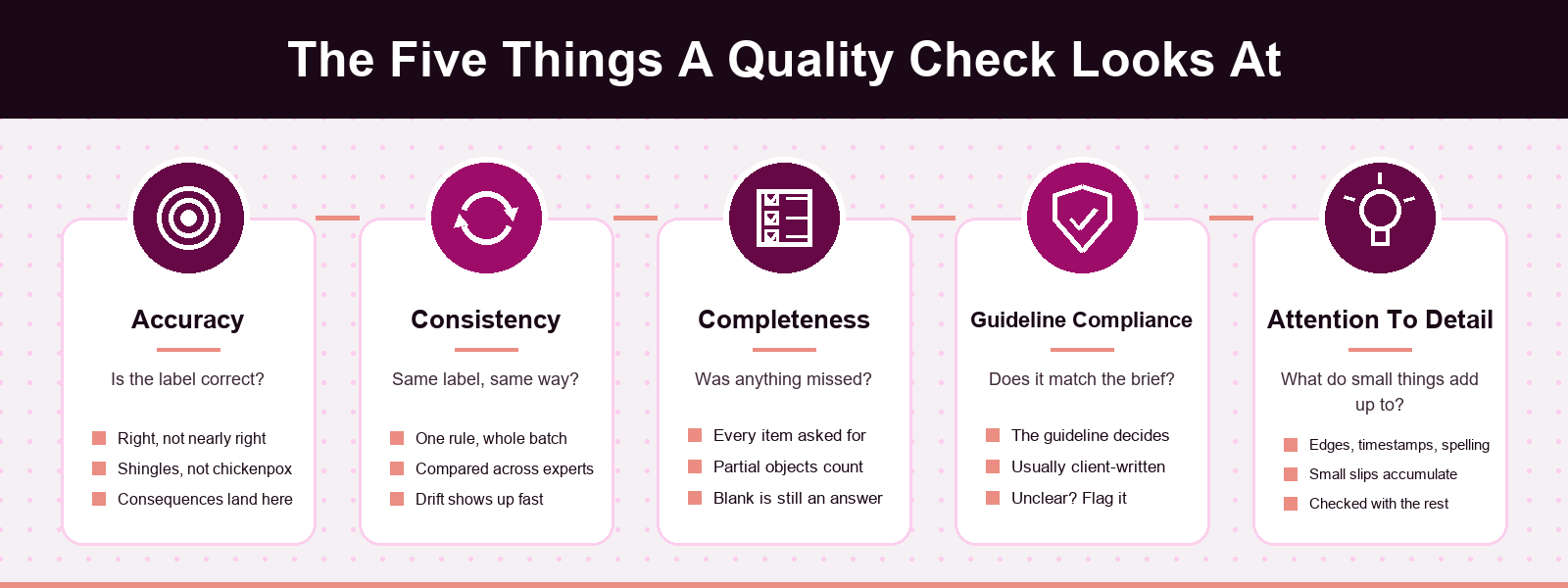
The five things a data annotation quality check looks at: accuracy, consistency, completeness, guideline compliance, attention to detail
The Five Things A Data Annotation Quality Check Looks At
Accuracy is the obvious one, and it is only the first of five. The other four decide as much, and the important part is that they are not checked one at a time. They overlap, a review sees them together, and a single mistake in any one of them chips away at the integrity of the whole annotated set.
Accuracy
Is the label correct? Is that photo really a dog and not a cat, or more seriously, is it shingles and not chickenpox?
Accuracy in a data annotation quality check: is the label correct
Consistency
Do you apply the same label the same way across a whole batch, and does your reading match what other experts on the project produce?
Consistency in a data annotation quality check: the same label applied the same way
Completeness
Was anything missed? Partial objects count, and a blank where the guideline expects an answer is itself an answer.
Completeness in a data annotation quality check: nothing missed in the batch
Guideline Compliance
Does the work match what the project actually asked for, rather than what seemed sensible at the time?
Guideline compliance in a data annotation quality check: the work matches what the project asked for
Attention To Detail
The small things: an edge a few pixels out, a timestamp a second late, a spelling. On their own they are nothing, and they accumulate.
Attention to detail in a data annotation quality check: the small things that accumulate
Maps projects are the clearest example of all five landing in one task. You confirm a pin sits on the right building, do side research to verify the address, and give a separate relevance rating for the result, all in the same piece of work.
What Is A Gold Question?
A gold question is a task item already checked and confirmed as ground truth, slipped back into the project queue at random. You annotate it without knowing, and the system compares your answer to the one it already holds. Roughly one in a hundred works this way, enough to show whether guidelines are applied correctly.
Gold sets have a reputation for being traps, and Rebecca, who has been on the receiving end of them for decades, was direct about it.
"They're not there to trip you up. They are not there to find you out."
The better comparison is a spot check on a factory line. You do not test every single item coming off it, but you do want to know the line is calibrated. It lets a project confirm that everyone is reading the guidelines the same way without reviewing every task by hand, which would be impossible at any real volume.
Why Agreement Between Experts Matters
Sometimes you and several other people see the same item, annotate it separately, and the project compares the results. If everyone agrees, that is a good sign the guideline is clear and being followed.
Picture a referee calling a foul with ten people watching. Nine say it was a foul, and they can point to why. The referee was almost certainly right. Now picture the same call splitting five against five. At that point the useful question is not who was wrong, it is whether the rules themselves are clear enough to call. That is exactly what an agreement check is for. It does not just score people, it finds the places where a guideline has a gap, is genuinely ambiguous, or has run into an edge case nobody anticipated.
"Low agreement usually means that there's a gap in the guidelines. It's very rarely a sign that you're a bad annotator."
You may also see the term inter-annotator agreement, and occasionally Cohen's kappa. The first is the broad idea of how consistently people label the same thing. The second is a specific formula that discounts the agreement you would expect from chance alone, in the same way that guessing on a multiple-choice test still produces some correct answers.
What To Do When A Guideline Is Ambiguous
Guideline examples are always clean. A photo of a dog in front of a fire, labeled "dog." Then production arrives and you have a crowded street scene, an instruction to label the cars, and one car that is a single headlight behind somebody's shoulder.
The rule is simple and Rebecca did not soften it: call it out, do not guess. Name the section that is unclear, say which two readings you can see, and explain your reasoning against the guideline rather than against your intuition. Most projects give you somewhere to do this, whether that is a comment box on the task, your project manager, or a project group in the community. It is worth knowing that project guidelines are generally written by the client, not by us, so your flag is the thing that starts the conversation that gets them changed.
One practical point she corrected herself on during the session, and it is worth repeating precisely. Do not screenshot guidelines and share them anywhere. If your project management team needs to see a section to fix an issue, you can send it to them directly. In a community forum, point people to the page number and the section title instead, because your peers on the project have access to the same document.
What Data Heuristics Watch For
Alongside gold questions and agreement, projects run automated rules that flag likely problems. These are called data heuristics, and they look at behavior rather than content. They are rough, deliberately, and they only ever produce a flag for a human to look at.
The examples are what you would expect. Somebody moving at five seconds per item on work that genuinely takes longer. Somebody selecting the same option every single time. Somebody labeling every picture of an animal "dog" regardless of what is in it. None of these prove anything on their own, which is the point of calling them heuristics. They surface the small number of cases worth a closer look, so the rest of the review can stay focused.
Why Quality Checks Are On Your Side
All of this exists because the consequences are real. The same mechanisms sit behind annotation feeding medical diagnosis, financial transactions and legal precedent, and nobody wants to be the source of the data that made a system worse at any of them. Quality control is how that gets caught early rather than late.
There is a second reason, and it is the better one. When your judgment disagrees with the pattern, that disagreement is information. It is how an ambiguous guideline gets found and rewritten, which is why Rebecca describes an expert's judgment as sitting inside the system rather than outside it.
"Your judgment doesn't just apply to the guidelines. It often helps shape them."
Comments (0)
Popular

Dive in
Related
Blog
Why Getting Verified Is Non-Negotiable on OneForma (And How to Do It)
By Aleksandar Scekic • Jul 13th, 2026 • Views 396
Blog
What Is Egocentric Data And What It Means For AI
By Aleksandar Scekic • Jul 23rd, 2026 • Views 127
Blog
What Is Egocentric Data And What It Means For AI
By Aleksandar Scekic • Jul 23rd, 2026 • Views 127
Blog
Why Getting Verified Is Non-Negotiable on OneForma (And How to Do It)
By Aleksandar Scekic • Jul 13th, 2026 • Views 396