

What Is Data Annotation? A Simple Guide
# Data-labelling
# Data-science
# Dataset-review
# Senior-expert
# Guide
Three things it is not, and five kinds of data
October 6, 2026
Aleksandar Scekic

Rebecca Hobbs
What Is Data Annotation IS NOT?
Everyone in this industry uses the term as if you already know it, and most people would rather stay quiet than ask. There is nothing complicated underneath it, and the parts people actually get wrong come down to three.
This comes from our session with Rebecca Hobbs, OneForma's Learning and Development Manager, who has spent around two decades working on the quality side of annotation projects.
You have seen data annotation projects listed, or you have already worked on one, and the task instructions assumed a vocabulary nobody handed you first. This post covers what the work is, the three things it gets confused with, the kinds of data involved, and what the task types are called.
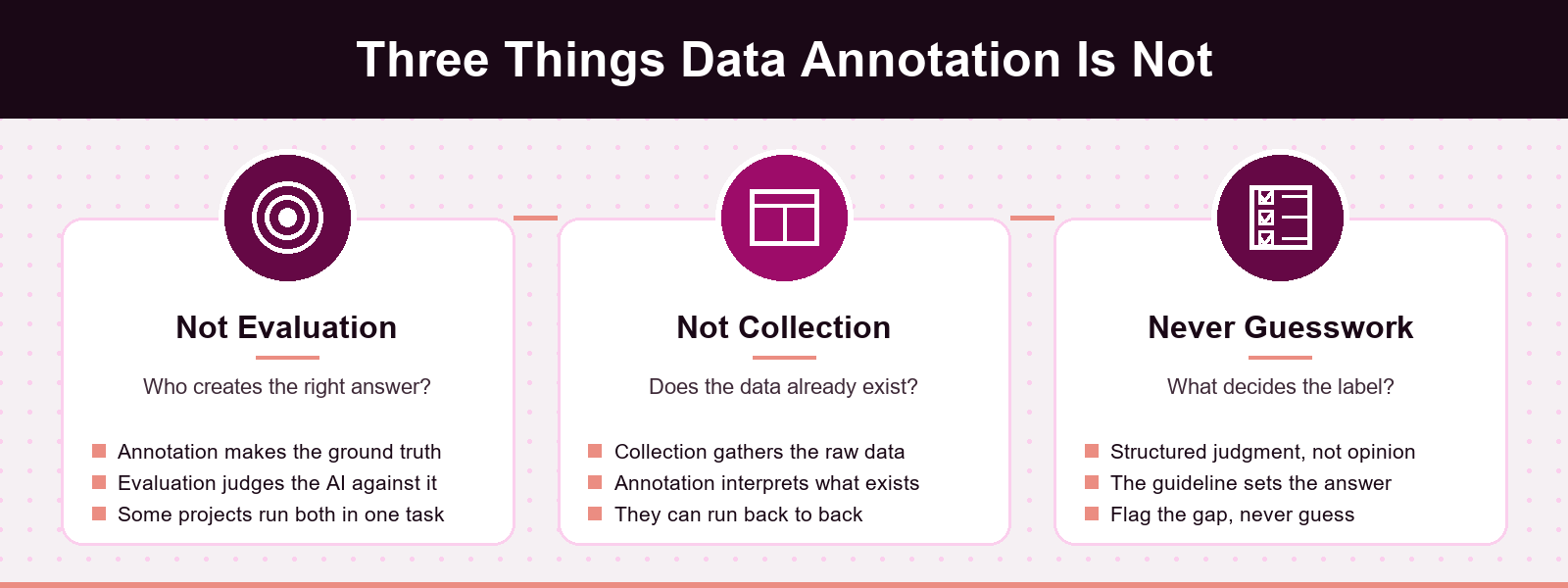
Three things data annotation is not: not evaluation, not data collection, never guesswork
What Is Data Annotation?
Data annotation is adding structured information to raw data so an AI system can learn from it. If the system sees a photo of a dog, somebody has to give that photo the word "dog." Your brain does this constantly, so quickly you never notice. A machine has to be shown.
The easiest way to picture it is a photo and its caption. The photo is the raw data. The caption is the annotation.
"Without the caption, the AI is just staring at a bunch of pixels."
One piece of vocabulary is worth having early. A label is the specific piece of information you assign, and it is not always a word. People hear "annotation" and assume it means typing keywords next to things, when the work is far broader than that.
What Is The Difference Between Data Annotation And Data Labeling?
Data annotation and data labeling are often used interchangeably, and in most project briefs they mean the same thing. The useful distinction is scope. Annotation is the whole family of work: boxes, timestamps, transcription, categories. Labeling is one part of that family, assigning a category or a tag.
Rebecca said she has drifted away from the word labeling for exactly that reason, because it makes people picture a label maker and a jar of pasta. If you hear either term on a project, read the guideline rather than the word.
Three Things Data Annotation Is Not
Most of the confusion sits here, and clearing it makes task instructions much easier to read.
Annotation is not evaluation. Annotation creates the ground truth, and evaluation judges an AI system's output against it. If you draw a box around a car in a photo and label it, that is annotation. If you look at a caption the AI produced and decide whether it was right, that is evaluation.
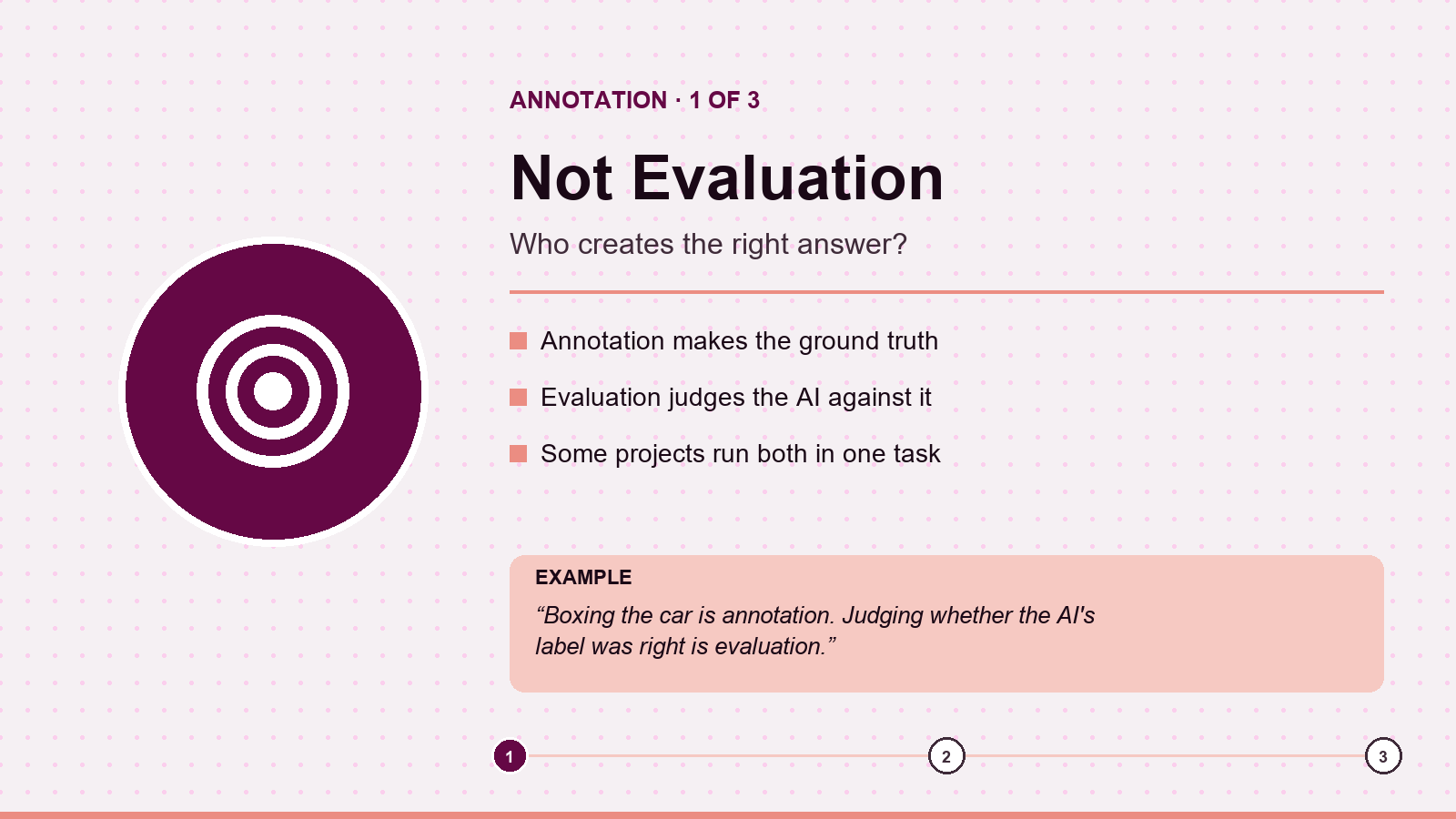
Not evaluation: annotation creates the ground truth, evaluation judges the AI against it
Annotation is also not data collection. Collection gathers the raw material: voice recordings, photographs, scans of legal forms. Annotation is what happens once that material exists. Some projects run the two back to back, which is why they blur together. You might be asked to photograph the outside of your house, then draw boxes around every window in your own photo.
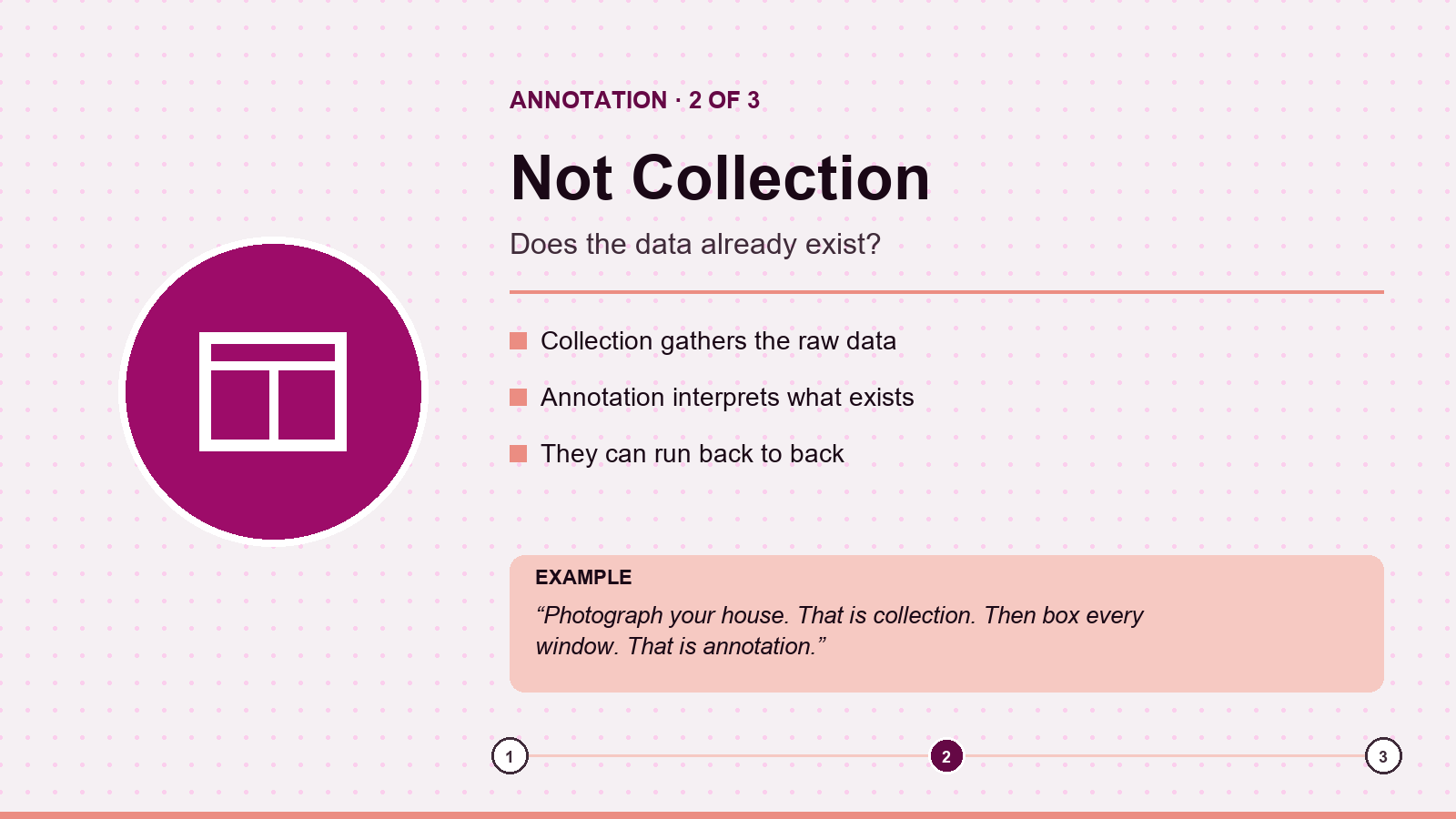
Not data collection: collecting gathers the raw data, annotation interprets it once it exists
The third one matters most.
"Annotation must never be guesswork. Annotation is a structured judgment against an agreed guideline."
It is not personal opinion, and "that feels about right to me" is never the standard. The guideline decides, every time. That sounds restrictive and it is the opposite: it means you are never carrying the decision alone.
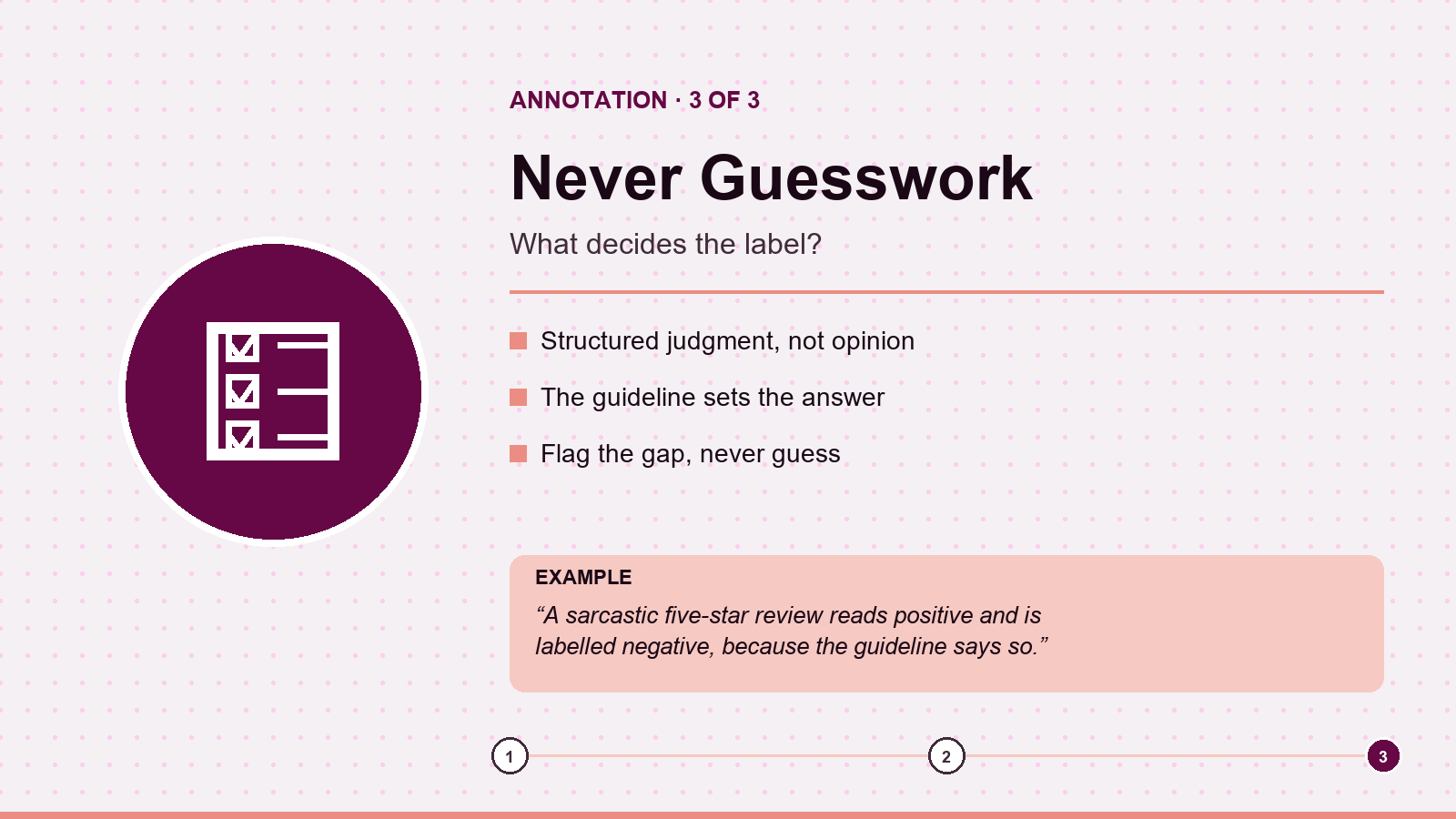
Never guesswork: annotation is structured judgment against an agreed guideline, not personal opinion
What Kinds Of Data Get Annotated
The data decides the form of the work, so no two project briefs look alike. Text is the most familiar: highlighting every noun or every place name, or labeling a restaurant review as positive, negative or neutral. That last one shows why this is not mechanical. Somebody writes a glowing sentence that is obviously sarcastic, and a human reading the context knows the correct label is negative.
Images are the ones people picture first. Sometimes a rough box around a car is all a project wants. Sometimes the box has to trace the edge of the car almost pixel by pixel. Audio covers transcription, which is a type of annotation in its own right, along with labeling sounds like a car horn or birdsong in the background. Video adds time: you might mark the moment a cricket ball leaves the bowler's hand and the moment the bat connects. Tabular data is about categories, valid and invalid records, long inventory tables checked line by line.
What The Data Annotation Task Types Are Called
The glossary is smaller than it looks. Classification is assigning data to a category, which is the photo of the dog getting the word "dog." Sentiment is classification applied to feeling, and it is one of the harder ones, because people are rarely obvious about how they feel. Ranking is ordering items from most to least relevant.
Transcription converts speech to text, and an exact transcription keeps the ums and the repeated words, because that is how people really talk. Bounding boxes run from a simple square around an object to a dot-by-dot outline that traces its exact shape, which is called polygon or segmentation work. In audio and video, segmentation means something close: marking where one section ends and the next begins, by timestamp or by action. One piece of data can carry several of these at once. A photo of someone on a bicycle might need the action labeled "cycling" and a box drawn around the bicycle in the same task.
Why Does AI Need Annotated Data At All?
An AI system learns by finding patterns, not by understanding context. Raw data with nothing attached to it has no right answer inside it, so the pattern is a jumble. Annotation turns a pile of material into something a model can actually learn from, and it gives us a key to check the model against.
Think of the raw data as ingredients. The photos, the audio, the text: all of it sits there without instructions. The annotation is the recipe card that tells the system how these ingredients go together and what they are supposed to produce. And it keeps working after training, because it is also the answer key. When we want to know whether a system got something right, we check it against the annotation an expert produced. That is why the quality of the judgment behind a label matters so much, and it is the reason these projects go looking for people who know a field properly rather than people who can simply work fast.
Where Your Own Expertise Fits
You will find you suit some of this better than other parts of it. Some experts cannot tune their ear to audio but hold enormous precision across dense text. Others are at their sharpest on detailed images and scans. That is a fit, not a ranking, and knowing your own is genuinely useful when you choose what to apply for.
If this is new, the vocabulary is the thing to take away, not the detail. Knowing what the words mean makes every project brief you open from here easier to read, and it makes it much easier to ask a good question in the community when something is unclear.
"You never have to memorize all of this. Every single project will have its own set of guidelines."
Rebecca also warned that it gets into your head. After a project annotating shop aisles, she could not walk down one without mentally drawing the boxes. That is what the work does once you understand it, and the vocabulary above is where it starts. Put your expertise to work.
Comments (0)
Popular

Dive in
Related
Blog
The Future of AI Work Is Human — Here’s What Our Leadership Had to Say
Jun 17th, 2026 • Views 130
Blog
What Is Egocentric Data And What It Means For AI
By Aleksandar Scekic • Jul 23rd, 2026 • Views 127
Blog
What Is Egocentric Data And What It Means For AI
By Aleksandar Scekic • Jul 23rd, 2026 • Views 127
Blog
The Future of AI Work Is Human — Here’s What Our Leadership Had to Say
Jun 17th, 2026 • Views 130