

What Is Egocentric Data And What It Means For AI
# # ai-research
# Ai-evaluation
# Data-collection
# Training
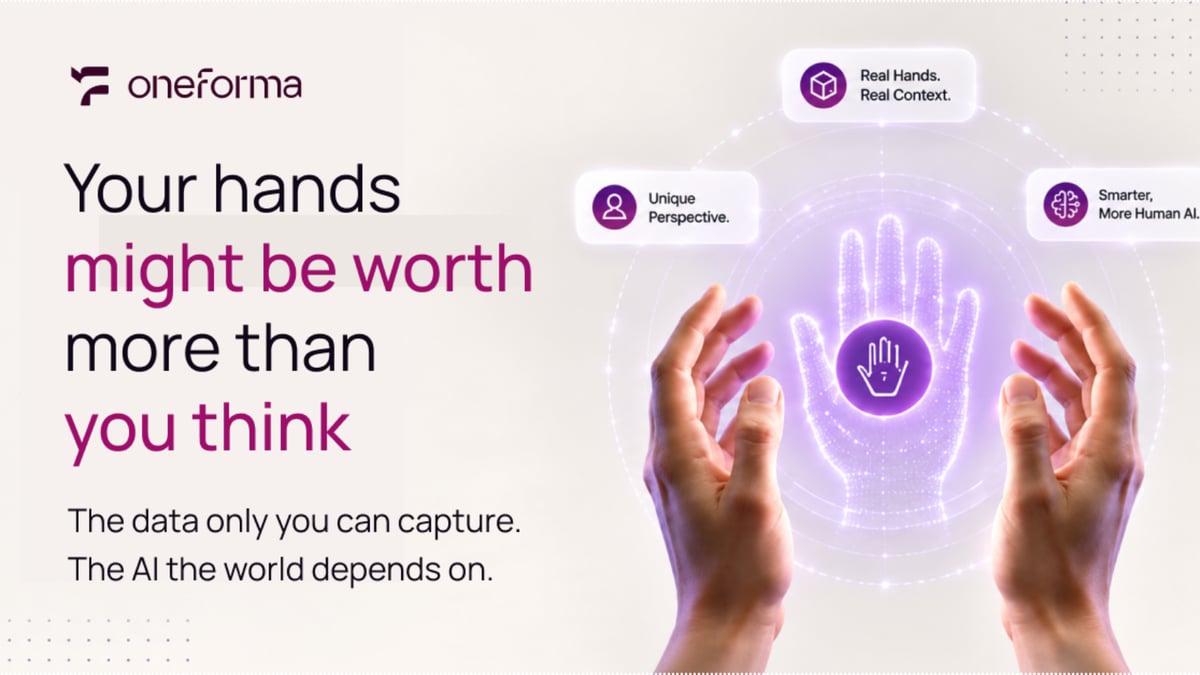
Why Your Hands Might Be Worth More Than You Think
July 23, 2026
Aleksandar Scekic

Pooja Anthony
The Part of AI Nobody Is Talking About Yet
Most conversations about AI work focus on the same things. Annotation. Evaluation. Language tasks. These are real, they are in demand, and they matter. But there is a category of AI work growing faster than almost anything else right now that most contributors have never heard of, and it does not require a degree, a technical background, or even a computer in the traditional sense.
It requires your hands.
We sat down with Pooja Anthony, Associate Vice President of Global Workforce Solutions and Talent at OneForma, to talk about where AI work is heading over the next two years. What she described was something most people in the contributor community have not encountered yet, but will. It is called physical AI, and the data that trains it is called egocentric data. Here is what that actually means, and why it matters for you.
First, What Is Physical AI?
Before getting into egocentric data specifically, it helps to understand the broader category it sits inside.
Most people are familiar with AI in its digital form, chatbots, voice assistants, search tools, content generators. These are AI systems that live on screens and process text, audio, or images. Physical AI is different. It is AI that interacts with the real, physical world. Robots that perform surgery. Autonomous systems in manufacturing. Machines that assist in warehouses, kitchens, construction sites, and operating theatres.
Pooja was direct about where this is heading.
"Physical AI is the next big wave. We are already seeing things in motion. Every major robotics lab and every physical AI lab we are talking to right now is demanding that kind of information and data from us. It cannot be synthesized. They want it done by real experts in real environments."
That last part is important. This is not data that can be generated artificially or scraped from the internet. It has to come from real people, doing real things, in real settings. And that is exactly where contributors come in.
So What Is Egocentric Data?
Egocentric data is, at its simplest, data captured from a first-person perspective, from the point of view of the person doing the work. It records physical movement: hands, fingers, head, eyes, body position. It captures the way a human being interacts with the physical world in precise, measurable detail.
Pooja broke it down clearly.
"Egocentric data is anything that you currently do with your hands, your legs, head movement, eye movement. A lot of our customers are now asking for egocentric information from people in certain domain jobs."
Think about what that means in practice. A surgeon performing a procedure. A technician repairing a machine. A chef preparing a dish. A person assembling components on a factory floor. All of these involve a specific set of physical movements, judgments, and muscle-memory patterns built up over years of practice. Egocentric data is the process of capturing those movements and turning them into training material for the AI systems that need to understand and eventually replicate them.
The Surgical Gloves Example
To make this concrete, Pooja used an example that is worth sitting with.
"There are heart stent operations currently done by robots. All of that was trained by looking at what humans do. And for that we do a lot of data collection from our experts — where you can come on site or do it remotely in your area of convenience."
The way that data is collected for something like surgical robotics is more precise than most people would expect. When OneForma works with contributors on this kind of project, the technology used to capture movement is purpose-built for the task.
"When you want to understand how a doctor's hands are actually moving during surgery, we give them specialized gloves. Those gloves capture the twenty-one touch points that exist on your fingers. We can bend your finger different ways, so you try and use that to get precision. That is the key — you want expertise, you want precision. And that is what gets trained into these robots."
Twenty-one touch points on a single hand. That level of detail is not incidental — it is exactly what the AI needs to understand what a skilled human movement actually looks like, so it can begin to approximate it. And the only way to get that data is from a real person with real expertise doing the real thing.
It Is Not Just Surgery
We want to make this point very clear... Physical AI data collection is not limited to high-stakes medical environments. It covers an enormous range of everyday tasks, and the bar for what counts as expertise is much lower than you might think.
"Even repairing a keyboard on a laptop requires precision. How do you open the screws? How do you dismantle it? How do you clean it? How do you assemble it back together? All of this work is now being collected as data. That is what egocentric data means. And we are huge in that space right now."
Keyboard repair. Not neurosurgery. Not aerospace engineering. A skill that many people reading this have done in their kitchen or at their desk. The movements involved: the sequence, the pressure, the hand position, the decision-making are exactly the kind of data that physical AI systems need. Because those systems are being trained to do things in the physical world, and the physical world is full of tasks that look ordinary but require years of accumulated skill to do correctly.
This is the same logic Pooja applies to manufacturing, construction, food preparation, and dozens of other domains. If you have spent years doing something with your hands (anything), there is a real possibility that what you know is something an AI system needs to learn.
How the Data Is Actually Collected
The process varies depending on the project, but Pooja outlined the most common formats.
"We have different devices and formats. You might be recording your hands, we give you specialized gloves. Or you wear a head-mounted camera, or a GoPro camera, a chest-mounted camera. Or you have a stationary camera fitted in your house or place of work. And it just records hand movements, head movements, and anything to do with physical work."
Some of this data collection happens on-site, in a controlled environment. But a significant amount of it can be done remotely, in your own space, using equipment that is either provided or already available to you. The flexibility is intentional. OneForma operates across more than a hundred countries, and the whole point of this kind of data is that it reflects real people in real environments, not a single controlled setting.
And the scale is already significant. Pooja confirmed that OneForma is currently working with at least five customers on egocentric data collection across twenty-five different countries. This is not a future project. It is happening now.
Why This Changes What It Means to Be an Expert
The most important thing Pooja said about physical AI was not about the technology. It was about who gets to participate.
In most people's minds, AI work is for people with technical backgrounds, meaning: coders, data scientists, people who understand how models work... Physical AI breaks that assumption completely. What physical AI needs is not technical knowledge. It is domain expertise in the physical sense, basically the kind that comes from doing something repeatedly, with precision, over a long period of time.
"When we talk about expertise, it is not just expertise in technical aspects of the work. We are also looking at people who work in spaces where, if you are a baker, for example, you are an expert. We do need information and expertise from you even if you are a baker. If you are a chef, if you are somebody who operates a very complex machine, all of this work that needs to come through is from the expert community."
A baker. A chef. A machine operator. An electrician. A carpenter. A nurse. A logistics coordinator. A warehouse picker who has spent ten years developing an instinct for how to move efficiently through a space. All of these people hold knowledge that physical AI systems need and cannot get anywhere else.
What This Means for You
Physical AI is not a niche corner of the AI industry. It is, as Pooja put it, the next big wave, and it is already arriving. If you have a skill that involves physical precision, domain knowledge, or years of hands-on experience in any field, there is a strong chance that OneForma will be looking for contributors exactly like you in the months ahead.
The projects are diverse. The requirements vary. Some will need on-site participation, others can be done remotely. Some will involve specialized equipment, others will not. But the common thread across all of them is the same: the data has to come from real people who actually know what they are doing. That cannot be faked, automated, or generated. It has to be earned, and you have already done that work.
Keep an eye on the projects available on OneForma. Update your profile with the physical skills, domain experience, and practical expertise you hold. And if you have ever wondered whether what you do with your hands every day has any place in the world of AI, the answer, increasingly, is yes.
1
Comment (1)
Popular

Dive in
Related
Blog
Why Getting Verified Is Non-Negotiable on OneForma (And How to Do It)
By Aleksandar Scekic • Jul 13th, 2026 • Views 323
Blog
What Makes a Great AI Trainer (And Why it Matters)
By Aleksandar Scekic • Jun 25th, 2026 • Views 97
Blog
What Makes a Great AI Trainer (And Why it Matters)
By Aleksandar Scekic • Jun 25th, 2026 • Views 97
Blog
Why Getting Verified Is Non-Negotiable on OneForma (And How to Do It)
By Aleksandar Scekic • Jul 13th, 2026 • Views 323