

Do You Need To Be An Engineer To Work On AI?
# Ai-ethics
# Engineering
# Senior-expert
# Industry-expert
What domain experts in AI bring that engineers cannot
October 29, 2026
Aleksandar Scekic

Miloš Rajičić
Are You Good Enough?
Most people assume this work belongs to engineers, so the doctor, the lawyer and the teacher stay on the sidelines. Four people who run this work across Europe said the opposite: domain experts in AI do the one part engineers cannot, and it is the part that most needs a human.
This comes from our Europe In The AI Race panel with four leaders at Centific. Miloš Rajičić is General Manager for Europe. Sergio Jociles is Director of Delivery for LLM Data Services in Europe. Vincent Swan is VP of Strategy and Innovation and one of the founders of OneForma. Uroš Pajić is Lead AI Engineer.
If you have ever thought "I am not technical enough for this," this post is for you.
Do You Need A Tech Background To Work In AI?
No. Engineers build the model. Someone who knows the field has to judge whether its answers are right, safe and useful, and an engineer without that background cannot. That judgment is what domain experts in AI bring: years of knowing what right looks like in medicine, law, language or any trade. No code required.
The myth goes like this: to work on these systems, you must understand how they are built. You need to know code, models and reinforcement learning, or you have nothing to add.
Miloš answered that directly, and he did not soften it.
"You don't need to be an AI engineer in order to participate. An AI engineer knows how to build a model. On the other hand, we need doctors, healthcare experts, who know how to evaluate the medical reasoning, whether it's dangerous or not."
That is the split worth remembering: build versus judge. A model cannot check its own medical reasoning, and an engineer without a medical background cannot check it either.
What Domain Experts In AI Actually Do
Domain experts in AI judge the output against what they already know. A doctor checks whether the medical reasoning holds. A lawyer checks whether the legal interpretation is correct. A native speaker checks whether the meaning survived, not only the words.
That last one matters more than most people expect. Uroš made the point that a model can translate a sentence correctly and still not understand it, because language carries culture, urgency, humor and expectations. Miloš added that you do not always need a title. A native speaker who knows a subject well, through work or real interest, brings something no dataset has.
Sergio and Miloš both described the same pattern with clients: the closer someone is to the language, the place and the field, the better the result. Being native and a domain expert is the combination that counts.
How The Work Changed: From Producing To Judging
Vincent has watched this shift since the start. In the early years, the work was simple and huge in volume: collecting two million photos of the sky, partly blocked by a pole or a tree, to help drones deliver safely. Or labeling what is in a picture.
Today the work asks for far more. Vincent described the people in the community today as language experts rather than translators. They understand the fine detail of meaning, and they know that every city has its own layout and its own way of driving.
Miloš gave the shift a name: the community is moving from producing to judging. Some routine tasks are shrinking, and evaluation is where the momentum is. He was clear that this should not intimidate anyone. Uroš pointed to the EU AI Act, which requires documented human oversight of high-risk AI systems, and to who that human has to be.
"That someone is not a GPU. It's people qualified to say: okay, this answer is wrong, and here's why."
What Gets An Expert Picked For A Project?
The skill that gets an expert picked is explaining why an answer is wrong, not just sensing that something is off. Point to the exact problem, say why it matters in your field, and offer a corrected version. That combination makes your judgment usable, and it is why teams come back to the same expert.
That was Miloš's answer in our quick-fire round, and it breaks down into three steps you can practice.
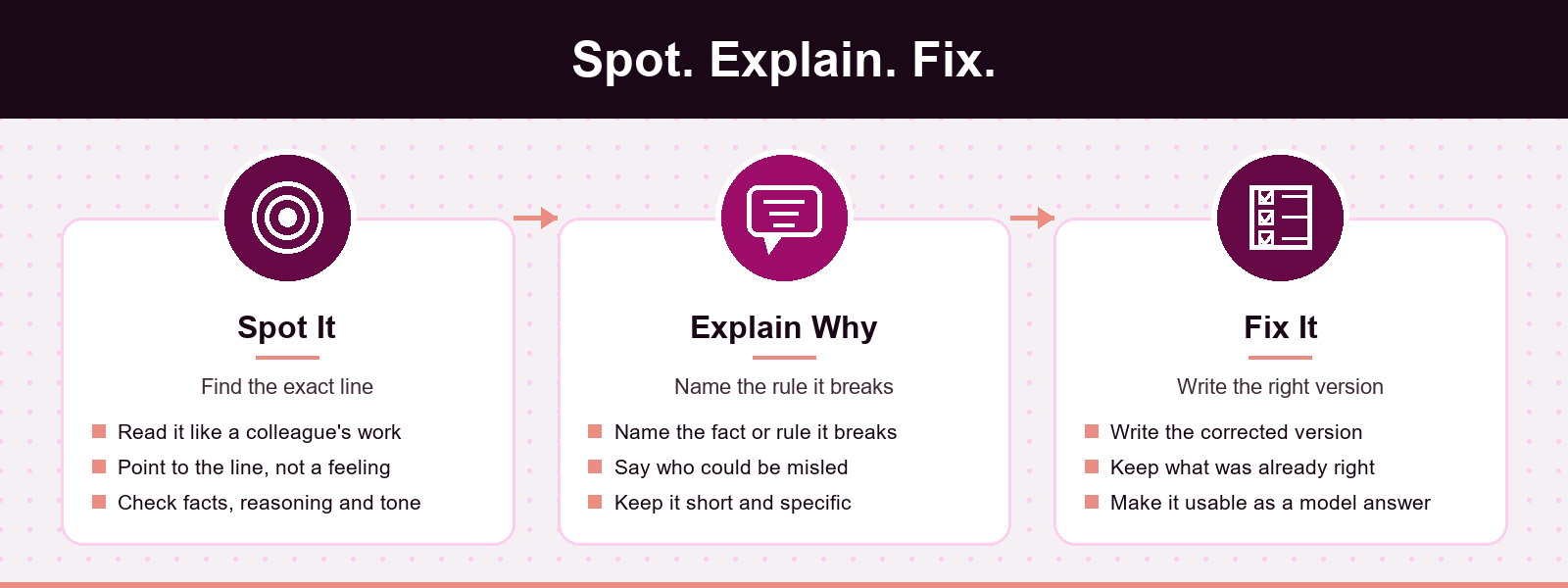
Spot, explain, fix: the three steps experts use to judge an AI answer, shown as a target, a speech bubble and a checklist
- Spot it. Read the answer the way you would read a colleague's work in your field. Point to the exact sentence or step that is wrong.
- Explain why. Name the fact, rule or convention it breaks, and who could be misled or harmed.
- Fix it. Write what the answer should say instead, and keep what was already right.
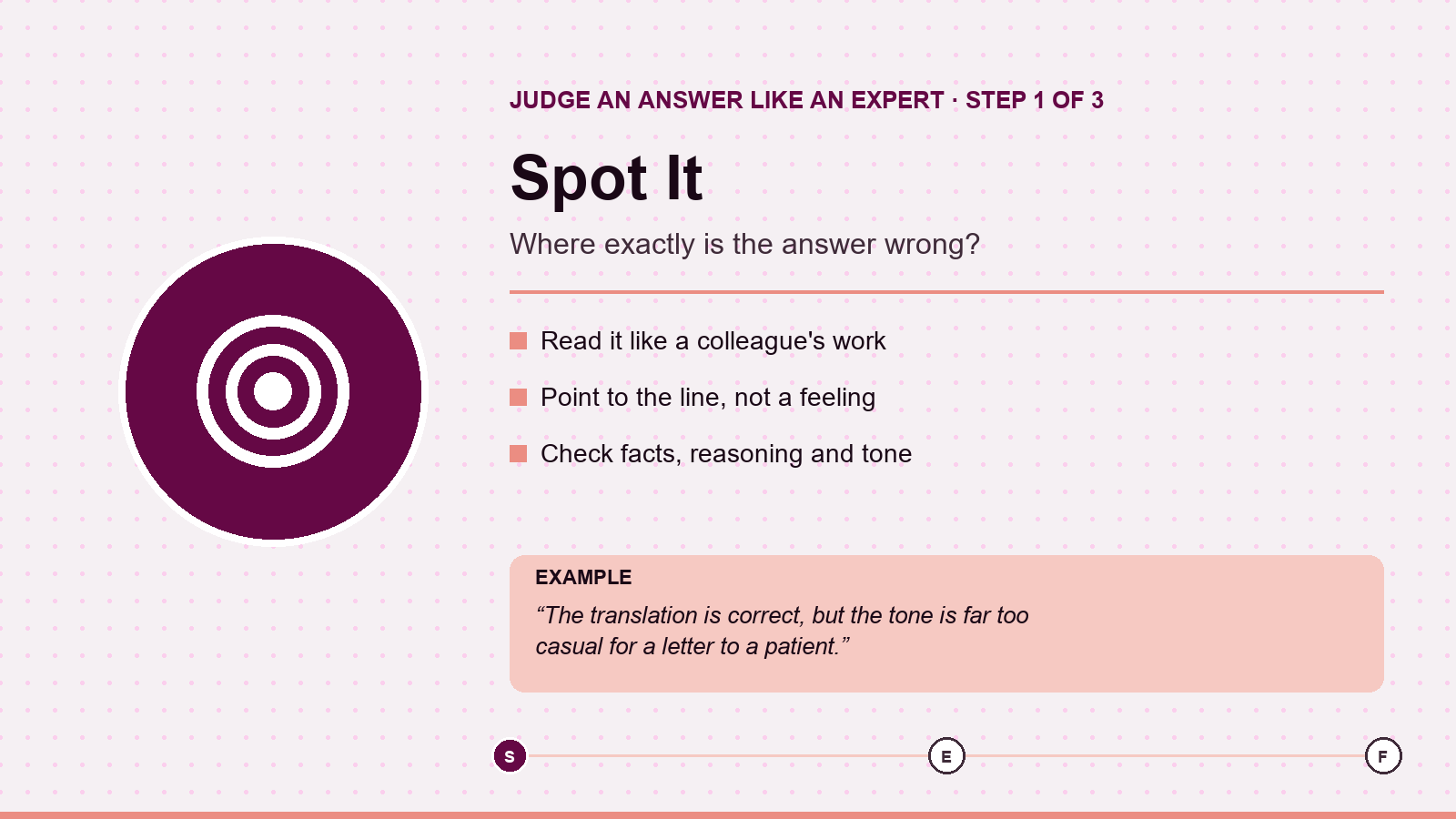
Step 1, spot it: find the exact line that is wrong, with an example of a German translation that uses the wrong tone
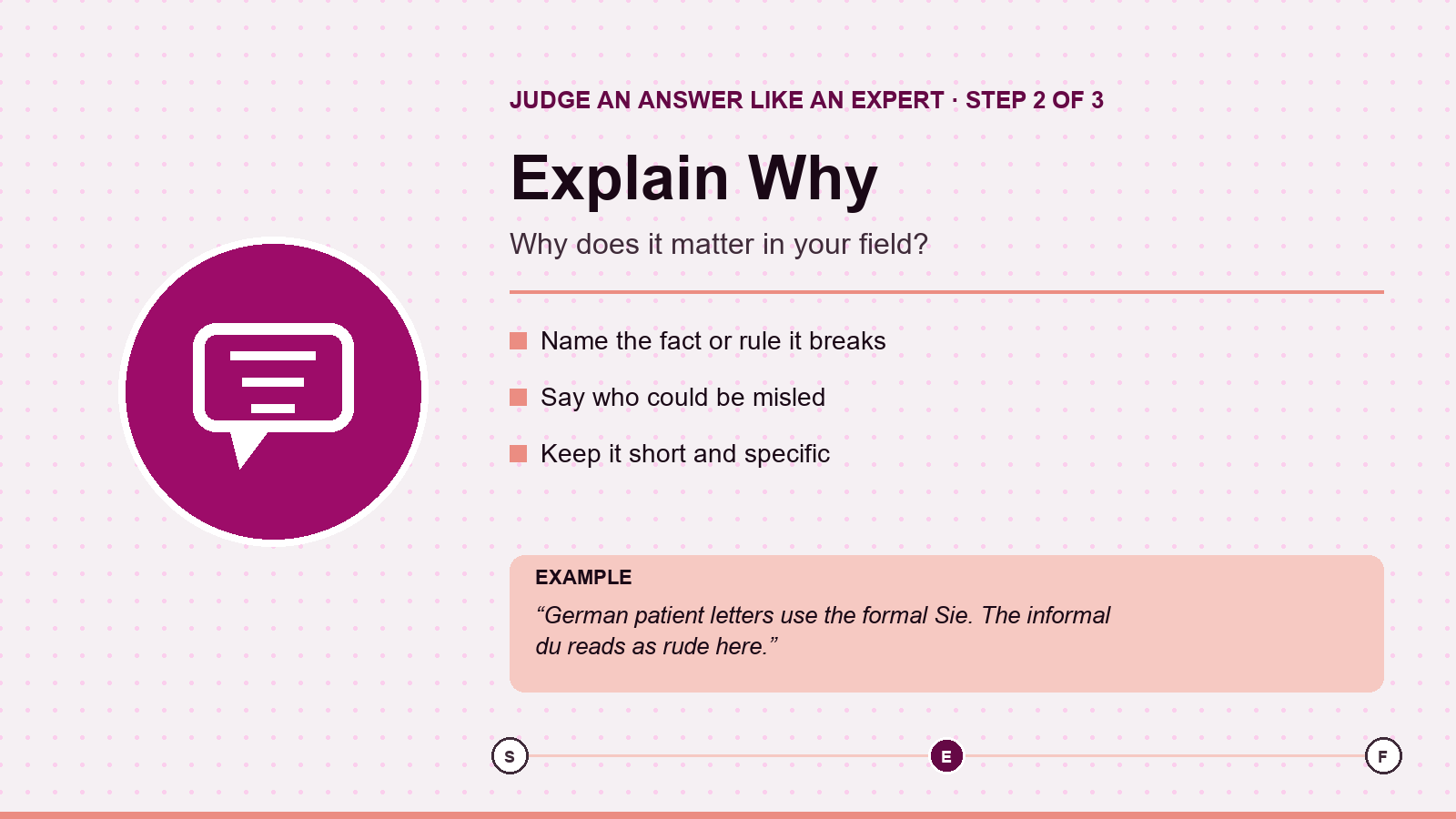
Step 2, explain why: name the rule the answer breaks and why it matters, with the example of formal address in German
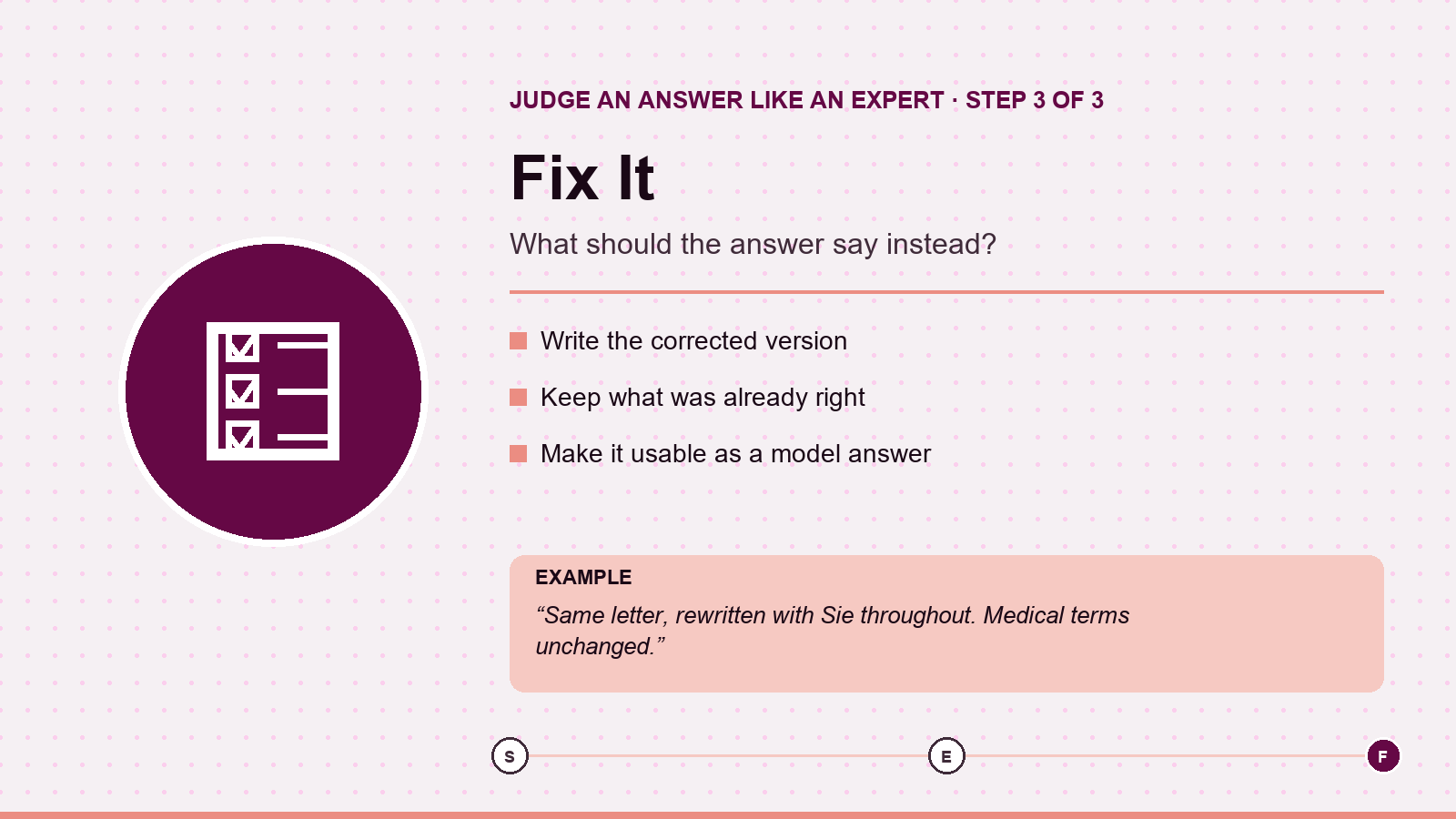
Step 3, fix it: write the corrected version and keep what was right, with the example rewritten in the formal form
Most people stop after step one. The expert who goes all the way to a corrected version gives the team something they can actually use.
Start This Week: Test The Tools In Your Own Field
Sergio closed the topic with a simple ask, and it is the easiest way to build the skill above. Use several of the assistants you can reach and test them on real work from your field.
- Pick one task you know well: a diagnosis question, a contract clause, a lesson plan, a repair procedure.
- Run it through two or three different assistants.
- Note what each one did well.
- Note where you would not trust it, and write down why.
- Share what you found in the community, so other experts in your field can compare.
"Test it in your domain. Let us know what is working well and what is not working really well. Probably we are focusing too much on what is not working."
Noting what each tool did well is the step people skip. Knowing what works in your field is as valuable as knowing what fails, because it tells teams where a tool can already be trusted.
Where That Leaves You
You do not need to learn to build a model to have a place in this work. You need what you already have: years of knowing what right looks like in your field, and the habit of saying clearly when something is wrong and how to fix it.
Vincent's closing advice from the panel was simple: experiment with these tools, use them as tools, and do not be scared of them. Start with one task from your own work this week. Your expertise, recognized.
Comments (0)
Popular

Dive in
Related
Blog
Why Getting Verified Is Non-Negotiable on OneForma (And How to Do It)
By Aleksandar Scekic • Jul 13th, 2026 • Views 463
Blog
Project Application Process Explained By a Recruiter
By Aleksandar Scekic • Nov 5th, 2026 • Views 92
Blog
Your First Week on OneForma: 8 Steps to Get You Started
By Aleksandar Scekic • Jul 29th, 2026 • Views 857
Blog
The Future of AI Work Is Human — Here’s What Our Leadership Had to Say
Jun 17th, 2026 • Views 144
Blog
Why Getting Verified Is Non-Negotiable on OneForma (And How to Do It)
By Aleksandar Scekic • Jul 13th, 2026 • Views 463
Blog
Your First Week on OneForma: 8 Steps to Get You Started
By Aleksandar Scekic • Jul 29th, 2026 • Views 857
Blog
The Future of AI Work Is Human — Here’s What Our Leadership Had to Say
Jun 17th, 2026 • Views 144
Blog
Project Application Process Explained By a Recruiter
By Aleksandar Scekic • Nov 5th, 2026 • Views 92