

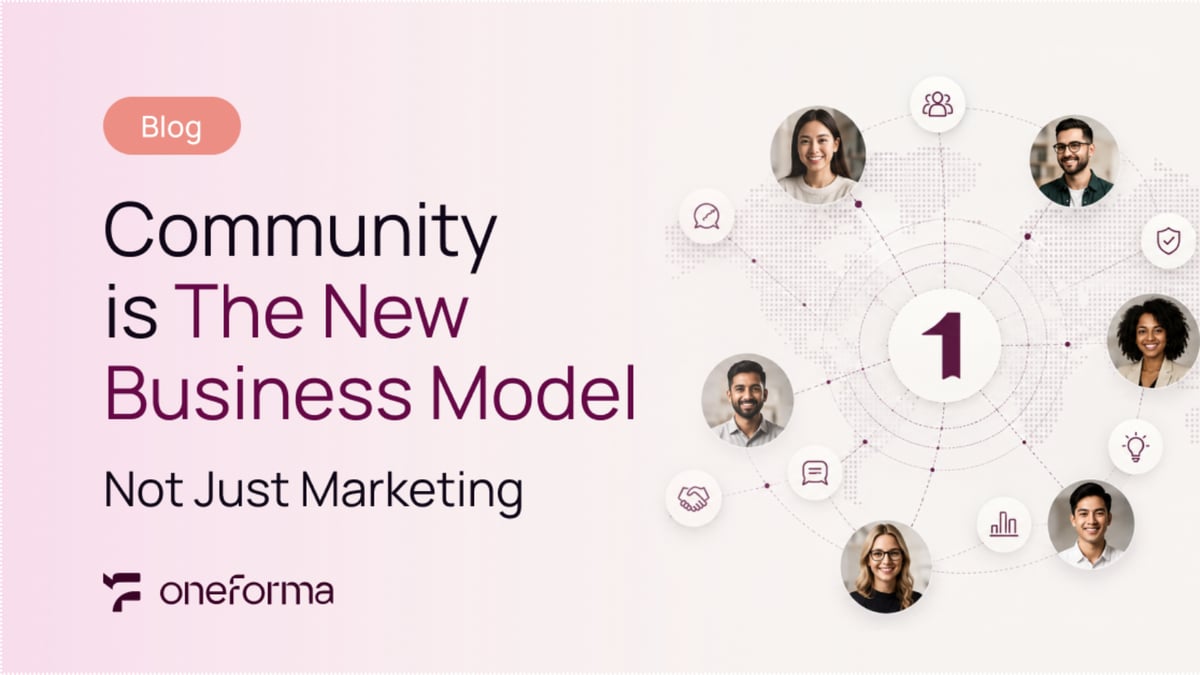
Community is The New Business Model, Not Just Marketing

Community is The New Business Model, Not Just Marketing
# Community
# Ai-ethics
# Article
# Artificial-intelligence
# Assessment

Why the fastest-growing companies aren't buying attention, they're building ecosystems.

July 10, 2026
Community is The New Business Model, Not Just Marketing

The New Business Model

Let's be honest for a minute. For years, "community" sat inside the marketing department. It meant a Facebook group, a hashtag campaign, maybe a few brand ambassadors reposting product shots. Useful, but peripheral, a nice-to-have layered on top of the real business.
That thinking is outdated, and the companies that still treat community as a marketing tactic are going to be outpaced by the ones that treat it as infrastructure.
Because here's the shift happening right now: the businesses growing fastest aren't the ones with the biggest ad budgets. They're the ones built around a community from day one, where the community isn't promoting the business. It is the business.
We didn't need to look far to find proof of that. It's the model OneForma runs on.

Two Ways Community Becomes the Engine, Not the Megaphone

There are two distinct paths businesses take when community moves from marketing tactic to core operating model. OneForma happens to run on both.

1. Plug into an existing community instead of building one from zero.

Mastermind groups are a good example of this outside the tech world. Organizations like BrainTrust bring together women entrepreneurs in structured peer groups, with defined cadences and agendas, all aimed at helping members hit real business and financial milestones. Nobody is selling anybody anything. The group itself is the product. Members show up because the collective knowledge in the room is worth more than what they'd get working alone.
OneForma was built on a version of this same principle, just applied to AI development instead of entrepreneurship. Instead of asking companies to build an in-house annotation team from scratch, or contributors to go find scattered freelance gigs on their own, OneForma exists as the connective tissue. A domain expert in radiology, a bilingual linguist in Manila, a legal researcher in Nairobi: none of them built this network. They plugged into one that already exists, and the platform gets stronger with every expert who joins it.
This is precisely why our member personas aren't marketing segments dreamed up in a deck. They're a reflection of an actual, functioning community with different reasons for showing up, different needs, and the same underlying want: to be recognized for what they know, not treated as an interchangeable resource.

2. Combine two communities to create something neither could build alone.

The second path is partnership, two established audiences merging to create a new one. Samsung's collaboration with fashion house Thom Browne on a limited designer phone is an unlikely but instructive example: a tech audience and a luxury fashion audience overlapped just enough to create a new market neither brand could have reached solo.
OneForma, as part of Centific's broader AI Data Foundry, plays this game constantly, just with expertise instead of aesthetics. Every time a domain expert with a deep specialty (finance, medicine, law, engineering) joins a project, two communities merge: the AI development community that needs ground-truth human judgment, and the professional community that has spent years building that judgment. Neither side could produce a reliable, industry-grade AI model without the other.
That's the whole thesis behind "the expert in everyone." It's not a tagline. It's a description of how the business actually works.

Why This Matters More Now Than It Did Five Years Ago

People are done being marketed at passively. What they want now is real participation, and they'll give their loyalty, their time, and their expertise to whoever offers it authentically.
It's showing up in the data everywhere community-led companies operate. People don't stay loyal to platforms that treat them like a transaction. They stay loyal to platforms that treat their contribution, their name, their expertise, as something that actually matters to the outcome!
For us, it's the entire growth strategy. Every contributor who stays because the work is meaningful, every domain expert who chooses to add their name to their profile instead of remaining anonymous, every worker who tells another skilled friend about a project that finally used their language fluency the right way, that's community functioning as the business model.

What This Means If You're Building Something

If you're an entrepreneur or a leader thinking about your own next move, the takeaway isn't "start a Discord server." It's a shift in how you think about growth entirely:
  • Look for existing, well-run communities you can add real value to before trying to build your own from scratch. Being a visible, genuine contributor to one focused community beats being a passive member of ten.
  • Consider who you could partner with, not to run a co-branded campaign, but to genuinely combine two different pools of expertise or audience into something new.
  • Remember that marketing-driven communities still have their place. This isn't an either/or. It's about recognizing that community can also live inside your operations, your product, and your growth model, not just your social calendar.
The businesses that will define the next decade are the ones that figured out how to make their community indispensable to the product itself.
Comments (0)
Popular
avatar
ďťż
Dive in

Related

Blog
Winning in the AI Workforce: Key Takeaways from Our Latest Community Webinar
Jun 19th, 2026 • Views 65
Video
The 3 Skills Every Expert Linguist Needs Now
Aug 4th, 2026 • Views 3
Blog
Top 3 New Roles Opening for Language Experts
Aug 4th, 2026 • Views 7
Your Privacy Choices