

How To Fix AI Fake Answers And Why It Happens

The Model Was Built To Give You a Wrong Answer
September 15, 2026
Aleksandar Scekic

Steven Junop
Why AI Makes Things Up and Still Sounds Certain
Ever been given an answer that turned out to be completely invented, delivered in the same calm, certain tone as everything else? That tone is not knowledge. Why AI makes things up has a plain mechanical explanation, and once you can see it, you will never read a confident answer the same way again.
Steven Junop, Marketing Manager at OneForma, has spent years writing and stress-testing prompts against these systems for real campaigns. He has watched them invent things at close range. The four-part picture below is the one he comes back to when somebody asks him why it happens.
You have probably been told to "double-check what it tells you," which is useless advice on its own, because you cannot double-check something when you have no idea where the wrong answers come from. By the end of this you will know why AI gives wrong answers instead of admitting the gap, what a fabricated answer looks like from the inside, and the three moves that cut most of it out. We call the whole picture the Confidence Gap.
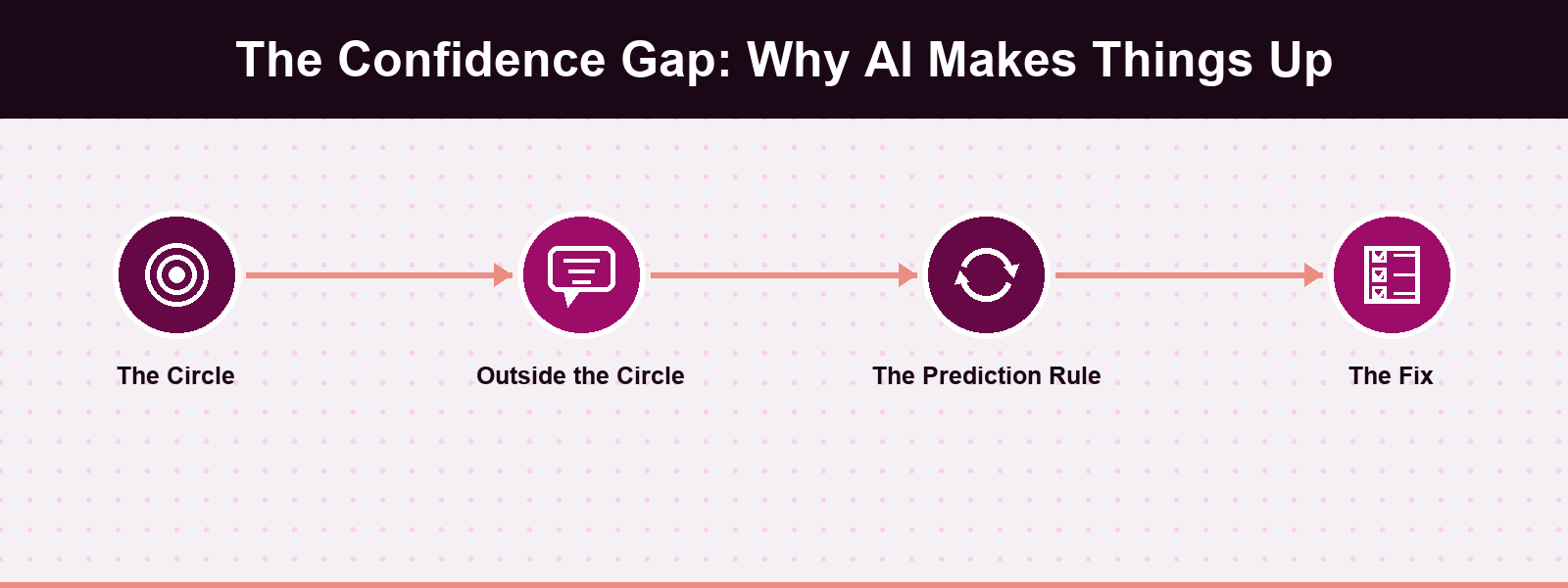
Overview of the Confidence Gap in four parts: the circle of what the model knows, a question landing outside it, the prediction rule, and the fix
What Is an AI Hallucination?
An AI hallucination is an answer the model invents when your question falls outside what it learned. It is not lying. It predicts the next likely word, so it completes the sentence with the closest pattern it has, written in the same confident tone as a correct answer.
That definition matters because of what it rules out. There is no hidden decision being made, no moment where the system knows the truth and chooses to give you something else. The word "hallucination" is a little misleading in that way: it makes the whole thing sound like a malfunction, a glitch that a future version will patch out. It is closer to the opposite. The machine is working exactly as designed, and the invented answer is what that design produces when it runs out of material.
Which is also why you cannot spot one by reading carefully. A wrong answer is not written in a shakier voice than a right one, because the system has no idea which of the two it just produced. Everything after this is really one question: where does the material run out, and what happens at that edge?
"I've stopped asking myself whether the answer sounds right. It always sounds right. That's the whole problem."Steven Junop, Marketing Manager, OneForma
Everything the Model Learned Sits Inside One Circle
Picture a circle. Inside it is everything the model was built on: books, public web pages, documentation, forums, code, transcripts, an enormous amount of written material. That is a genuinely huge circle, and it is why these systems feel like they know everything. But it is a circle, which means it has an edge, and the edge is the part almost nobody pictures.
Most people assume they are talking to something plugged into the live internet, reading as it goes. That is the single most common misunderstanding about how any of this works. Unless the chatbot or assistant you are using has explicitly been given search or a document to read, it is not looking anything up while it answers you. It is working from a snapshot, and the snapshot stopped being updated on a particular day.
So the circle has two hard limits. It stops at a date, and it only ever contained material that was publicly written down. Your project's internal guidelines are not in there. Your client's process is not in there. Neither is anything that lives behind a login, anything that was only ever said out loud in a call, and anything nobody bothered to write about.
What an AI Knowledge Cutoff Date Actually Means
An AI knowledge cutoff date is the day the material used to build the model stops. Events after that date did not happen as far as the system is concerned, and it has no way to tell you so. Ask about last month and you are already outside the circle.
The answer you get back will not feel any different from one about something ten years old.
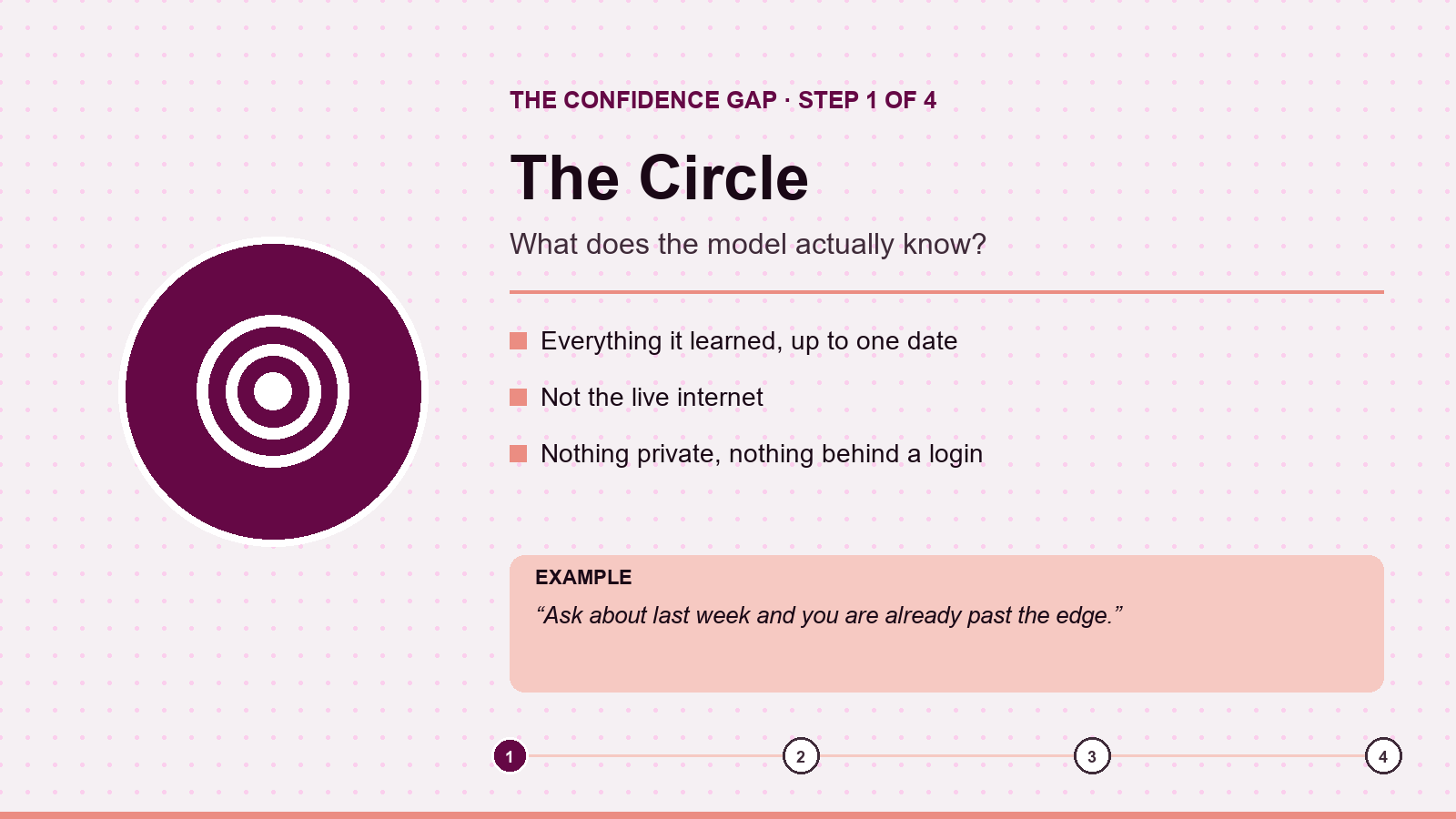
Step one of the Confidence Gap, the circle: everything the model learned up to one date, not the live internet, nothing private
What Happens When Your Question Lands Outside the Circle
Now put your question on the picture. Most of the time it lands comfortably inside, which is why these tools are genuinely useful and why you get good answers far more often than bad ones. The trouble starts with the questions that land outside, and there are only really three ways that happens.
The first is too recent. Anything after the cutoff simply is not there. The second is too specific: a question about one project, one client process, one internal rule, one set of guidelines that exists in a document the model has never seen. The third is the quiet one, a question about something nobody ever wrote down in the first place. Plenty of real expertise lives only in people's heads and in their hands, and none of it made it into the circle.
Here is the part that decides everything that follows. When your question lands outside, nothing announces it. There is no warning, no flag, no change in behavior. From the outside, a question the system has nothing for looks precisely like a question it has plenty for. It simply carries on and produces an answer, because producing an answer is the only thing it does.
Three questions that fall outside
"What changed in the guidelines this week" falls outside because it is too recent. "What is the exact payout structure on my project" falls outside because it is too specific, and that information is not public. "How do experienced reviewers decide between two nearly identical labels" falls outside because that judgment mostly lives in people rather than in documents. All three will still get you a fluent, complete, confident answer.
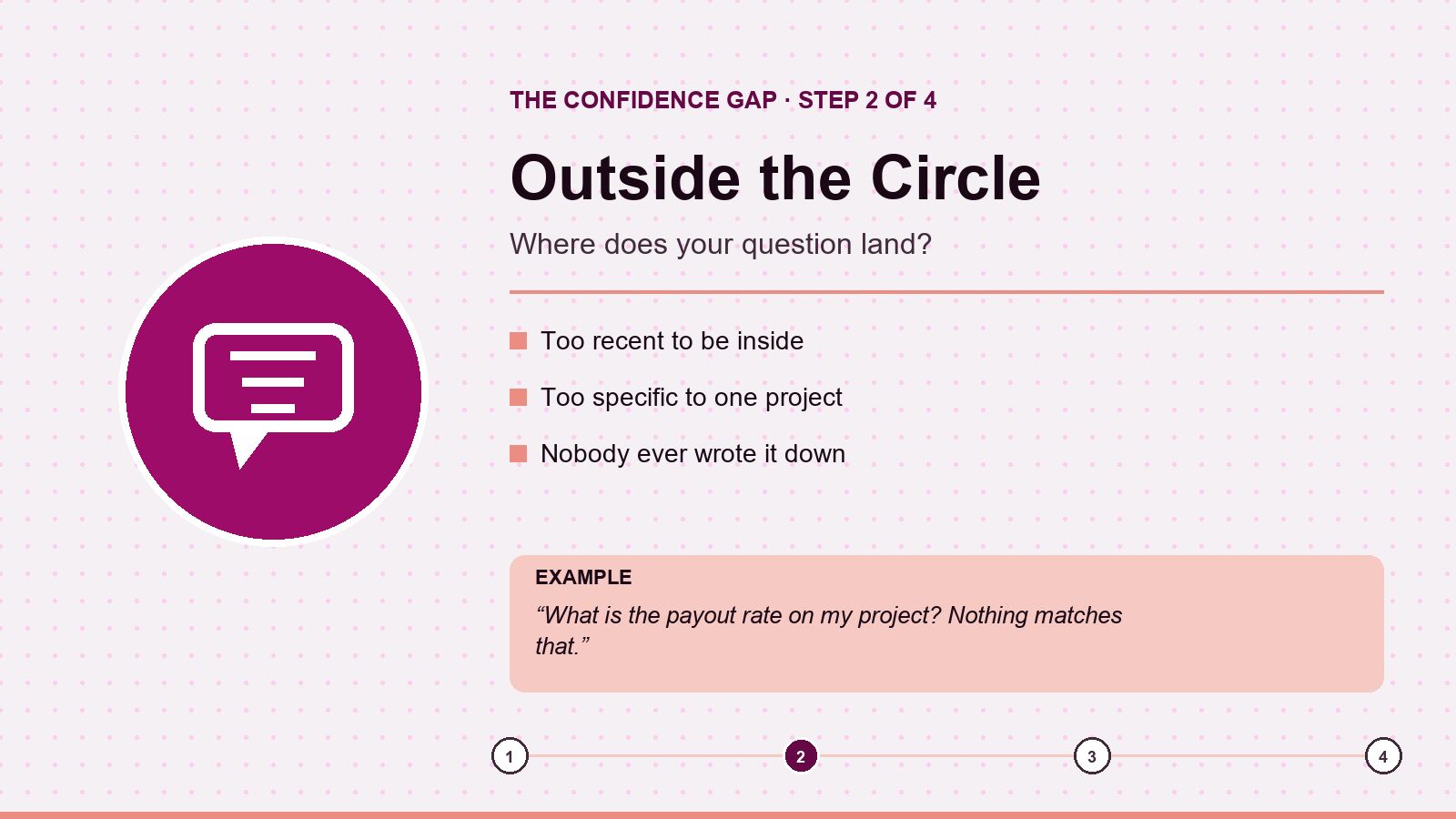
Step two of the Confidence Gap, outside the circle: questions that are too recent, too specific, or never written down
Why AI Makes Things Up Instead of Saying "I Do Not Know"
This is the part that makes everything else make sense. A large language model is not retrieving an answer and then wording it for you. It is doing one thing over and over: given everything written so far, what is the most likely next piece of text? Then it does it again. And again. A whole answer is that single move repeated hundreds or thousands of times.
Run that process on a question with nothing behind it and the machine does not stall, because there is nothing in the process that can stall. It reaches for the nearest thing that fits the shape of the question and continues. A request for a source produces something that has the shape of a source. A request for a case reference produces something with the shape of a case reference. The output is shaped correctly and grounded in nothing, which is a far stranger failure than simply being wrong.
And "I do not know" almost never wins as the next most likely piece of text, because the writing these systems were built on is overwhelmingly writing where somebody knew the answer. Explanations, documentation, articles, answers. Confident prose is the house style of the entire circle, so confident prose is what comes out, whether or not there is anything underneath it.
Confidence is a writing style, not knowledge
There are publicly reported cases of lawyers filing court documents containing citations that did not exist, produced by exactly this process. Those fake citations were not sloppy or obviously odd. They were formatted correctly, named plausibly, and read identically to the real ones sitting next to them on the page. That is the whole lesson in one example: fluency and accuracy are produced by two completely different things, and only one of them is visible to you.
So when you ask yourself "does this sound right," you are measuring the wrong thing. You are measuring the writing. The confidence is the font, not the fact.
"The model isn't trying to trick you. It's finishing a sentence. You're the one deciding to trust it, and that decision is yours to make better."Steven Junop, Marketing Manager, OneForma
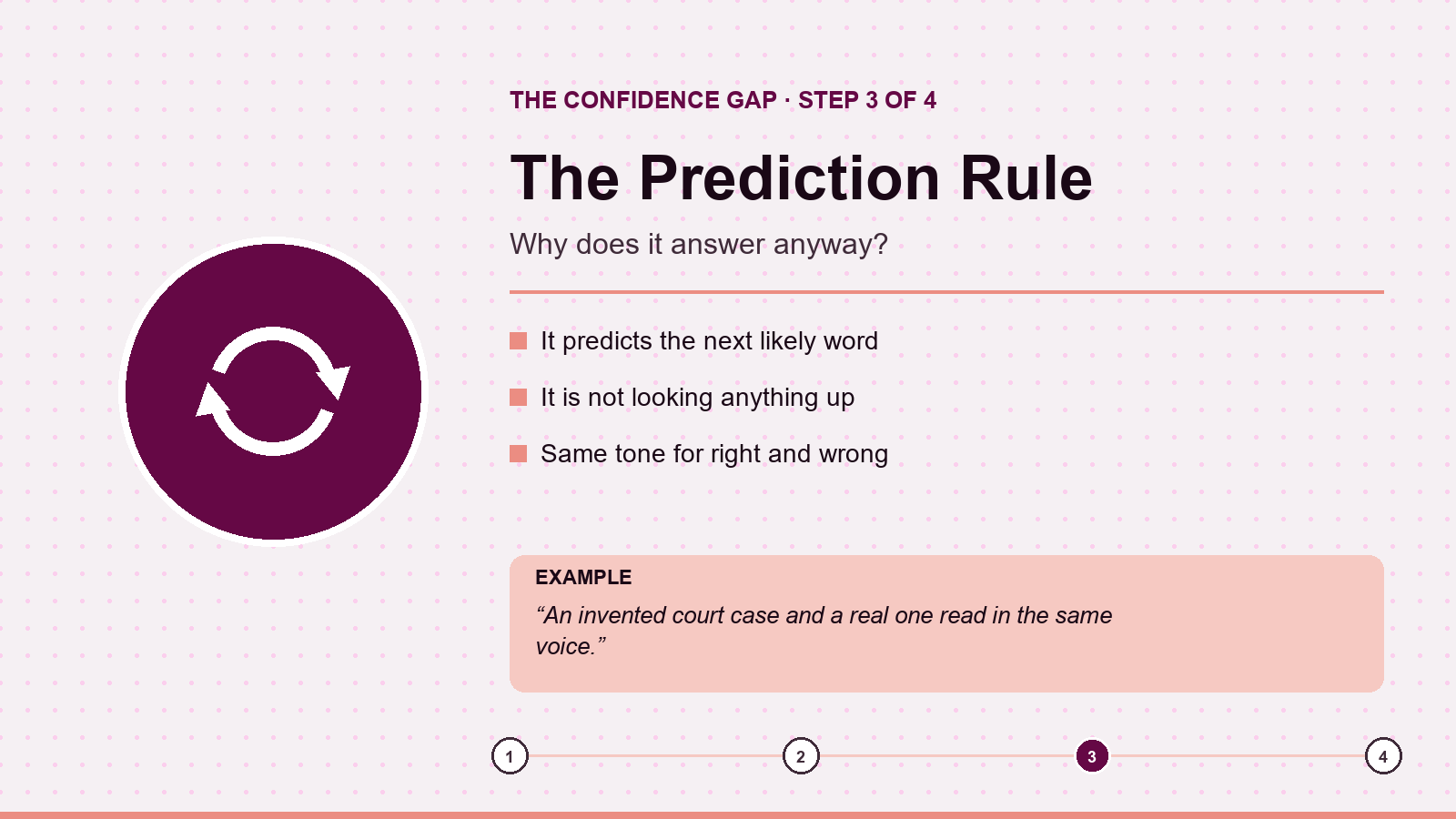
Step three of the Confidence Gap: the prediction rule behind why AI makes things up, and why the tone never changes
How to Stop AI From Making Things Up
The good news is better than it sounds. You do not have to make the model smarter, and you do not have to wait for a future version to fix this. You move the question inside the circle. Three moves do most of the work, and you can start using all three today.
- Give it the source. Paste in the document, the guidelines, the page, the transcript, and tell it to answer using only that. This is the single biggest change you can make, because it turns the task from recalling into reading. A question about a document that is sitting right there is no longer a question about the edge of anything.
- Make it quote the exact line. Ask for the specific sentence it used for each claim. If it can produce the line, you can check it in seconds. If it cannot, or if it produces a line that is not in the document you just gave it, you have caught a fabrication without needing to know anything about the subject yourself.
- Have a person check it. Not a general skim for whether it reads well, which is the thing you now know is unreliable, but somebody with real knowledge of the subject checking whether the claims hold.
Those three stack. Source narrows what it can draw on, quoting makes each claim checkable, and the human check catches what survives the first two. None of them requires you to understand the technology, which is the point.
Can hallucinations be fixed?
Not by waiting. The behavior comes from how these systems produce text, so it does not disappear in the next release. What changes the outcome is what you do around the answer: what you feed in before it, and who looks at it afterwards.
The sharper edges do get smoother with each release. Treat every confident answer to an outside-the-circle question as a draft, never as a finding.
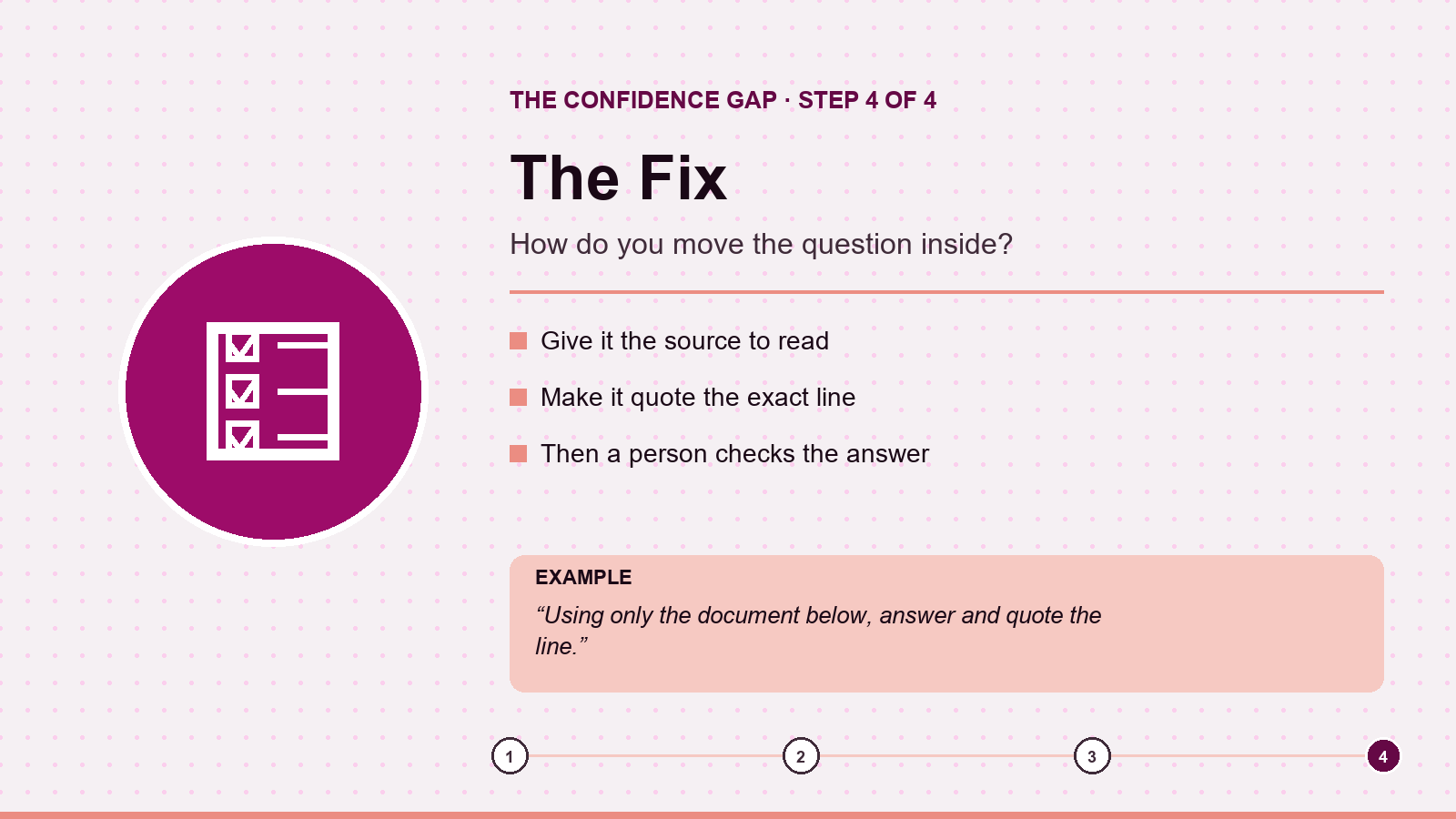
Step four of the Confidence Gap, the fix: give it the source to read, make it quote the exact line, and then have a person check the answer
The People Who Grade These Answers
This is where you come in. Every one of these systems is corrected by people, and the correcting is real, specific, paid work. On OneForma projects, experts read model answers and grade them: is this accurate, is it complete, is this source real, is this the judgment somebody in this field would actually make? A doctor catches the clinical claim that reads well and is wrong. A translator catches the phrase that is grammatically perfect and culturally off. A lawyer catches the citation that does not exist.
That work does not just flag a bad answer. Corrections like these are what the systems are improved from, which is how the circle gets a little bigger and a little more accurate over time. The judgment that only lives in your head, the thing that never got written down anywhere, is exactly what is missing from the circle and exactly what these projects exist to capture.
"Paste in the source and ask it to quote the line. If it can't point at the line, it made it up. That one habit catches most of it."Steven Junop, Marketing Manager, OneForma
The model was never lying to you. It was finishing a sentence, with nothing in it that knows how to stop, and you were the only one in the exchange capable of telling the difference. That is not a weakness in you. It is the whole reason human expertise is not optional here, and why the people who can spot the confident wrong answer are worth paying to do it.
Your professional judgment is the thing the circle is missing. Put your expertise to work on a project that needs it.
Comments (0)
Popular

Dive in
Related
Blog
What Makes a Great AI Trainer (And Why it Matters)
By Aleksandar Scekic • Jun 25th, 2026 • Views 97
Blog
Why Getting Verified Is Non-Negotiable on OneForma (And How to Do It)
By Aleksandar Scekic • Jul 13th, 2026 • Views 308
Blog
What Is Egocentric Data And What It Means For AI
By Aleksandar Scekic • Jul 23rd, 2026 • Views 101
Blog
What Makes a Great AI Trainer (And Why it Matters)
By Aleksandar Scekic • Jun 25th, 2026 • Views 97
Blog
Why Getting Verified Is Non-Negotiable on OneForma (And How to Do It)
By Aleksandar Scekic • Jul 13th, 2026 • Views 308
Blog
What Is Egocentric Data And What It Means For AI
By Aleksandar Scekic • Jul 23rd, 2026 • Views 101