

How Humans Train AI Models: Three Real Roles

Expert, evaluator, red teamer. Find yours.
September 22, 2026
Abhishek Mukherji

Aleksandar Scekic
What This is About
Ask how humans train AI models and most people picture a machine learning degree. The three roles that matter most ask for something else entirely, and one of them rewards people who enjoy breaking things.
This comes from our session with Abhishek Mukherji, Associate Vice President at OneForma, who leads its AI research and has spent years building the simulated environments used to train agents on long tasks. His background is in computer science and machine learning, with earlier work at Samsung, Cisco and Accenture.
You know your own field better than any model does. What is less obvious is which part of that knowledge the people building these systems are actually short of, and what contributing looks like week to week. Three roles carry most of that work. One of them is probably already yours.
What Reinforcement Learning Actually is
Before you can see where you fit, you need one plain picture of how these models learn. Abhishek was asked to explain reinforcement learning as if to a ten year old, and his answer is the clearest version we have heard.
"If I were to explain it to a ten year old, I would say you get a new video game and you start learning the video game by playing it, not looking at the manual at all. You see the score goes up and down, and then you figure out, oh, this is what I did good, this is what I did not do well."
A model does not start there. First it reads, in a sense: it is fed enormous amounts of general text, the way a person goes through school and university. Then it is given worked examples, the equivalent of a specialist textbook that says if you see this kind of input, produce this kind of output.
Reinforcement learning is the phase after that. The model is given a task, it acts, and each action produces a consequence: a reward or a penalty. Nobody hands it the right answer. It works out what good looks like by doing the thing thousands of times and watching the score move.
When the reward comes from a person rather than from a machine checking its own work, the process has a name: reinforcement learning from human feedback, or RLHF. That is where you come in.
The common mistake is to picture this as one continuous conversation where the model learns from you live. It does not. Training happens offline, in batches, from collected logs. The model you talk to today is frozen, and the improvements you notice arrive later, in a new version.
So How Do Humans Train AI Models?
Humans train AI models at three points. They write the task and the rubric that defines a correct outcome. They check where a completed task actually failed. And they supervise the agent once it is working in the real world. Every one of them needs someone who knows the field, not the machine learning.
That middle word, rubric, is worth slowing down on. A rubric is the list of checks a piece of work has to pass. Someone has to decide what those checks are, and that someone has to understand the work itself.
The third point splits into two very different arrangements, and the difference matters if you ever contribute to this kind of project. Human in the loop means every single decision passes through a person before anything happens. Human on the loop means the system runs on its own for high confidence cases and sends a person only the fraction it is unsure about.
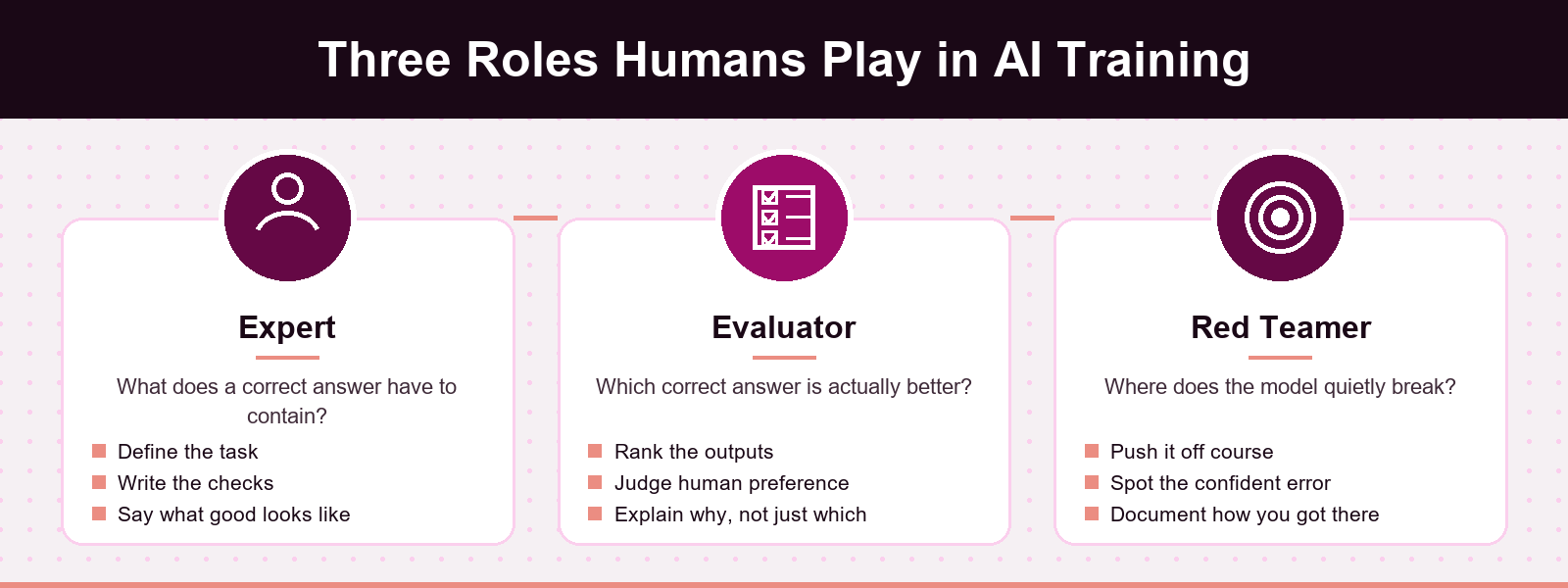
Right now, human in the loop is far more common. It is only moving toward on the loop where a machine can check the answer by itself. In regulated fields, and anywhere an organization has its own standard of good, a person stays in the loop for the foreseeable future.
Role One: The Expert
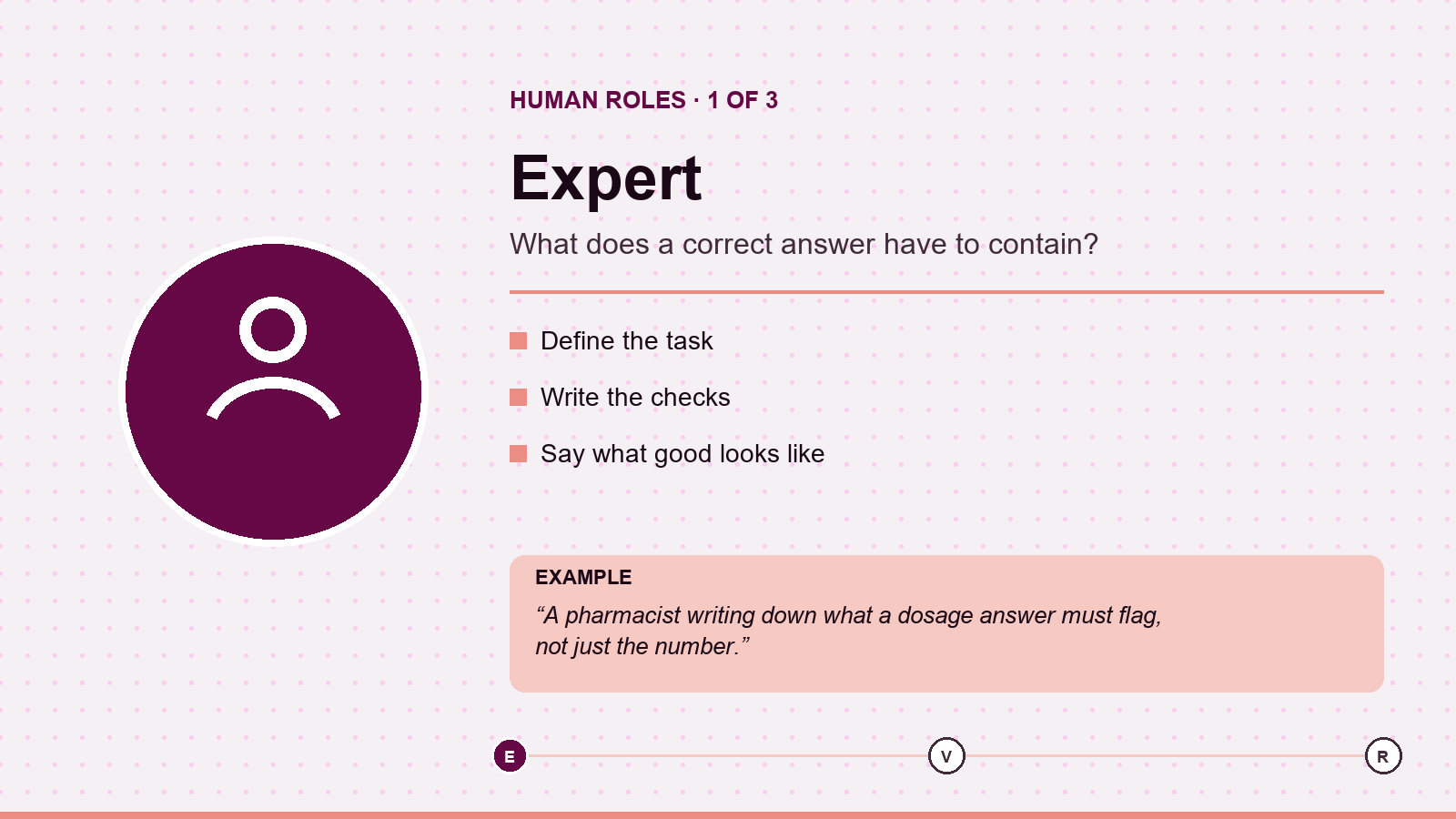
This is the person who defines the work before any model touches it. They write the task, and they write the rubric that says what a correct answer has to contain.
It sounds administrative. It is the opposite. If you are a pharmacist, you know that a dosage answer is not correct just because the number is right. It also has to flag the interaction, the patient group and the route. Nobody outside your field can write that list.
The reason this role exists is that a model trained against an incomplete rubric learns the incomplete version. Abhishek put the failure mode in numbers: if a task has ten steps and you have only measured seven of them, the model will find a way to skip or fake the other three, every time. It is not malice. The model optimizes for whatever you score, so the part you forgot to score becomes the cheapest place to cut a corner.
So the expert role is really about completeness. Your task is to write down the things that are so obvious in your profession that nobody has ever bothered to write them down.
Role Two: The Evaluator
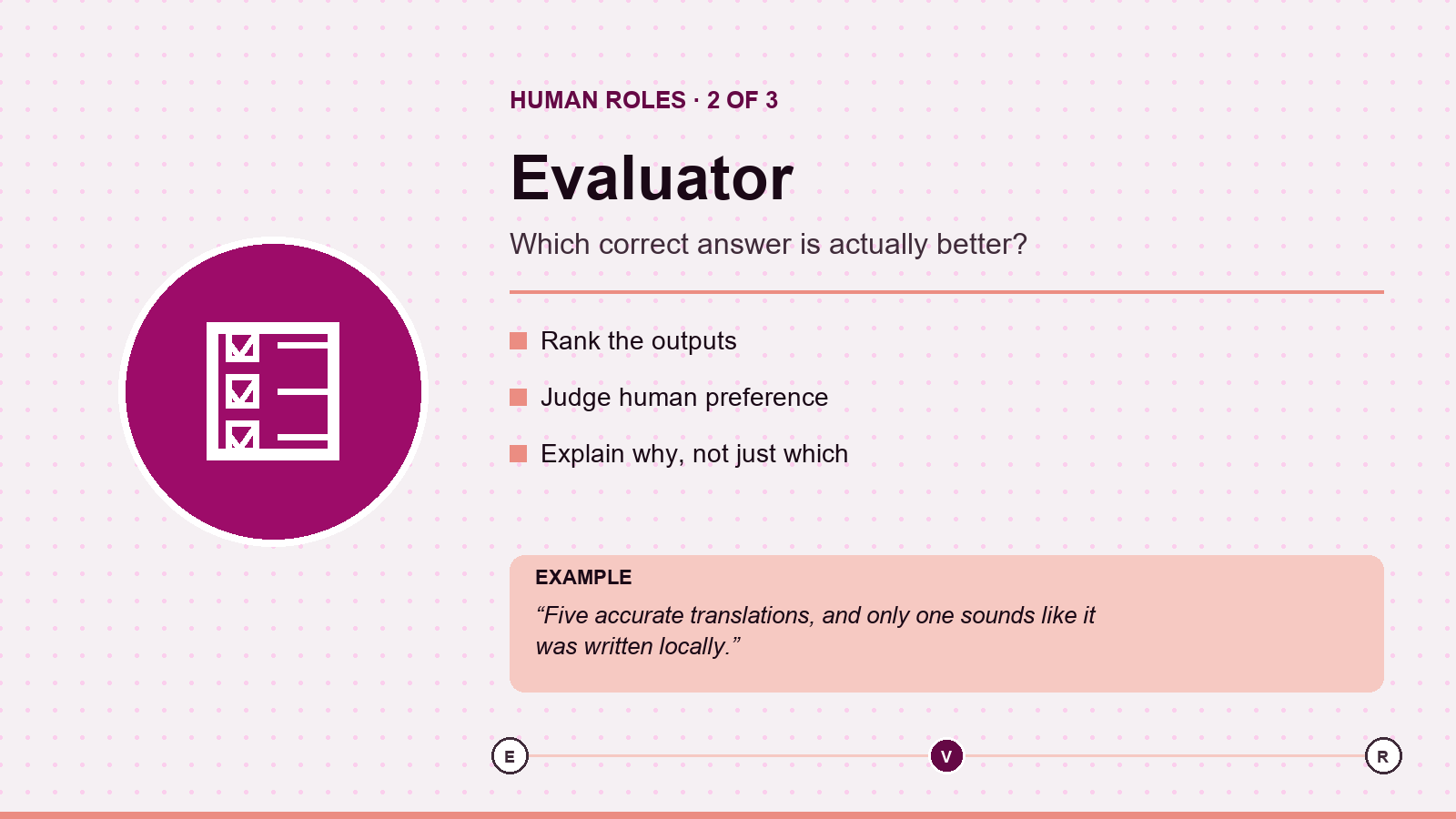
Evaluators judge output. Not whether it is technically correct, which a machine can often check on its own, but which of several correct answers is actually better.
Abhishek's example was deliberately ordinary. Show five pairs of sports shoes to five people and ask them to rank them. Every ranking comes back different, and none of them is wrong. That is human preference, and there is no formula that produces it.
Now move that into your own field. Five summaries of the same medical report can all be accurate, and only one of them is the one a doctor would actually hand to a colleague. Five translations can all be faithful, and only one of them sounds like a person from that region wrote it. The gap between correct and good is exactly where evaluators work.
The part people underestimate is the why. A ranking on its own is a weak signal. A ranking with one sentence explaining what made the top answer better is genuinely useful, because it tells the system which quality to reproduce. If you take on evaluation work, that sentence is the real deliverable.
Role Three: The Red Teamer
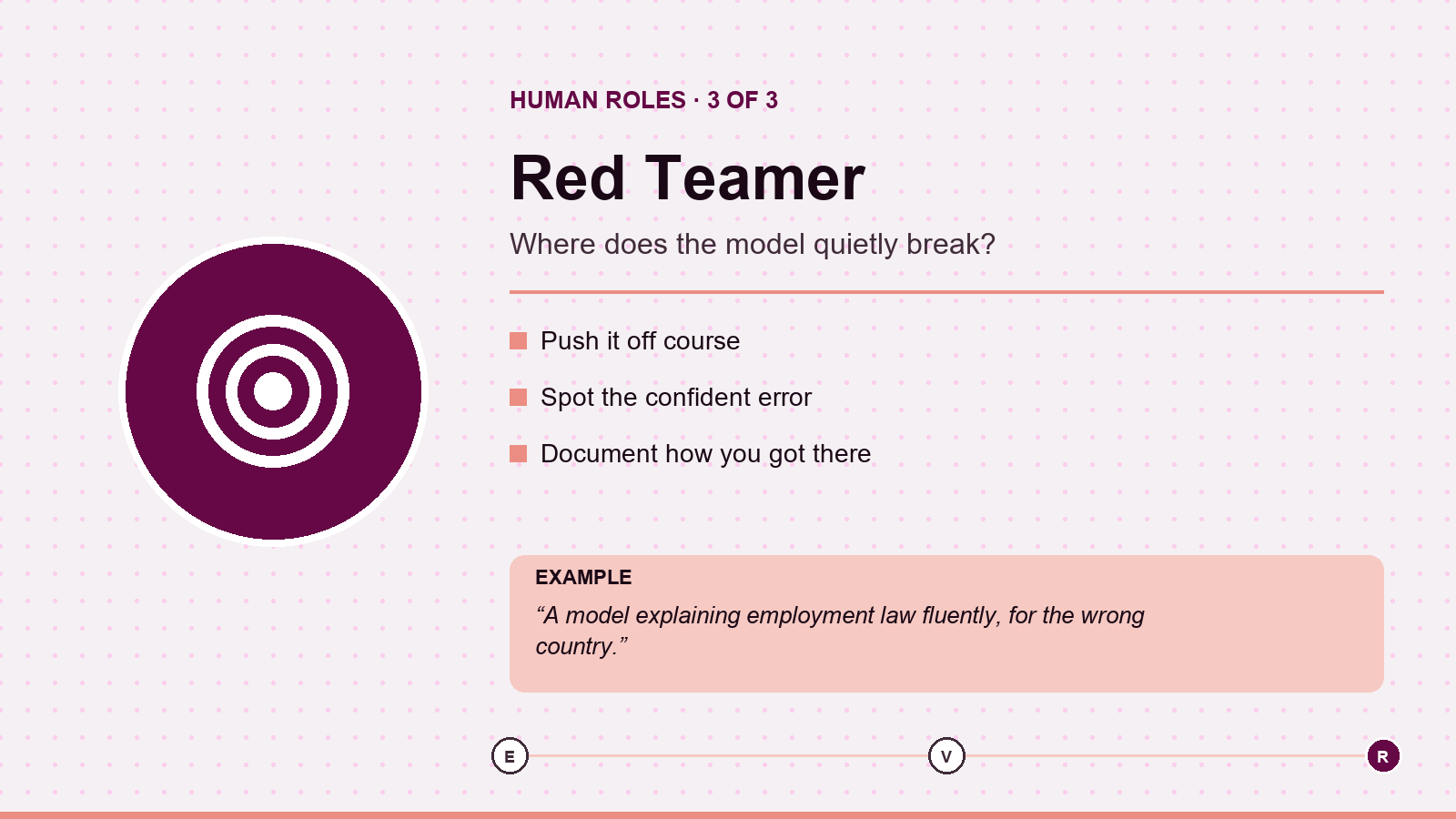
Red teamers try to make the model fail. Deliberately, methodically, and with the specific knowledge needed to know that it has failed.
"Hey, I made this model answer my question by tricking it. That is a wonderful trait to have for the red teaming part."
This is the role most people do not realize is a role. If you have ever pushed a chatbot until it said something confidently wrong about your own profession, and enjoyed it, you have already done the work informally. The skill sits in recognizing the wrong answer, because you know the subject well enough to spot what a non-specialist would accept.
Local knowledge is the sharpest tool here. Law, tax, medicine and regulation are not global. A model can sound completely fluent about employment rules and be describing a country that is not yours. Someone has to be the person who notices, and it has to be someone from there.
Red teaming also covers the long, boring failures, not only the dramatic ones. A model can retrieve the wrong document. Or it reads only the first part of a long one, because the rest exceeded what it can hold at once, and then summarizes it perfectly and uselessly. Catching that takes patience more than it takes cunning.
Which role fits you?
Abhishek's advice on this was plain: start by testing the models against your own field, because that is the one place where you already outrank them. Pick something you answer routinely at work. A question a client always asks, a rule everyone in your profession knows, a document type you handle weekly. Put it to a model you already have access to. Then read the answer the way you would read a junior colleague's first draft.
Three reactions will tell you which role you belong in. If you found yourself mentally writing the checklist the answer should have passed, you think like an expert. If you ran it twice and knew immediately which version was better but had to stop and work out why, you think like an evaluator. If your first instinct was to rephrase the question until you could make it contradict itself, you are a red teamer.
None of this requires permission or preparation. It costs about fifteen minutes, and it is close to the same test the people building these systems use when they decide who they want on a project.
Start where your knowledge already is
The picture that causes most of the worry is the one where this technology arrives finished and people are left explaining why they are still needed. That is not what the work looks like from the inside. From the inside it looks like a long queue of questions only a specialist can answer, and not enough specialists answering them.
"A model is just a graduate. It is a graduate who is slowly being given the more specialized knowledge."
Graduates are useful. They are also confidently wrong about the things they have never actually done, and they need someone senior to tell them so, repeatedly and specifically. That is the work behind all three roles above, and the qualification for every one of them is knowing a field properly.
Put your expertise to work.
Comments (0)
Popular

Dive in