

What Physical AI Actually Is, Explained By A Robotics Researcher

# Physical AI
# Robotics
# # ai-research
# Senior-expert
Why the self-driving car beats the humanoid
October 20, 2026
Aleksandar Scekic

Leela Krishna
What Is Physical AI? A Robotics Researcher Explains
Everybody pictures a humanoid when they hear the words physical AI, and the most advanced physical AI machine in the world is already parked on your street. The gap between those two pictures is why robot videos look so much better than robots are. This comes from our session with Leela Krishna, who leads physical AI research at Centific, our partner. Her field is where computer vision meets robotics. Before that she spent about eight years building autonomous driving and machine learning systems.
By the end of this post you will know what physical AI actually is, what changed to make it possible, and how far along it really is. You have seen the clips: a robot folds laundry, another one jumps, a third gets kicked and stays upright, and it is hard to tell real progress from a marketing cut.
What Is Physical AI?
Physical AI, sometimes called embodied AI, is artificial intelligence applied to the physical world, outside the laptop and the phone. It combines vision, language and audio models with sensors and motors so a machine can see, decide and act in real space. Self-driving cars, warehouse sorting arms and autonomous excavators are all physical AI. Humanoid robots are only one form of it.
The confusion starts with the word robot. We already have vision models that find objects in a video, audio models you can talk to, and language models that answer in full sentences. Physical AI is what happens when you take those out of the computer and give them a body of some kind, and that body is usually not a humanoid.
"Everybody thinks physical AI is only about robots and humanoids. That's not true. The ones that are driving autonomously, the ones sorting objects in a packaging warehouse, the ones doing excavation for humans, they are all physical AI."
From The Printing Press To The Self-Driving Car
Leela traces the idea back further than most people expect. The printing press was a machine that did a task people used to do by hand, copying books. Alan Turing's machines broke encrypted messages with mathematics no human could run at that speed. The concrete ideas behind physical AI date from the 1960s, and deep neural networks arrived in the 1980s. What was missing for decades was hardware that could carry them.
That history explains why the car got there first. Keeping a car in its lane without hitting anything is one task, done extremely well, and Leela calls the self-driving car the most advanced physical AI machine on the road today. It also explains the old limit: a pre-programmed robot is a printing press. It repeats one movement perfectly and has no cause-and-effect feedback loop, no way to notice a small deviation and ask whether it should change direction.
The Three Changes That Made Modern Robots Possible
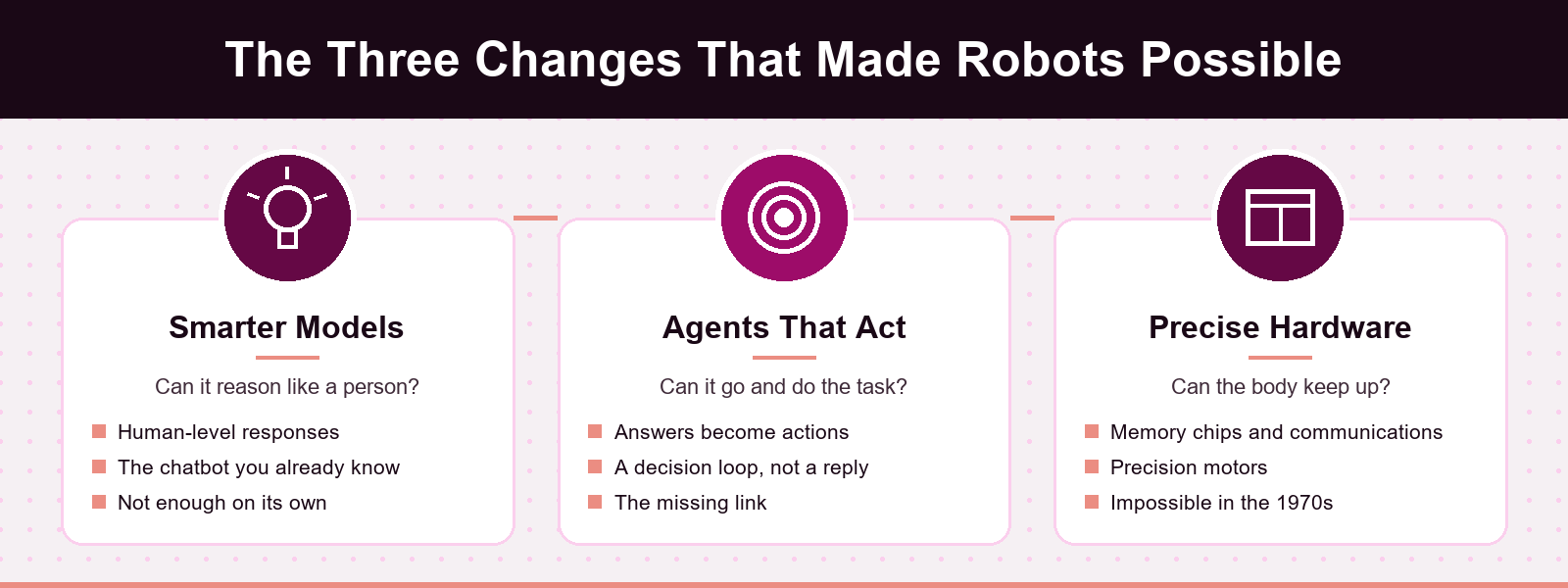
Leela puts the breakthrough down to three things arriving at the same time. None of them alone was enough.
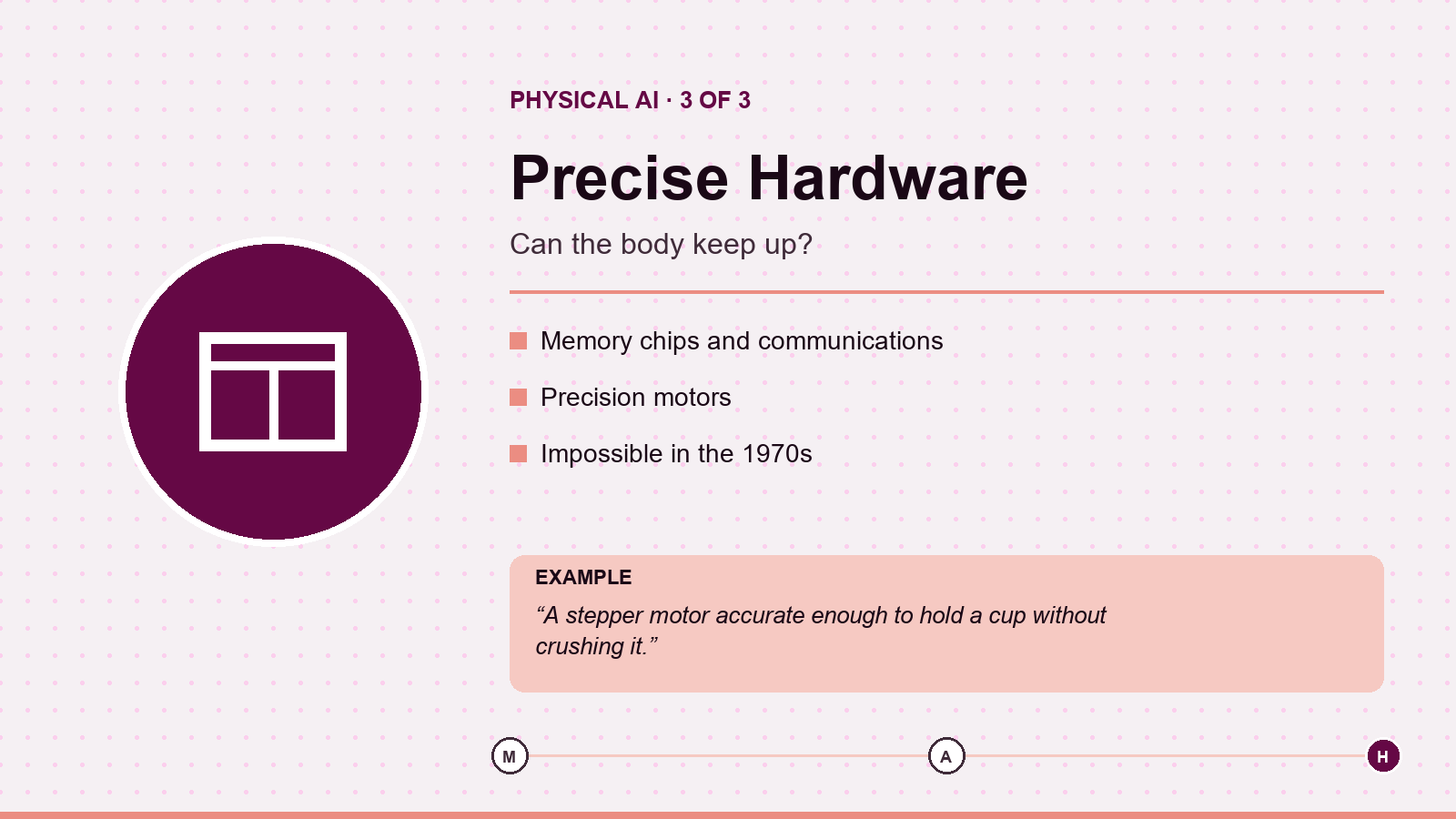
Smarter Models
Neural networks reached the point where a response reads as human-level reasoning. That is the part everyone sees in a chatbot, and it was the first dimension.
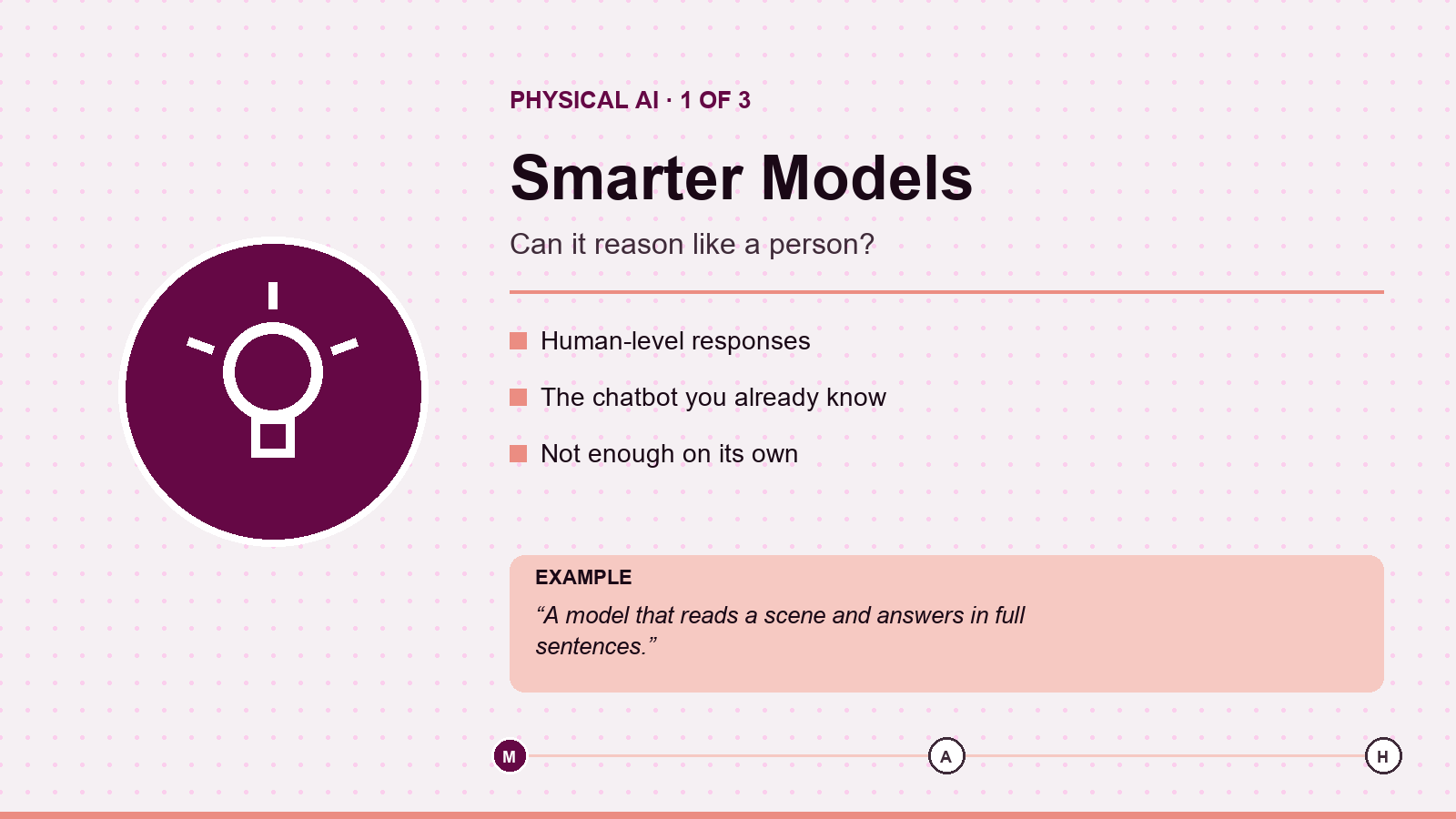
Agents That Act
An agent does not just answer a question, it goes and does a task: accepts a calendar invite, sends your out-of-office reply. Leela calls agents the missing link, because a robot needs exactly that decision loop. In 2021 people realized that if a model can generate text, it can generate a naive kind of thinking, and that is enough to make a robot act.
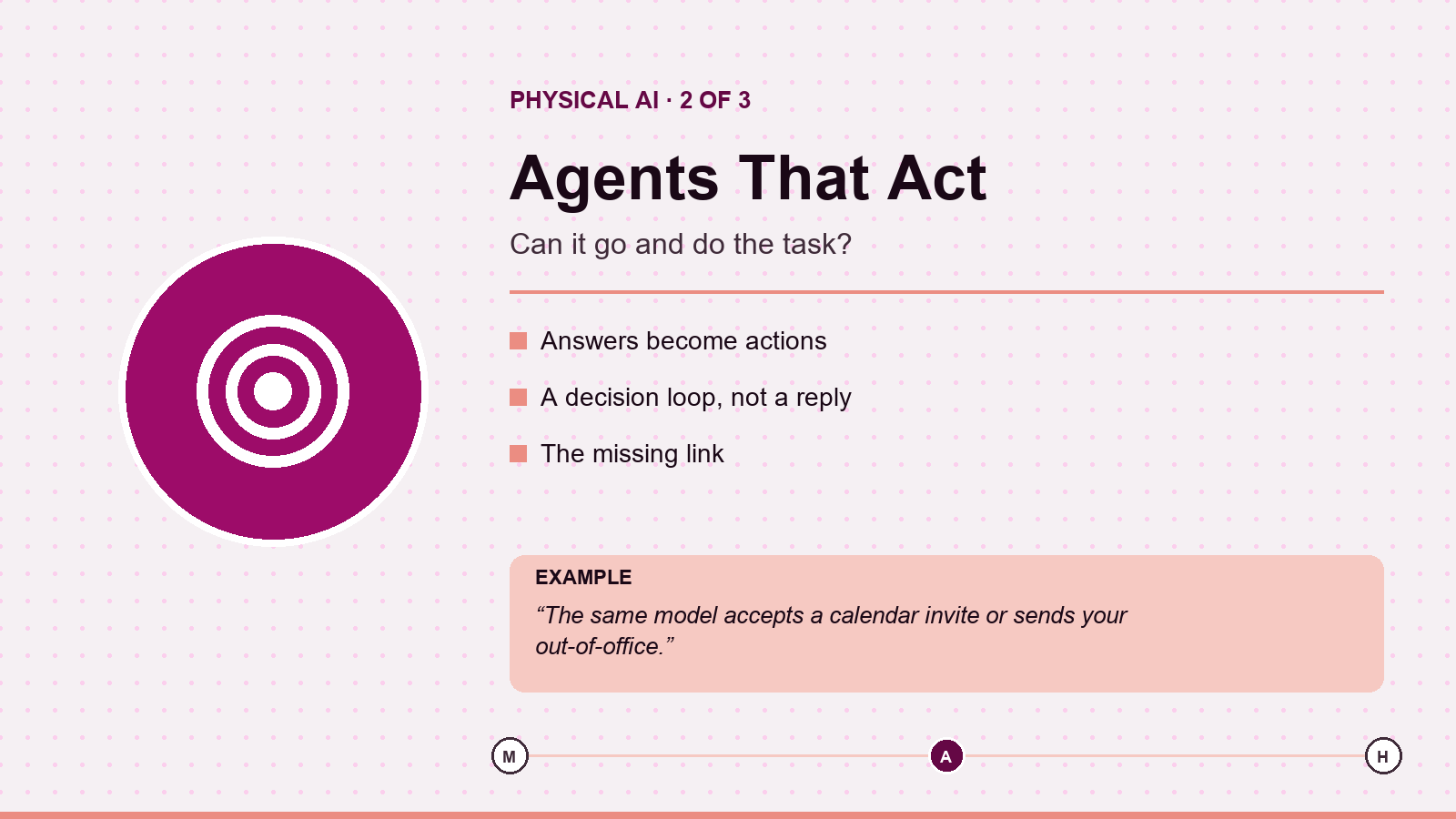
Precise Hardware
Memory chips, communications and motors all improved at once. A stepper motor with the precision today's robots need could not be built in the 1970s. The models improved, the motors improved, and the agents connected them.
The research result that tied it together is imitation learning, from around 2018. You record a task with a headband camera, the network breaks your movements into small chunks of action, and those chunks can be replayed on a robot. Leela's example is making a pizza with a camera watching your hands.
Why Robotics Is In Its ChatGPT 2 Era
You will hear people say robotics is having its "ChatGPT moment". Leela's response is to ask which ChatGPT they mean, because the first versions of that model were curiosities and the useful ones came years later.
"Which ChatGPT are we talking about? Is this GPT-2, GPT-3, 4, 5 or 6? I would like to say we are in the ChatGPT 2 era of robotics."
The advance is real: you no longer have to program a robot line by line. The limit is also real. Leela has not yet seen a robot that can make a pizza. She has seen robotic hands make a coffee and pick an object off the floor. That is honestly where robots are today, and it is the frame to hold every demo video against.
The Two Misconceptions Behind The Robot Videos
The first misconception is that it is easy for a robot to learn everything. Leela compares robots to children. A child spends the first two years just coordinating its own body. You cannot teach it to eat or dress itself until around age four. And humans are the best learning machines that exist. Driving is one task. A humanoid in a home needs thousands, because a household head, an employee and a person out in public each run through about a thousand distinct tasks a day. Her estimate for human-level dexterity is 10 to 15 years.
The second misconception is that a metal frame has the properties of a human body. The body evolved over millions of years, and the running and jumping robots in the clips are still at a primitive stage. Leela is fair about why people believe otherwise: it is the marketing, and the videos we see. Asked for the most overrated idea in robotics in the quick-fire round at the end of the session, she gave two: how easy learning is, and the humanoid itself.
Where You Fit In
The videos stop before the step that matters most. A robot in the ChatGPT 2 era does not learn from code. It learns from people doing real tasks on camera, over and over, with every variation a real kitchen or warehouse throws at them. That recording work is the human layer of robotics, and it does not need an engineering degree. It needs someone who already knows how the task is done.
"You can convert this into little chunks of action, and those actions can be transferred all the way to a robot. It's exactly like how you teach a kid."
The next post in this series walks through how a robot is actually built, step by step, and why most of the two to three years goes on teaching rather than hardware. For now, the next time a humanoid clip crosses your feed, you know the question to ask: one task, or a thousand?
Put your expertise to work.
Comments (0)
Popular

Dive in
Related
Blog
What AI companies Actually Need: Recruiter's Hot Takes For 2026
By Aleksandar Scekic • Jun 3rd, 2026 • Views 385
Blog
Project Application Process Explained By a Recruiter
By Aleksandar Scekic • Nov 5th, 2026 • Views 92
Blog
Project Application Process Explained By a Recruiter
By Aleksandar Scekic • Nov 5th, 2026 • Views 92
Blog
What AI companies Actually Need: Recruiter's Hot Takes For 2026
By Aleksandar Scekic • Jun 3rd, 2026 • Views 385