

How to Write Better AI Prompts: The SCOPE Framework

# Prompt-engineering
# Prompt-evaluation
# Guide
# Tutorial
# Industry-expert
A five-step framework for prompts that actually deliver.
September 8, 2026
Steven Junop

Aleksandar Scekic
What This Is About
Everyone tells an AI who to be. That is one fifth of a good prompt, and the missing four fifths are why most answers come back flat.
Steven Junop, OneForma's Marketing Manager and a prompt engineering expert, built the SCOPE framework after years of writing and testing prompts for real campaigns. It is the exact method he uses himself, distilled into five questions anyone can follow.
Most prompts fail for the same reason: they ask a question instead of writing a brief. Learning how to write better AI prompts really means learning to write that brief. If you have ever gotten a generic answer and wondered what went wrong, there is no magic phrase to add, just five parts you can reuse on every task.
Why Most AI Prompts Come Back Generic
A one-line prompt gives a model almost nothing to work with. It still has to decide who it should sound like, what you already know, what result you actually want, and what a good answer looks like, so it fills each of those gaps with a guess. Every guess is a place where the answer can drift away from what you had in mind.
That is also why the same prompt can feel brilliant one day and useless the next. Nothing about the model changed. The gaps just got filled differently.
"Most people talk to AI like it's a search bar. Once you start briefing it like you'd brief a new teammate, everything changes."
The fix is not a longer prompt. It is a more complete one. A brief with five specific parts removes the guesswork, and once you know what the parts are it takes about the same time to write as the vague version did.
What Is the SCOPE Prompting Framework?
SCOPE is a five-step framework for writing AI prompts: Specialist (who the AI should be), Context (what it needs to know), Objective (the exact result you want), Parameters (the rules to follow), and Evidence (what a good answer looks like). Answer all five and your prompt becomes a brief the model can actually execute.
SCOPE: How to Write Better AI Prompts in Five Steps
You now have the five parts. What makes SCOPE work is answering them in order, because each letter sets up the one after it.
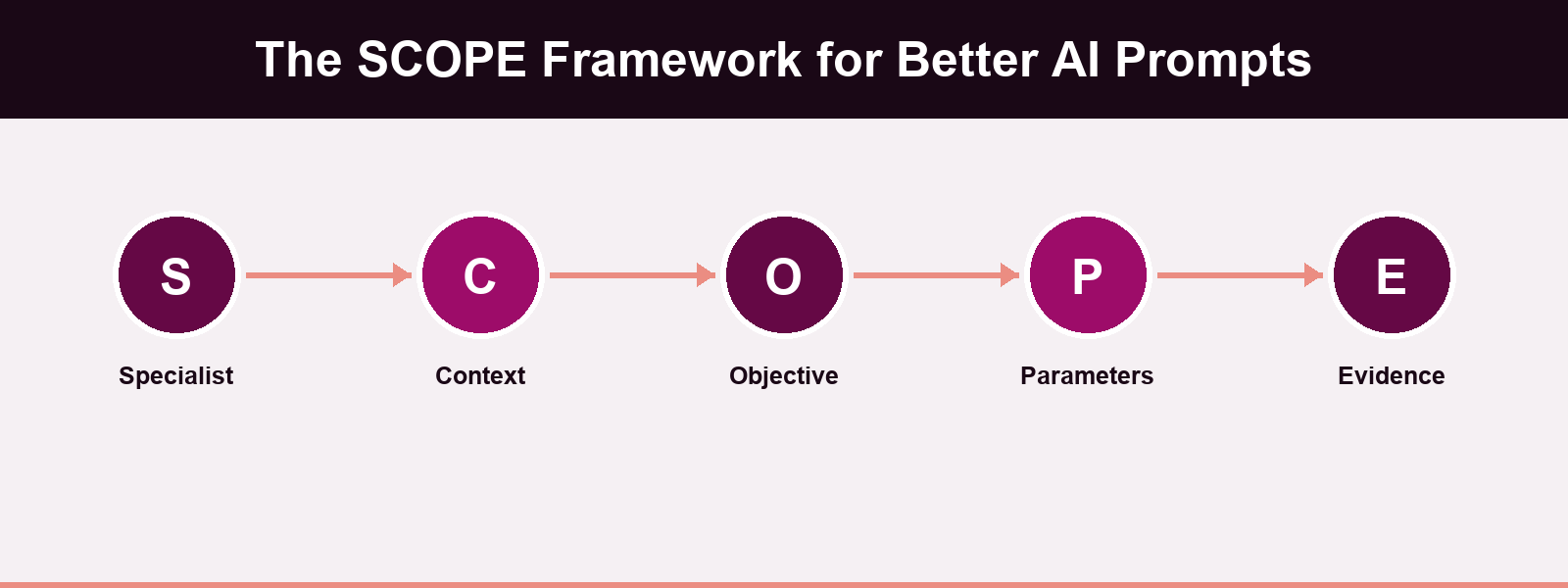
The order matters more than it looks. Specialist comes first because it sets the lens everything else gets read through. Context comes next because the model needs the situation before it can judge the request. Then Objective, then Parameters, and finally Evidence, the standard you will hold the answer to. Read top to bottom, it works like a brief you would hand to a colleague.
None of the five parts needs to be long. One well-chosen sentence per letter beats a page of vague description, and most strong prompts still fit in a short block of text.
S: Specialist
Tell the AI who it should be. Every answer changes depending on who is giving it, so naming a role hands the model a specific lens to think through, along with the vocabulary, the benchmarks and the instincts that come with that role. This is what prompt engineers call role prompting, and it is the single highest-leverage sentence in most prompts.
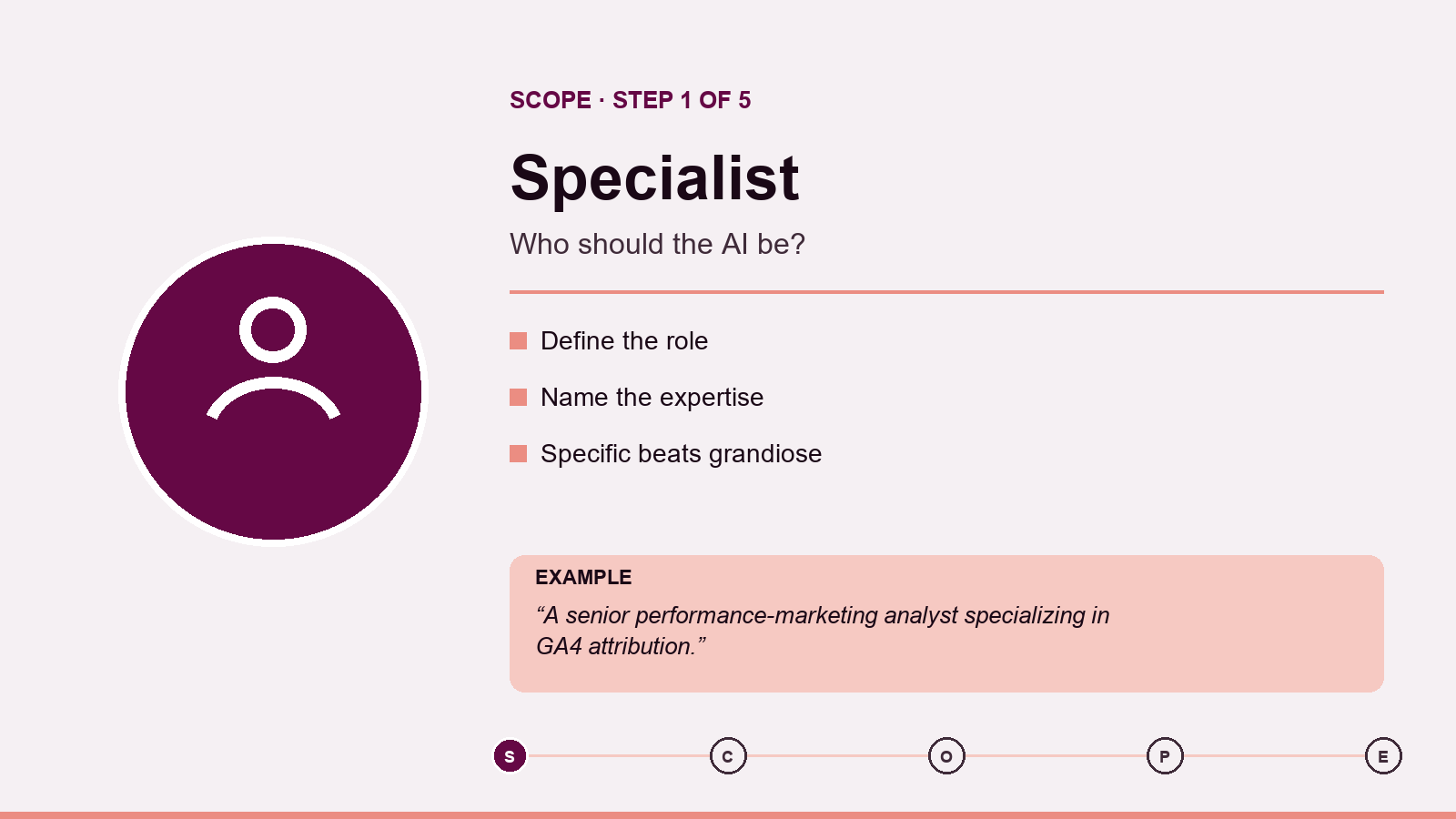
The most common mistake here is reaching for grandiose instead of specific. "World-renowned genius" describes status rather than knowledge, so it gives the model nothing usable. "Senior performance-marketing analyst specializing in GA4 attribution and paid social" tells it exactly which knowledge to draw on, and which details a real practitioner would care about.
A useful test: ask what this role would know that a general assistant would not. If your task touches a particular tool, market, discipline or regulation, name it inside the role itself. The more precisely you describe the expertise, the less the model has to invent to fill the space.
C: Context
Give the AI what it needs to know. Context is every piece of background that could change the answer, and only that: who you are, who the audience is, what information is already available, and why the task matters at all.
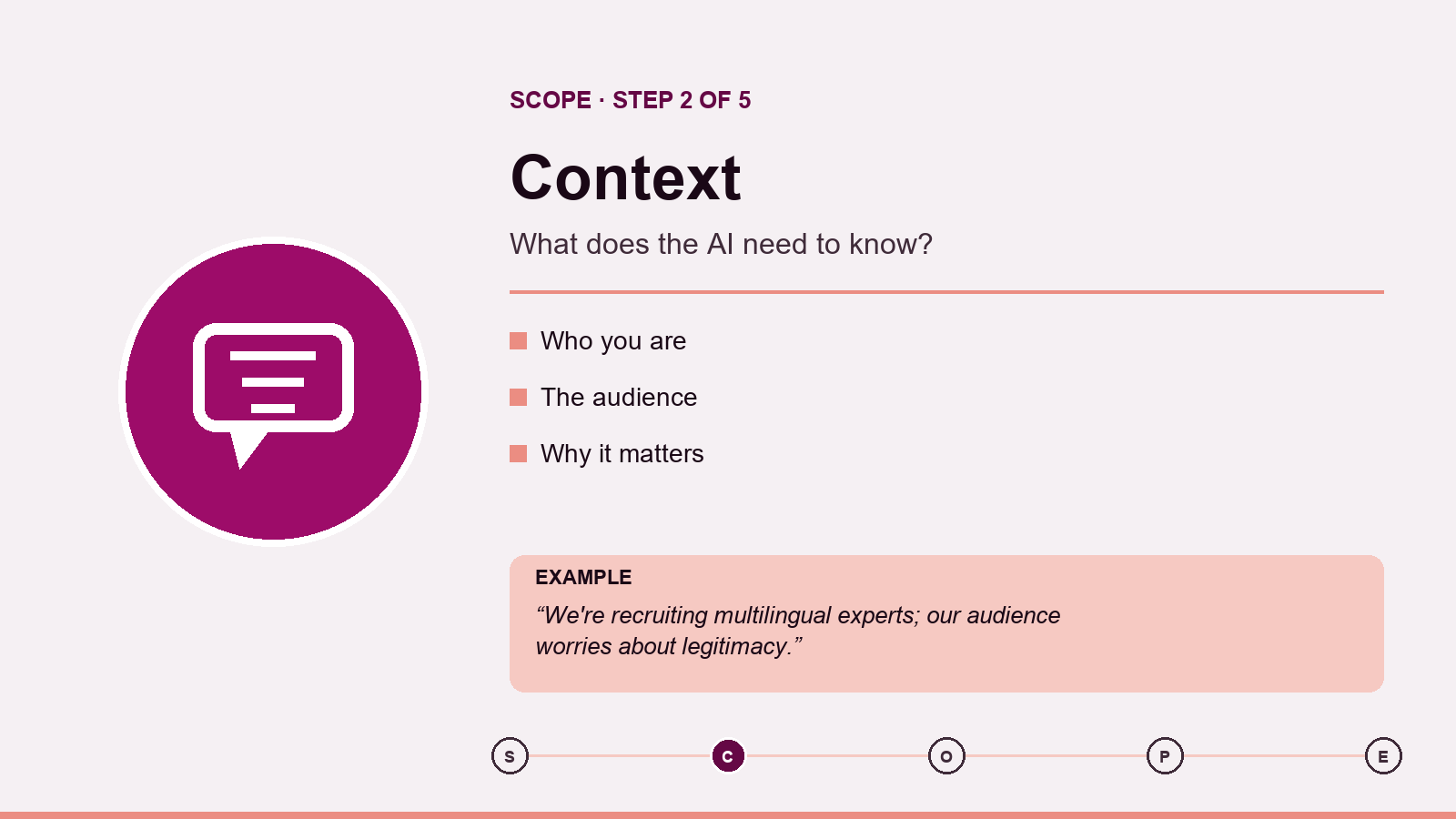
The filter is simple. If a detail would not change the output, leave it out. A long backstory weakens a prompt. It buries the parts that matter and pulls attention toward details that have no effect on the result.
Audience context does the most work in this section. An answer written for people who already trust you looks nothing like one written for people who are skeptical, and no model can guess which situation you are in. Tell it what the reader already believes, what they are worried about, and what they have heard from you before.
O: Objective
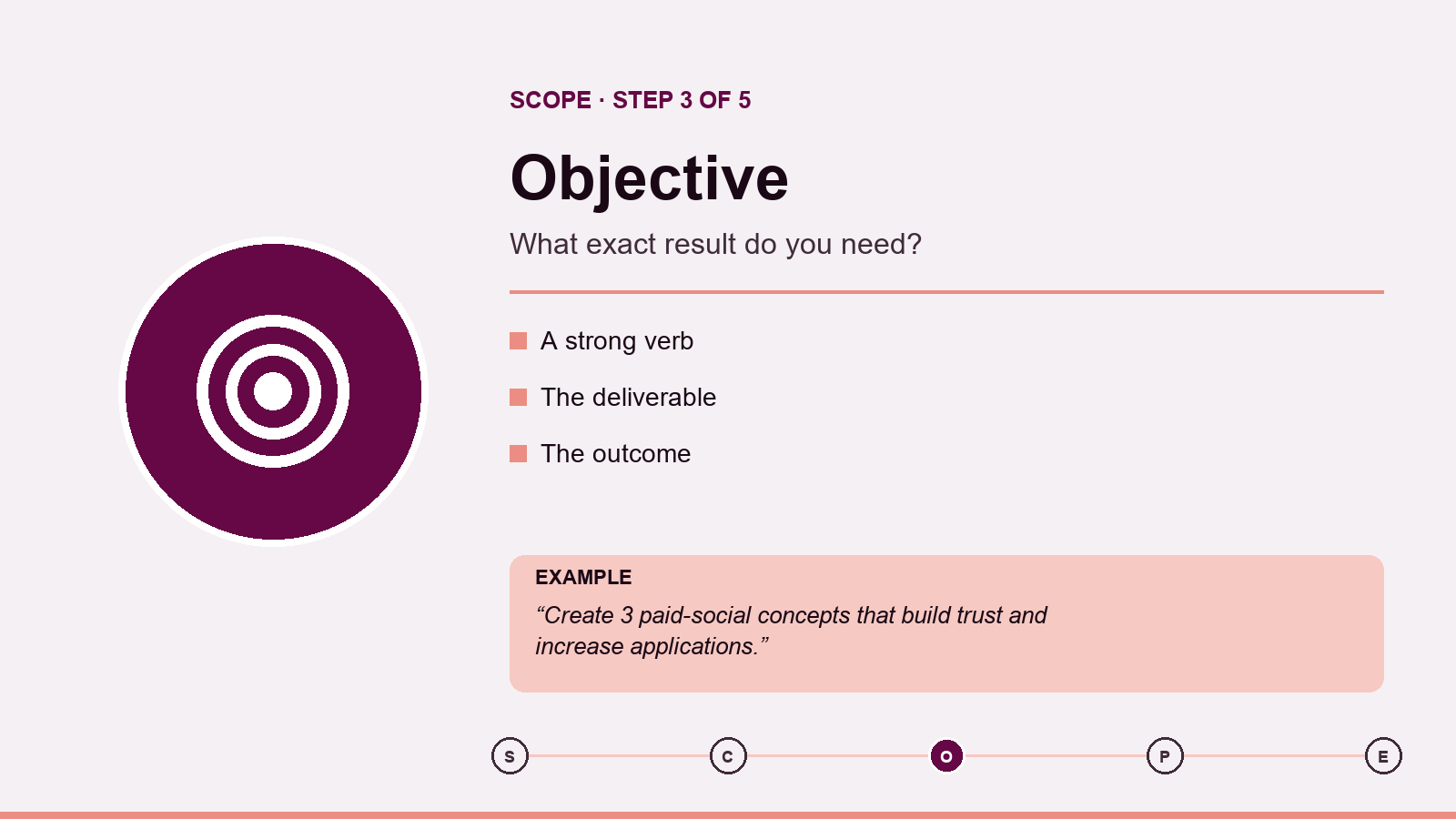
Name the exact result you need. This is the step most prompts get wrong without anyone noticing, because a topic is not an objective. "Marketing for our new project" gives a model nothing to execute, only a subject to wander around. Wandering is exactly what comes back.
"The Objective is where most prompts quietly fail. People name the topic, not the actual result they need."
A real objective has three parts:
- A strong verb cannot
- A named deliverable
- The outcome it is meant to produce
"Create three paid-social concepts that build trust and increase qualified applications" has all three, so it can be executed and then judged. "Some ideas about trust" cannot. T
The outcome half matters more than people expect. When the model knows what the work is supposed to achieve, it can make sensible calls on all the small things you never specified. Without it, you get output that matches your words and misses your intent completely.
P: Parameters
Set the rules of the assignment. Parameters are the constraints that keep a good idea from turning into a wrong answer: which inputs and sources to use, what has to be included, what is off-limits, and the tone, length and format you expect back.
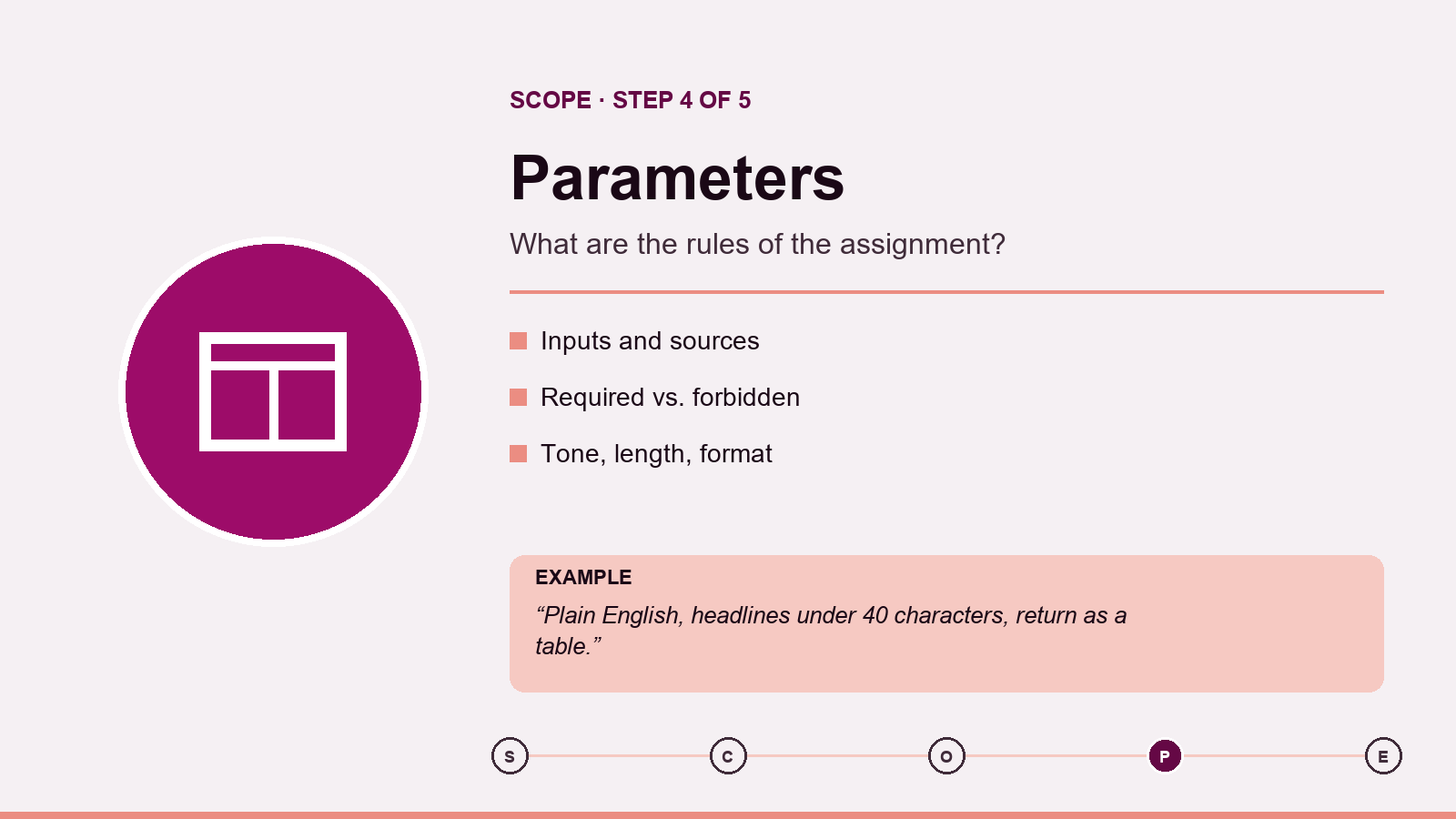
Formatting belongs here too. If you need a table, plain English, headlines under a certain length, or a particular structure, say so explicitly. Leaving format to chance is how you end up rebuilding the output by hand, which cancels out the time you saved.
The prohibitions earn their place as much as the requirements do. Name what to avoid, whether that is unsupported claims, heavy jargon, or a framing that does not fit how you talk to your audience. Each one prevents a specific failure you have already lived through. Good rule of thumb: if you have had to correct the same thing twice, it belongs in Parameters permanently.
E: Evidence
Define what "good" looks like. Evidence is the standard the model measures its own answer against before handing it back, given as an example, a reference, or a short checklist of what a strong answer has to contain.
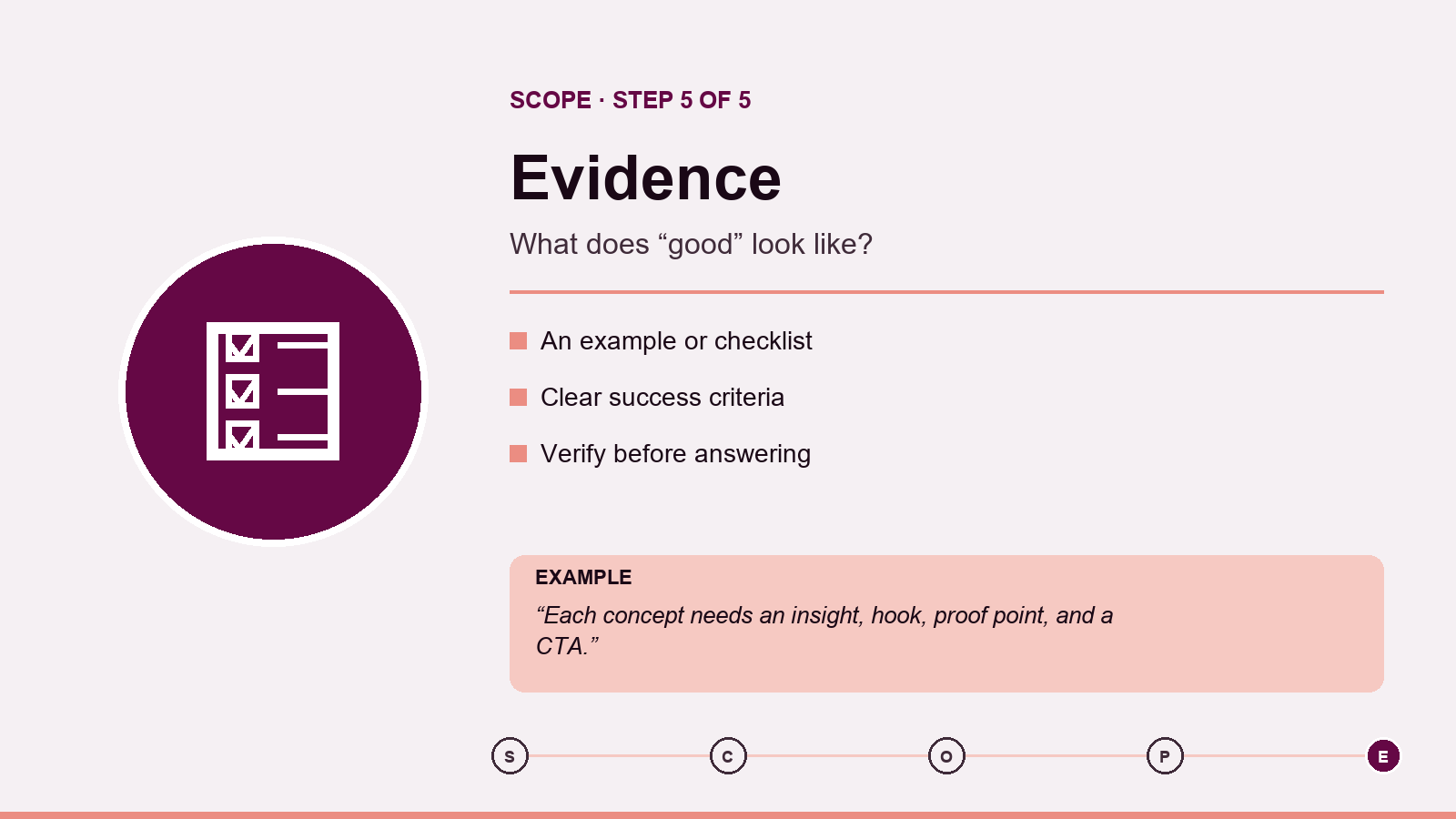
This is the step that turns a request into something checkable. "Each concept needs an audience insight, a hook, a proof point and a CTA" gives the model a test it can run on its own draft. Ask it to verify the answer against those criteria before it replies, and it will catch a surprising number of near-misses.
For anything you will do repeatedly, examples beat description. One example shows the shape you want, several show the range you will accept. When consistency really matters, three to five relevant and varied examples give the model a much clearer target than any amount of explaining. This is few-shot prompting, and it is the fastest way to make output consistent across a batch of similar tasks.
Try It On Your Next Prompt
"You don't need a perfect prompt. You need one that answers five questions. That's it."
Next time an answer comes back flat, resist the urge to rewrite the whole thing from scratch. Run it against SCOPE instead and find the question you skipped, because that is usually the entire fix. Most prompts are one missing sentence away from working.
Try SCOPE on a real task this week, then bring what you learn back to the community. Someone else is stuck on the exact prompt you just fixed.
Comment (1)
Popular

Dive in
Related
Blog
AI Can Write the Job Description. It Can't See the Person Behind It
By Aleksandar Scekic • Jul 1st, 2026 • Views 108
Blog
How to Give Yourself the Best Possible Chance on a Project Certification
By Aleksandar Scekic • Jun 29th, 2026 • Views 408
Blog
AI Can Write the Job Description. It Can't See the Person Behind It
By Aleksandar Scekic • Jul 1st, 2026 • Views 108
Blog
How to Give Yourself the Best Possible Chance on a Project Certification
By Aleksandar Scekic • Jun 29th, 2026 • Views 408