

Top 3 New Roles Opening for Language Experts
# Linguistics
# Guide
# Language-teaching
# Ai-evaluation
# Senior-expert
Traditional translation is shrinking, but demand for language work is climbing - here are the three roles that shift opens up
August 4, 2026Quick Truth Bomb
Let's drop the obvious first... The language profession is changing faster than it has in a generation, and if you work in it, you have almost certainly felt it! Traditional translation work is thinner than it was five years ago. That is real, and pretending otherwise helps no one.
But the headline misses the more important half of the story. The money flowing into multilingual work is going up, not down. Budgets are growing, demand is growing, and total volume is climbing. What has changed is the kind of work, and the new work needs exactly the judgment and precision that experienced language experts already carry.
We heard this firsthand at a recent OneForma community session on what the growth of AI means for language experts. Two people with nearly fifty years in the field between them mapped out where things are heading: Jonas Ryberg, who built his career in translation and localization, and Laia Gimeno, a quality manager on our team in Barcelona. When Jonas broke down where the work is going, three distinct roles emerged. They are the centerpiece of this piece, so let's take them one at a time.
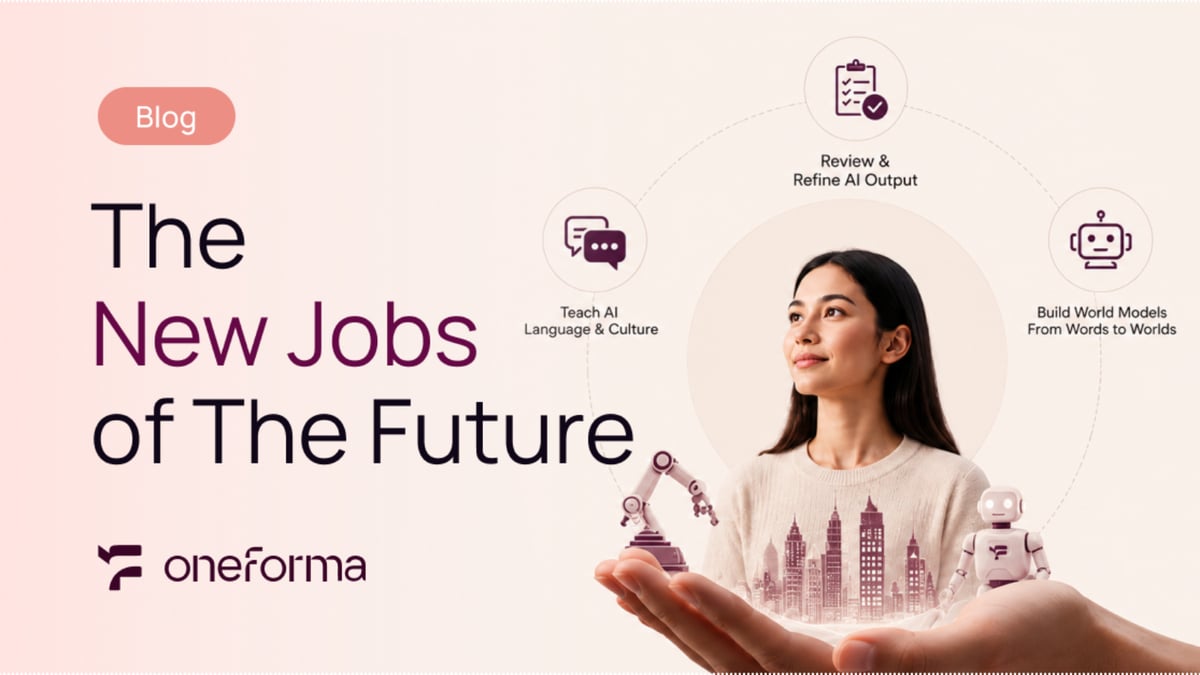
Role One: Reviewing and Governing What The Model Produces
This is the nearest-term shift, and the highest in volume. A large share of straightforward translation is moving to an AI-first workflow: the system drafts, and a language expert reviews. The high end of the market (marketing, transcreation, anything where tone and brand really matter) still needs a human translating from scratch. A slice of low-stakes content will pass through with little or no review at all. The new roles sit in the middle of that scale, and they are less about producing language than about controlling its quality.
"The work is moving from human translation to quality assurance, post-editing, and governing what the AI produces, giving structured feedback on what needs to change. That loop improves the content, and it improves the AI over time."
The word to hold onto there is governing. This is not a mechanical pass to fix typos. It is deciding whether a piece of output is accurate, culturally appropriate, legally acceptable, and aligned with the brand it represents. The judgment calls a system cannot make for itself. Laia made the same point from the quality side: an expert now reviews not only translations but also reports and automated checks, validating whether the machine's own assessment holds up.
Role Two: Teaching The Model Itself
The second role moves one step further back. So, from correcting a system's output to improving the system. This is where Jonas sees the sharpest demand right now. The industry calls it reinforcement learning through human feedback: a loop that tells an AI company how well its model actually performs in a specific language, market, or domain, so it can get better.
"It requires language professionals to evaluate, to correct, and to help shape those systems. We need a governance layer where those professionals give feedback on the output, across every language, but also culturally, for the markets where an AI assistant has to align with the values of that specific country."
That cultural layer is what makes the role expert work rather than data entry. Companies building these assistants want them to feel as natural in Swedish or Japanese as they do in English, and that does not happen automatically! It takes people who live in the language to shape it. The nuance runs even deeper than country lines: Jonas noted that he uses an AI assistant differently than his daughters do, and that generational gap can be wider than the cultural gap between, say, Sweden and Spain. Catching distinctions at that resolution is precisely what resists automation, and precisely why this is, in his view, the role with the most room to grow.
Role Three: Mapping The World "From Words to Worlds"
The third role looks further out, and it is where the title of this piece comes from.
Most of what we call AI today is text-based, built on large language models. The next wave reaches into the physical world. That means systems that help run robots, machines, and tools that have to understand their surroundings and not just process words. Training that kind of AI needs a different sort of input, and a different sort of expert.
"What we have now is mostly text-based, built around large language models. But the next wave of AI helps run robots, and for that you need a different kind of AI... one that understands the world in a bigger way than text alone. We move from words to worlds, if you like. And we become something like cartographers, drawing the maps for these AI systems."
Cartographers is the right word. The people who understand a task, a place, or a craft from the inside are the ones who can chart it for a system that has never lived it. That is the same logic behind the real-world, expert-led data collection already happening across the OneForma community, and for anyone whose expertise lives in language and culture, it is a natural next chapter rather than a leap into the unknown.
What All Three Roles Ask of You
Notice the common thread. Reviewing output, teaching a model, mapping a domain... each depends less on raw translation speed than on the ability to reason through why something is right or wrong, and to communicate that clearly to people who are not linguists. Laia named this directly as the biggest mindset shift.
"Until now, maybe only the most experienced translators were used to giving feedback — and to another translator, where we can take things for granted, because we understand each other. Here the audience is different. You are giving feedback to an engineering team, and feedback that helps the model itself improve."
Feedback used to travel between people who shared the same instincts and shorthand. Now it has to be structured, analytical, and legible to engineers who bring the technical knowledge but rely on you for the linguistic and cultural knowledge. Strong analytical skills, precise reasoning, and the discipline to explain your thinking are what turn a good linguist into an expert these three roles are built around.
Where This Leaves You
Notice what none of these roles do: none of them remove the expert. They move the expert further up the chain. That means from producing language, to reviewing it, to shaping the systems that produce it, and eventually to mapping the world those systems will act in.
If your background is in language, culture, or localization... much of what this future asks for is already in your hands. The most useful next step is to build on it deliberately: learn how these systems work by doing the work, keep evidence of what you have done, and get specific about a domain you know deeply.
Remember... The field is not shrinking! It is just changing shape, and it is changing in a direction that rewards the people who know their craft best.
1
Comment (1)
Popular

Dive in
Related
Blog
3 Things Language Experts Can Do Today to Stay in Demand
By Aleksandar Scekic • Aug 12th, 2026 • Views 192
Blog
3 Things Language Experts Can Do Today to Stay in Demand
By Aleksandar Scekic • Aug 12th, 2026 • Views 192