

This Decides If AI Will Replace Humans
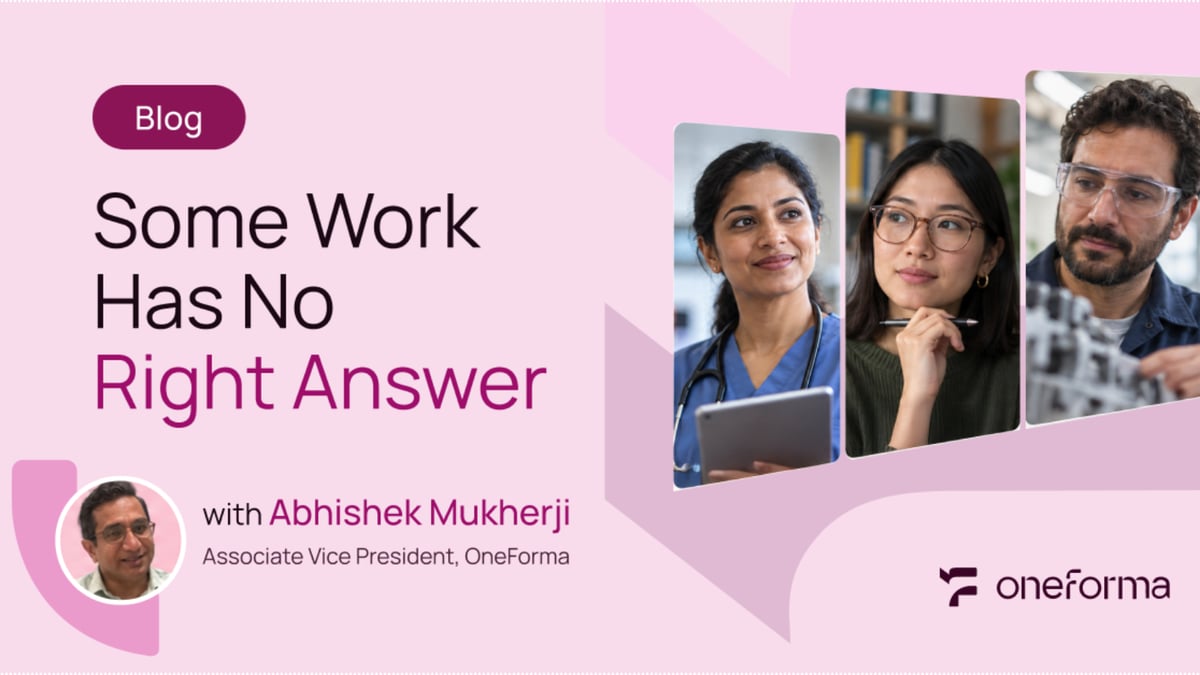
Three kinds of work no machine can check
September 24, 2026
Abhishek Mukherji

Aleksandar Scekic
Will AI Replace Human Expertise? What It Cannot Check
Will AI replace human expertise? Part of it, yes, and one line decides which part: whether a machine can check the answer without asking a person.
This comes from our session with Abhishek Mukherji, Associate Vice President at OneForma, who leads its AI research and spends his working life building the environments these systems are trained in. When we asked which question he most wanted to answer, he picked this one before we had finished reading the list.
You have probably been told both versions: that everything is about to be automated, and that nothing really will be. Neither is useful, because neither tells you which part of your own work is which. By the end of this post you will have a line you can hold your own week up against, and a realistic read on the next five years.
The line that decides whether AI replaces human expertise
Split all work into two piles. In the first pile, a correct answer can be checked by a machine, on its own, with no human opinion involved. Code either passes its tests or it does not. A calculation is right or it is wrong. There are only so many ways to solve the problem, and a computer can score every one of them.
That pile is called verifiable work, and it is where progress has been fastest. It is also where the honest news is uncomfortable. Abhishek was direct about it: in areas like software engineering, where the output can be tested automatically, the amount of human effort required is genuinely reducing.
The second pile is everything else. Work where two people, both competent, both careful, produce different answers and both are defensible. No test suite settles it. Somebody has to decide, and the deciding is the work.
This is not a soft distinction or a comforting one. It is the line the people building these systems use when they plan what to automate next. It runs through the middle of most professions, so almost nobody sits entirely on one side.
What counts as non-verifiable work?
Non-verifiable work is any task where a correct answer cannot be confirmed by a machine, because the answer depends on taste, context or accountability. It covers personal preference, the standards a specific organization holds itself to, and decisions in regulated fields. In each case the judgment is the deliverable, not the output.
The clearest way in is Abhishek's own example, which is deliberately mundane.
"The taste that you have versus what I have is very different. Our budgets may be different, our buying patterns may be different. So if we ask a system to show us some sports shoes, each of us is going to like a different one."
Nothing about that is technically difficult. That is the point. A system can find every running shoe in stock, filter by size, sort by price and never once know which one you would actually buy. And the answer shifts inside a single household, and shifts again by region depending on what is even available there.
The same shape shows up in serious work far more often than people expect. Once you start looking for it, you find it in the parts of your week you thought were routine.
Work shaped by personal taste
This is the pile people dismiss first and should not. Preference work is not trivial work. It is the entire reason a system that is technically accurate can still be useless to the person holding it.
Think about what you actually deliver. A translator producing a line that is faithful and also sounds like it was written by someone from that town. A photographer choosing between eight technically perfect frames. A teacher deciding which of three correct explanations this particular class will understand. In every case the machine can get to the shortlist and stops there.
The gap is not intelligence. It is that there is no ground truth to train against, because the right answer is different for every person who receives it. You cannot score what you cannot define, and you cannot define a preference that belongs to somebody else.
What this means practically is that preference has to be collected, person by person, rather than computed. That collection is real work with real demand behind it, and the qualification for it is having a developed taste in something, which most professionals have and rarely think of as an asset.
Work shaped by how your organization does it
Here is where this stops being about individuals. Two organizations can run what looks like an identical process and mean completely different things by a good result.
"Marketing agency A does work very differently than a marketing agency B. That is the organizational taste and judgment I am talking about."
Abhishek's second example is recruitment, and it is worth sitting with because it looks so automatable from the outside. You write a role description, it gets approved, it goes out, applications arrive, you match them, you interview. Step by step, the same everywhere.
Except it is not. What a specific team needs from a specific role at a specific moment is different from what the team next door needs from the same role with the same title. That detail lives in people's heads, it changes month to month, and it is the part that decides whether the match works out.
His estimate for this kind of work was sixty to seventy percent. That is roughly how much of it a well built agent can handle accurately today. The remaining thirty to forty percent is not leftovers. It carries the organization's standard, which is why a person stays inside the work and makes the final calls.
Work that sits under regulation
The third kind is the most clear cut, and Abhishek drew the line without hedging. Asked where this technology should not be used yet, he named medicine first and said plainly that he would still go to a medical expert for advice.
Regulated fields share a structure. Law, finance, healthcare and law enforcement all require a named human to be accountable for the decision. Not involved in it, not consulted about it: accountable for it, in a way that has consequences.
Accountability is the one thing that cannot be delegated to a system, because a system cannot hold it. You can automate the retrieval, the drafting, the cross checking and the first pass. The signature at the end has to belong to someone who can be asked to explain it and can be held to the answer.
This is also why regulated work is where human in the loop, a named person signing off on the output, stays the standard rather than the exception. In most fields the direction of travel is toward looser supervision over time. In these ones, the supervision is the point, and it is unlikely to loosen.
What the next five years look like
Abhishek's forecast was specific, which is rarer than it sounds. The verifiable pile keeps getting automated and keeps getting faster, partly because models are increasingly able to generate their own practice problems and grade their own attempts without a person present.
The second shift is quieter. Today a model is frozen once it is trained: it stops learning the moment it is released to you. Abhishek pointed to a handful of research groups working on systems that keep updating from live use instead. That is a genuine change in how these things behave, and it is early.
The third is the one that matters for anyone reading this. The big push is into the non-verifiable pile, because that is what is left and that is where the value now sits. Making progress there requires exactly one input that cannot be synthesized: people with real expertise, giving real judgment, at scale.
That is a demand curve pointing up, not down, for the domain expertise you already have. It is also why we spend our time building an expert talent network instead of a larger model.
The honest read: will AI replace my work?
The fear behind this question is reasonable, and it deserves a straight answer. Some work is genuinely moving. If your week is mostly tasks with one checkable right answer, that is the part to look at clearly and plan around. Pretending otherwise would not help you.
"There is nothing to worry or fear about, as long as AI is improving your efficiency and improving your day to day life."
The version where this goes well is the one where the technology augments the expert instead of replacing them: it takes the checkable work, and people keep the judgment. That outcome is not automatic. It depends on enough experts staying close enough to the work to say when a system is wrong, which is a choice available to you right now.
Find a project that knows your worth.
5
Comments (0)
Popular
