

AI Can Write the Job Description. It Can't See the Person Behind It

AI Can Write the Job Description. It Can't See the Person Behind It
# human-computer-interaction
# humanities
# blog
# communications
# ai-ethics

An HR Specialist at an AI Company on What Technology Still Gets Wrong About People

July 1, 2026
Aleksandar Scekic
Aleksandar Scekic
Jelena Milcic
Jelena Milcic
AI Can Write the Job Description. It Can't See the Person Behind It

The Limits of a Dashboard

AI is becoming a bigger part of how companies operate, and HR is no exception. Today, AI tools can support everything from candidate screening and administrative tasks to data analysis, employee development, and improving the overall employee experience. The promise is real: less time spent on repetitive work, faster processes, more room for HR teams to focus on the things that actually move people forward.
But there is a question that doesn't get asked enough: what happens to the parts of HR that were never about efficiency in the first place?
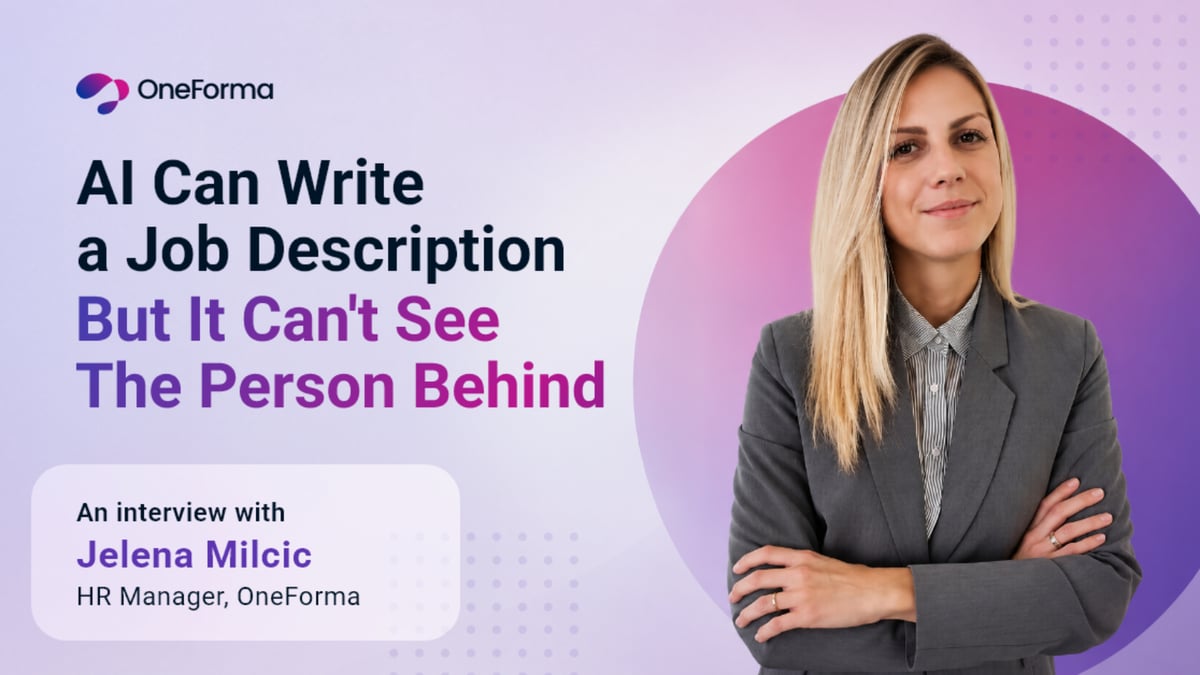
To dig into that, we sat down with Jelena Milčić, an HR specialist who works at the intersection of two worlds that don't always agree with each other — a company built around AI, and a profession built around people. Her job puts her in a strange position. She sees, every day, how much AI can take off a team's plate. She also sees, just as clearly, the moment where AI runs out of road and a human has to take over.
What follows is that conversation.

AI Sees Data. People See Potential.

There is a scenario every HR professional eventually runs into. Two employees, same role, same KPIs, same performance review scores on paper. And yet, anyone who has actually worked with both of them knows they are not in the same place at all.
"I had two people once, almost identical numbers on every metric we track. On paper, you'd treat them the same. But one of them had been asking questions in every single meeting. Now, it was not because she didn't understand, but because she wanted to understand more than what was asked of her. Let’s be honest, that's not something you can put in a spreadsheet. Six months later she was leading her own initiative. The other person was still doing exactly what was in the job description, and doing it well, but nothing more. The data didn't lie, it just didn't tell the whole story."
That gap, between what shows up in a report and what a person is actually capable of, is exactly where Jelena says human judgment still does work AI cannot. AI is very good at telling you where someone stands today. It is not good at telling you where someone is headed. Curiosity, the way someone responds when something goes wrong, whether they lift the people around them or just complete their own tasks... None of that lives in a KPI dashboard. It lives in the kind of attention a manager or an HR professional pays simply by being present.
To put it properly, AI sees performance, while people see potential, and in a lot of cases, potential is the more valuable signal of the two.

The Signals Nobody Says Out Loud

If the first point is about what data fails to capture, this one is about something almost the opposite. It’s the things people actively choose not to say.
According to Jelena, employees rarely leave a company the day they hand in their resignation. That decision is usually made weeks, sometimes months, earlier, and it shows up in ways that never make it into a survey or an engagement score.
"Nobody walks into your office and says, I'm starting to check out. It's quieter than that. Someone who used to always have their camera on stops turning it on. Someone who used to jump into conversations starts waiting to be asked directly before they say anything at all... You stop seeing them at the coffee machine, or in the group chat, or staying two minutes after a call just to talk. None of that shows up anywhere official. You have to actually be paying attention to people to catch it, and by the time it's in a resignation letter, you're already too late. Difficult, I know... but that is also where the beauty of this job lies"
This is, in a sense, the most honest argument for why HR still needs a human in the room. An engagement survey can tell you that satisfaction dropped two points this quarter. It cannot tell you that one specific person has gone quiet in a way that is out of character for them. That distinction requires knowing the person, being there, noticing the slow change...
Remember: People rarely leave without warning. The warning is usually hidden in behavior, not in data.

HR Is the Conscience of the Organization

The third point is the one Jelena was most direct about, and it goes beyond performance or engagement into something closer to ethics.
Not every decision a company faces is a question of policy or procedure. Sometimes a company has every legal right to make a certain call, and the real question is whether that call is fair, and whether it actually reflects the values the company claims to have. That judgment, Jelena argues, does not come from an algorithm, but from a person who understands context, consequence, and impact.
"I had a case where someone's performance had clearly dipped over a couple of months, you know... missed deadlines, more absences than usual. If you only looked at the dashboard, it would have flagged her as a problem. But I knew her. She'd been one of our top three strongest performers for years, and her child had gotten seriously ill right around the time the numbers started slipping. Now, an AI system sees a decline, but it doesn't see why. My job in that moment wasn't to ask what we were allowed to do. It was to ask what we should do. We gave her flexibility instead of a warning, and she's still one of our best people today. Win-win, I must say!"
This is the line Jelena keeps coming back to. AI can flag a drop in performance, but it really cannot tell you whether that drop deserves a conversation or a consequence. That distinction is not a technical limitation that will eventually be solved with more data, or maybe ever...? It is a question of values, and values are not something a model holds.

What This Means for AI

Let’s be honest here, AI is going to keep changing the way we work, HR included. Its biggest value was never about replacing people. It is about letting people work faster, with better information, and with less time spent on the parts of the job that do not require judgment. AI can process enormous amounts of data, spot patterns, and automate the routine. What it still cannot do is recognize potential, understand context, or make an ethical call.
The future of HR is not a choice between people and AI. It is a partnership, where technology supports the process and people make the decisions that actually matter.
The way we see it is: the future of HR is human intelligence, empowered by artificial intelligence.
Comments (0)
Popular
avatar

Dive in

Related

Blog
AI can translate your words. It can’t make them land.
Jun 8th, 2026 Views 40
Blog
How to Give Yourself the Best Possible Chance on a Project Certification
By Aleksandar Scekic • Jun 29th, 2026 Views 96
Video
The Future of How AI Companies Will Operate
Jul 7th, 2026 Views 6
Blog
Why You Weren't Selected (And What Actually Gets You Chosen on OneForma)
By Aleksandar Scekic • Jul 7th, 2026 Views 146
Blog
Why You Weren't Selected (And What Actually Gets You Chosen on OneForma)
By Aleksandar Scekic • Jul 7th, 2026 Views 146
Blog
How to Give Yourself the Best Possible Chance on a Project Certification
By Aleksandar Scekic • Jun 29th, 2026 Views 96
Your Privacy Choices